January 27, 2025 – February 8, 2025 | Vol.15, #5 & 6
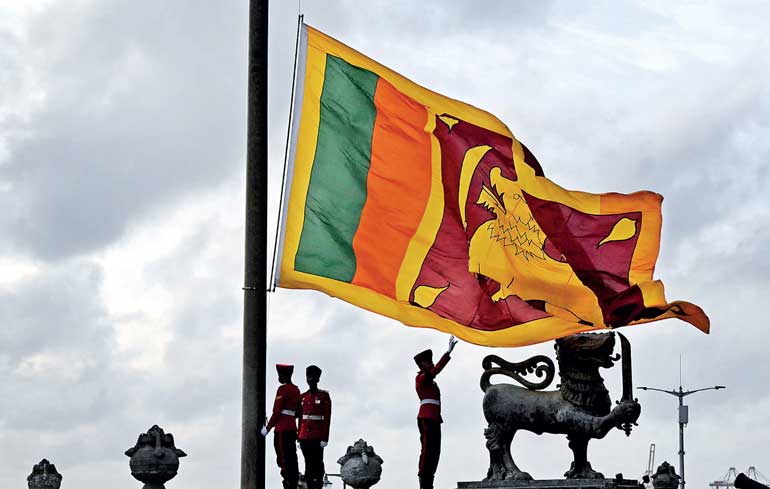
Event: On February 4, Sri Lanka’s 77th Independence Day was ceremoniously celebrated at Independence Square under the theme ‘Let’s join the national renaissance’.[1][2][3] The national anthem was sung in Sinhala and Tamil at the ceremony.[4][5][6]

[paywall layout_id=”1906″ service_tags=”TMA,FP” preview=”true”]
Key insights
- The simplicity of the Independence Day celebration received praise in both print and social media. However, some privately-owned print media and social media commentary criticised the ‘scaling-down’ of the event and questioned the value of the savings.
- Coverage of Independence Day surfaced discourse about independence in relation to economic conditions and about the nature of national identity, with contrasting assertions on national identity.
Analysis
Overview of the media coverage
Last week’s Sinhala press reporting, TV coverage and social media commentary of Sri Lanka’s 77th Independence Day converged in their praise and criticism of the ceremony.
Sinhala mainstream media, including privately-owned newspapers such as Lankadeepa and Divaina, along with privately-owned Siyatha TV, commended the government for holding a ‘simple’ ceremony that avoided excessive spending. This sentiment was also reflected in social media commentary, as analysed using data from Junkipedia.[1]
In contrast, certain print media, including a political columnist in the privately-owned Mawbima newspaper, along with some social media users, criticised the absence of the usual grandeur and elegance traditionally associated with Independence Day celebrations. They also questioned how the supposed savings from the ‘scaled-down’ event would be utilised.
A closer examination of last week’s Sinhala media coverage of the Independence Day celebration revealed two concerns that have arisen regularly in how the Sinhala public reflects on ‘independence’: (1) anxiety over economic independence and (2) assertion of national identity.
1. Anxiety over economic independence
The first concern arises from reflecting on independence through an economic lens. This reflects public sentiment on the paradox of Sri Lanka ‘celebrating’ political independence while grappling with dependency on international financial assistance, economic vulnerabilities and a heavy burden of external debt.[2]
Privately-owned newspapers such as Mawbima and Aruna argued that the economic hardships faced by the people and the government compromise the idea of being independent.
2. Assertion of national identity
The second concern stems from reflecting on independence along the lines of national identity. Two contrasting assertions of a ‘national identity’ emerged in last week’s Sinhala media discourse.
The first position focused on the national aspect of national identity, prioritising unity among the various people groups. It resonated with the existing public sentiment on ethnic and religious reconciliation that calls for a united ‘Sri Lankan’ identity.[3]
This position was advanced in privately-owned mainstream media such as Lankadeepa, Mawbima and Siyatha TV, as well as in President Anura Kumara Dissanayake’s speech. He emphasised that Sri Lanka’s independence must be celebrated as an inclusive, multi-ethnic nation rather than merely a Sinhala-centric nation.
The second position focused on the ethnic identity aspect of national identity, prioritising the reaffirmation of the country’s Sinhala-Buddhist culture and history.[4] While this position garnered marginal traction in mainstream and social media, it was voiced by Sarva Jana Balaya MP Dilith Jayaweera and the Aruna newspaper (which is co-owned by Jayaweera), who portrayed independence as a path to promote the aspirations of the Sinhala-Buddhist majority.[5]
This sentiment was also reflected in the minimal yet lingering opposition to the national anthem being sung in Tamil, expressed in privately-owned newspaper Divaina. The same sentiments were also reflected in the criticism of the lack of military parades, which were portrayed as symbolic of the nation’s dignity and a vital component of Independence Day celebrations.
[1] The MPA team monitored Facebook profiles, TikTok handles and YouTube channels using Junkipedia for the keywords independence, black flags, Black January, national anthem, Anura, renaissance and state pardon. The monitoring period was January 27 to February 7, 2025.
[2] See TMA, Vol.13, #06 and Vol.11, #05.
[3] See TMA Vol.05, #04 & 05.
[4] See TMA Vol.11, #05.
[5] For more information, see: https://sri-lanka.mom-gmr.org/en/owners/individual-owners/detail/owner/owner/show/dilith-jayaweera/.
To view this week’s news summaries, please click here.
[/paywall]