Confidence in government strong and steady 

February 24, 2025 – March 2, 2025 | Vol.15, #09

Issue: Over the past three weeks, the Sinhala media focused on several issues including, but not limited to, the following:

On February 9, Sri Lanka experienced an island-wide electricity disruption.[1][2] The Minister of Energy Kumara Jayakody stated that a monkey had come into contact with the power grid and caused an imbalance in the system.[3][4] On February 18, the Ceylon Electricity Board (CEB) released a statement identifying the cause of the power outage as high solar photovoltaic penetration and the system’s low inertia.[5][6]

On February 20, the Committee on Public Enterprises (COPE) disclosed possible procurement-related irregularities and mismanagement of funds within the National Youth Services Council (NYSC) and its affiliated bodies. [7][8] Similarly, COPE raised concerns regarding mismanagement and irregularities concerning the Sri Lanka Foreign Employment Bureau (SLFEB).[9][10]

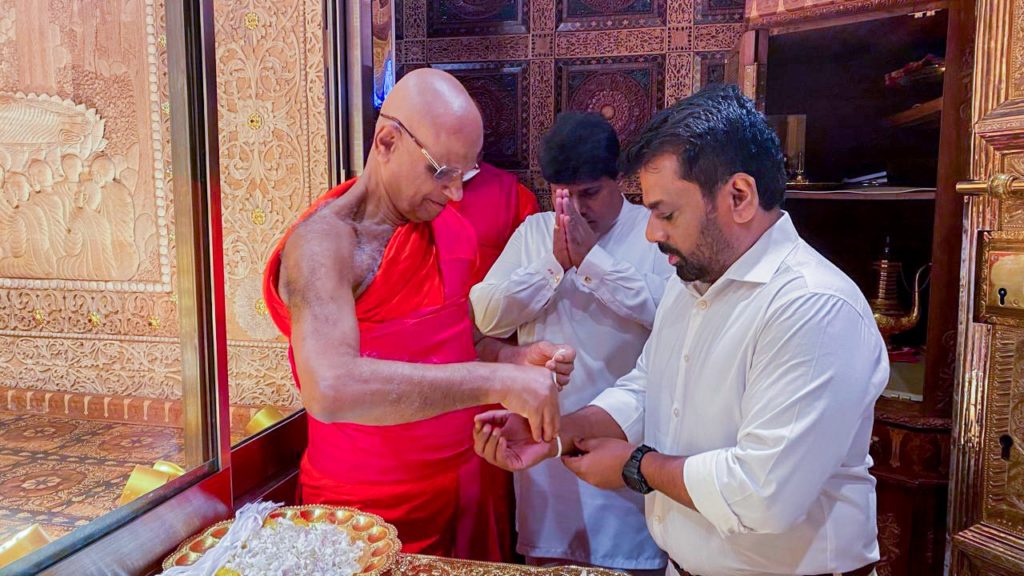
On February 21, President Anura Kumara Dissanayake visited the Temple of the Sacred Tooth Relic in Kandy. Subsequently, the chief prelates of the Asgiriya and the Malwathu chapters and the Diyawadana Nilame (lay custodian) of the Temple of the Sacred Tooth Relic accepted Dissanayake’s request for an exposition of the tooth relic to the public in April.[11][12]

On February 28, Prime Minister Harini Amarasuriya claimed that Dissanayake’s official foreign trip expenses were significantly lower than those of former presidents.[13][14]

[paywall layout_id=”1906″ service_tags=”TMA,FP” preview=”true”]

The mainstream media coverage and social media commentary continued to diverge on their assessments of the government.[1]

Social media commentary on the government (analysed through Junkipedia, a social media monitoring tool) was largely positive, as seen in past issues of the MPA.[2] In contrast, privately-owned TV channels such as Hiru TV and newspapers such as Mawbima were highly critical of the government; exceptions included state-owned media and privately-owned channels such as Siyatha TV, which featured voices supporting the government.

Some private media outlets seemed to have adopted a more partisan stance, shaping their coverage in a way that appeared to be aligned with specific political interests that also limited the positive news about the government. This was reflected, among other things, in the limited coverage of COPE’s corruption investigations, which were discussed favourably in social media commentary supporting the government.

Privately-owned TV channels have previously faced criticism for partisan reporting on past governments. However, some now appear even more selective in excluding positive coverage of the government.

Despite regular mainstream media criticism, public confidence in the NPP government appears to remain strong.

This week’s MPA will unpack three key drivers of confidence in the government, as distilled from Sinhala commentary in all forms of media.

First, the positivity surrounding the president appears to be strengthening the confidence in the government, despite the criticism from the opposition. While some voices in the Sinhala media have raised concerns regarding the behaviour of government ministers, President Dissanayake continues to be seen as a leader capable of delivering on his election promises.

Public confidence in the president was evident from the positive media commentary on several issues, including the approval of his request to exhibit the tooth relic and the relatively low costs incurred during his visits to India, China and the United Arab Emirates compared to the costs incurred by former presidents.

Second, the perception of the NPP’s performance under Dissanayake in implementing measures to change the political culture and counter corruption boosts public confidence in the government. Media commentary, particularly on social media, conveyed a sense of confidence in the NPP as the only party capable of tackling corruption in the country and changing the political culture.

The confidence placed in the government is evident from the positive reception of the COPE examinations. Commentary on social media lauded the government for exposing past instances of corruption, including the alleged disbursement of funds to the National Youth Services Council (NYSC) the day before the 2024 Presidential Election.

Revelations of former politicians’ misuse of public funds and resources appeared adequate to provide positive media commentary of the government. This contrasts with the media’s evaluation of the former yahapaalanaya government (2015 – 2019), where the focus of the media was not on revelation but on tangible accountability – with the then government evaluated on visible prosecutions and punishment meted out to those who had been corrupt. A case in point was the media coverage of the NPP’s revelation of the political beneficiaries of disbursements from the President’s Fund.[2] The media allotted positive coverage to the government for revealing the names of politicians who had received funds: with the focus almost solely on the “revelation”. There was little to no discussion on initiating investigations to hold accountable those who were culpable in abusing the President’s Fund in this way.

Third, confidence in the NPP government appears to be bolstered by the absence of legitimacy for the opposition voices

The opposition’s lack of legitimacy seems to stem from the absence of meaningful and substantive critique of the government’s actions by the majority of the opposition voices. As highlighted in the previous issue of the MPA, the opposition’s arguments against the government’s 2025 Budget – claiming it to be a continuation of former President Ranil Wickremesinghe’s past budgets, aligning with the IMF policy framework and lacking ‘radical’ or left-leaning policies – failed to resonate with the public concerns.[3]

By contrast, a few voices did gain traction as relevant and meaningful claims from the opposition, irrespective of the politicians’ perceived credibility, and seemed to carry weight. For instance, the criticism from SLPP MP Chamara Sampath, who is widely perceived as lacking credibility due to his past behaviour,[4] on the misuse of government vehicles appeared to gain significant traction in the media.[5]

Furthermore, presently, opposition parties are portrayed as caught up in internal party tussles and prioritising their vested interests over the interests of the public. 

Public confidence in Dissanayake’s government seems to ease opposition-driven fears about the NPP. Before and after the 2024 elections, critics painted the NPP as inexperienced to govern. However, this narrative appears to be losing traction as public anxiety about policy actions of the NPP now seems to be on the wane.


[1] The MPA team monitored Facebook profiles, TikTok handles and YouTube channels using Junkipedia for the keywords COPE, army, electricity, weapons, underworld, Anura and government in Sinhala from February 24 to March 3, 2025. The team also monitored for the keyword monkey in Sinhala from February 9 to February 28, 2025.

[2] For more information, see: https://www.newswire.lk/2024/12/17/govt-names-politicians-who-took-funds-from-presidents-fund/ and https://sundaytimes.lk/online/news-online/Millions-given-from-Presidents-Fund-to-politicians-Govt-reveals/2-1147719.  

[3] See MPA Vol.15, #07 & 08.  

[4] For more information, see:  https://www.dailymirror.lk/breaking-news/Forcing-a-Principal-to-kneel-Uva-CM-surrenders-to-Police/108-144475https://www.dailymirror.lk/breaking-news/Chamara-Sampath-threatens-Phosphate-Company-employee/108-280562https://www.newswire.lk/2023/07/19/watch-viral-video-of-sl-minister-inspecting-security-guards/ and https://www.themorning.lk/articles/2pxxg49WlFSrnuHKEGAN.     

[5] For more information, see: https://www.hirunews.lk/english/394540/mp-chamara-sampath-dassanayake-alleges-misuse-of-government-vehicles-video and https://www.adaderana.lk/news.php?nid=105199.  

To view this week’s news summaries, please click here.

[/paywall]