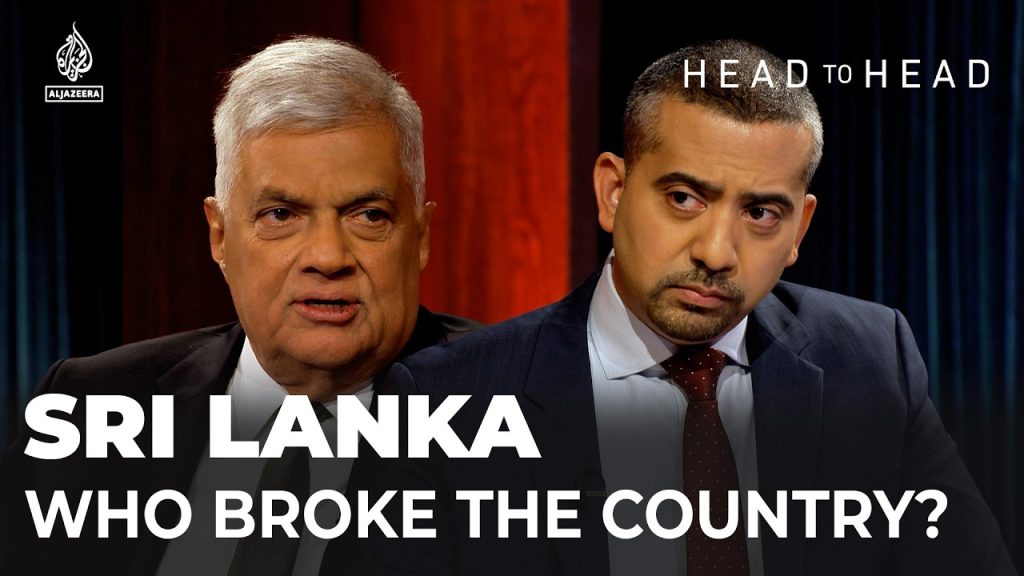
Mehdi Hasan interview: Questions on Batalanda reinforce criticism of the rejected political establishment 

March 3, 2025 – March 9, 2025 | Vol.15, #10

Event: On March 6, Al Jazeera released a one-on-one interview between former President Ranil Wickremesinghe and Mehdi Hasan.[1][2]

During the interview, Wickremesinghe faced questions on various incidents, including Batalanda, the Central Bank bond scam,[3][4] the Easter Sunday attacks,[5][6the burning of the Jaffna Library,[7][8and the economic crisis.[9][10]

[paywall layout_id=”1906″ service_tags=”TMA,FP” preview=”true”]

Over the past week, Mehdi Hasan’s interview with former President Ranil Wickremesinghe on Al Jazeera sparked significant discussion on social media (analysed through Junkipedia, a social media monitoring tool).[1]

By contrast, coverage in the Sinhala mainstream media on the same, particularly print, was notably limited. 

Social media commentary on Wickremesinghe’s interview with Mehdi Hasan spun around questions on his alleged involvement with the Batalanda “detention centre” (see box) during his tenure as minister of industries (1988 – 1993). 

This week’s MPA unpacks the mixed receptions to Wickremesinghe’s interview on Al Jazeera, that cast Wickremesinghe and the media in both a negative and positive light, and examines the underlying drivers for them.

Hasan’s questioning about Wickremesinghe’s alleged involvement in Batalanda reignited deep-seated public frustration with Sri Lanka’s long-established political leadership. It was this “political cabal” that was decisively rejected in the 2024 Presidential and Parliamentary Elections. As a key figure within this establishment, Wickremesinghe was cast in a negative light.

The interview reinforced the widespread perception that corruption and criminal abuse of power have been the norm within this political cabal. These actors are perceived to have operated outside the law and collaborated in shielding each other from accountability for their criminal activity. The interview served to bring these concerns from the background to the foreground. 

In recent discussions, corruption has often been framed as a problem relating to misappropriation of funds. However, the interview brough to the fore another aspect of corruption which engenders deep displeasure: that relating to criminal activities connected to politicians, and where it also colludes with state violence. 

The Batalanda Commission, established in 1994 under President Chandrika Kumaratunga, investigated allegations of torture, illegal detentions and extrajudicial killings at the Batalanda housing scheme.[4] Its 1997 report implicated security forces and political figures, including Wickremesinghe, then a senior minister.[5] Despite being submitted to President Kumaratunga, the commission’s recommendations were never implemented.[6] Likewise, Ranil Wickremesinghe, during his tenure as prime minister, is also alleged to have shielded Gotabaya Rajapaksa. As prime minister under former President Gotabaya Rajapaksa, Wickremesinghe earned the nickname ‘Ranil Rajapaksa’. 

Public frustration over such collusion across political divides explains the enduring resonance of a 2019 remark by former politician Ranjan Ramanayake: “ඒ ඔක් කොම යාළුවො මල්ලි”/ “é okkoma yaaluwo malli” (trans. they are all friends, my brother). The phrase gained widespread popularity, reinforcing the belief that political rivals within the establishment are, in reality, allies protecting each other.

Hasan’s interview reinforced the public’s frustration with most of Sri Lanka’s major media, which many see as partisan and lacking investigative depth. 

In contrast, Hasan and Al Jazeera received praise in social media commentary for their sharp, uncompromising approach. Social media users commended their “tough questioning” and for “exposing” Wickremesinghe.

There was also criticism of Sri Lankan media and journalists, that by comparison were deemed to lack the rigour or willingness to ask well researched and important questions (please see memes published in this issue of MPA for more information).

Despite the widespread negative reception, Wickremesinghe’s interview performance also had some limited support from two quarters. 

The first quarter of support was from individuals (or those connected to them) that might be similarly implicated in high crimes and corruption, as Wickremesinghe was in the questions on Batalanda. For instance, handles of UNP Chairperson Vajira Abeywardena and those such as Milinda Rajapaksa, former spokesperson for Gotabaya Rajapaksa, engaged in support of Wickremesinghe. They “hung together” with Wickremesinghe, arguing that he was unfairly interrogated by the Mehdi Hasan interview of Al Jazeera

This support base, however, fits the description of the “political cabal” (and its connected parties), which was the focus of ire of other social media handles that were critical of Wickremesinghe.

The second quarter of support arose from social media handles (both authentic and financed) that had been part of Wickremesinghe’s election campaign. Many of the comments in these handles invoked a superiority mindset connected to a Westernised class identity and positioned Wickremesinghe as an icon of that class. In contrast, they positioned the current President Anura Kumara Dissanayake as not being able to match up to that “class”. 

These social media handles praised Wickremesinghe for handling international scrutiny well, and claimed that his performance was superior to how other politicians, including President Dissanayake, might have fared in a similar environment of tough questioning by experienced international media.

Criticism of Al Jazeera arose from those who were positive about Wickremesinghe. They made various sorts of allegations, ranging from claiming that the network had an anti-Sinhala Buddhist agenda to castigating Hasan’s style of questioning. They also labelled the outlet as pro-LTTE and the audience and panel as aligned with pro-LTTE Tamil diaspora.


[1] The MPA team monitored Facebook profiles, TikTok handles and YouTube channels using Junkipedia for the keywords Ranil, Batalanda and Al Jazeera in Sinhala from March 3 to 8, 2025. 

[2] For more information, please read https://sangam.org/wp-content/uploads/2023/06/Batalanda-Commission-Report-Book-English-Final.pdf.

[3] For more information, please see https://english.newsfirst.lk/2025/03/10/sri-lanka-s-dark-past-batalanda-commission-report-explainedhttps://www.lankaweb.com/news/items/2015/08/03/demons-of-batalanda-who-was-behind-them/https://www.colombotelegraph.com/index.php/is-ranil-creating-the-2nd-batalanda/ and https://webarchive.archive.unhcr.org/20230521184844/https://www.refworld.org/docid/3ae6acfd54.html.

[4] For more information, please see https://www.themorning.lk/articles/rBlULblZlOF7fGsGjqv9 and https://english.newsfirst.lk/2025/03/10/sri-lanka-s-dark-past-batalanda-commission-report-explained.

[5] Ibid

[6] Ibid.

To view this week’s news summaries, please click here.

[/paywall]