May 5, 2025 – May 18, 2025 | Vol.15, #17 & 18 | ISSN 3084-9330
Issue: In October 2024, Dilshi Amshika, a student of Ramanathan Hindu Ladies’ College in Bambalapitiya, was allegedly subjected to sexual abuse by her mathematics teacher.[1][2] Following a complaint lodged in December 2024, the teacher was arrested in January 2025 and released on bail.[3][4]
On April 29, 2025, Amshika took her own life following alleged humiliation endured at the hands of the owner of a private tuition institute.[5][6] The owner has served as the organiser for the NPP in the Colombo North electorate.[7] Subsequently, the owner lodged a complaint with the Criminal Investigation Department (CID) alleging that a “deliberate smear campaign” is being orchestrated to tarnish his reputation.[8][9]
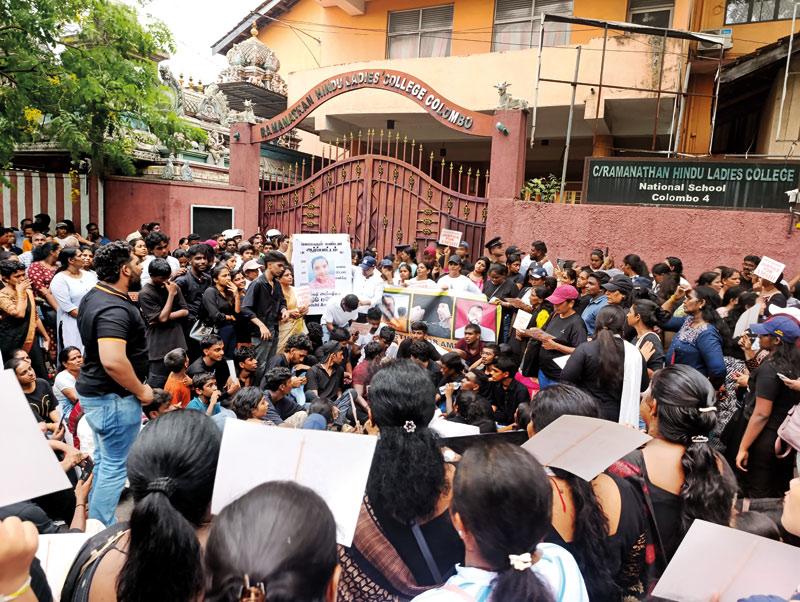
On May 8, parents and teachers at Ramanathan Hindu Ladies’ College staged a protest demanding justice for Amshika.[10][11]

Photo credits: Daily Mirror
[paywall layout_id=”1906″ service_tags=”TMA,FP” preview=”true”]
Analysis
Overview
Over the past two weeks, the Sinhala media discourse – across television and social media platforms (as monitored through Junkipedia, a social media monitoring and analysis tool) – featured an outpouring of anger following Amshika’s death.[1] However, this issue was only marginally discussed in the Sinhala press.
This week’s MPA explores the sentiment on the NPP government, as well as the broader issue of systemic concerns regarding the safety of children that have emerged in the wake of that incident.
1.How did the incident shape political sentiment?
The death of Amshika evoked anger towards the government, not because of the event itself, but because the government seemed more focused on defending its conduct than on proactively seeking solutions with regard to the delays in pursuing justice for Amshika. The NPP also faced criticism in the recent past for its delayed response in arresting Deshabandu Tennakoon.[2] This recurring tendency of the NPP to focus on absolving itself of blame rather than effectively addressing public concerns seems to be fuelling frustration and anger.
Against this backdrop, the NPP faced two types of negative perception: a perception of being insensitive and a perception of being inactive.
Perception I: Being insensitive
The NPP was perceived as insensitive for not proactively engaging with the victim’s parents or offering meaningful solutions to address the situation. Notably, the Minister of Women and Child Affairs Saroja Savithri Paulraj faced criticism for a statement made in parliament in which she claimed that the parents had neither lodged a complaint nor met with her.[3] These remarks were widely perceived as being insensitive to the bereaved family (please refer to memes published in this issue of MPA).
Perception II: Being inactive
The NPP was perceived as having failed to take adequate and prompt action to ensure justice for Amshika. Some social media posts interpreted the delays in providing justice as an attempt by the government to protect the owner of the private tuition institute, who also served as the NPP’s electorate organiser. In particular, Prime Minister and Minister of Education Harini Amarasuriya was criticised for her reportedly delayed response and intervention in the issue.
The NPP government has been expected to break from the patterns of conduct of past governments, particularly by ensuring that the law is applied equally and that action would be taken promptly to address public grievances. However, the government’s response to Amshika’s death seems to have fallen short of these expectations and was therefore widely viewed in a negative light.
2.What systemic concerns were reinforced by the incident?
Public anger over the incident sparked a broader discourse on issues surrounding the vulnerability of children. As observed in the past, cases involving harm to children, particularly those related to sexual abuse, resonate deeply with the public and are a significant cause of concern.
The Sinhala media discourse surrounding this incident appeared to highlight the inefficiency and dysfunction of existing mechanisms intended to protect children. The perceived inaction of the National Child Protection Authority (NCPA) – especially its failure to initiate investigations into child abuse in the absence of formal complaints as well as the non-establishment of School Children Protection Committees (Surakum Pawwa) at the school – was seen as a systemic shortcoming impacting the well-being of children.[4]
[1] The MPA team monitored Facebook profiles, TikTok handles and YouTube channels using Junkipedia for the keywords Kotahena, suicide, tuition, compass (symbol of the NPP) and abuse in Sinhala from May 6 to 17, 2025.
[2] See MPA Vol.15, #12.
[3] For more information, see: https://island.lk/minister-says-requested-complaint-over-teen-suicide-not-yet-made/.
[4] The School Children Protection Committees (SCPCs) are bodies that are intended to be established in schools to prevent child abuse and ensure children’s safety. For more information, see: https://ceylontoday.lk/2025/05/17/school-child-protection-in-shambles/ and https://childprotection.gov.lk/images/Legal/Circular_-__Surakum_Pauwa_-School_Child_Protection_Committees.pdf.
To view this week’s news summaries, please click here.
To view this week’s social media data, please click here.
[/paywall]