June 2, 2025 – June 15, 2025 | Vol.15, #21 & 22 | ISSN 3084-9330
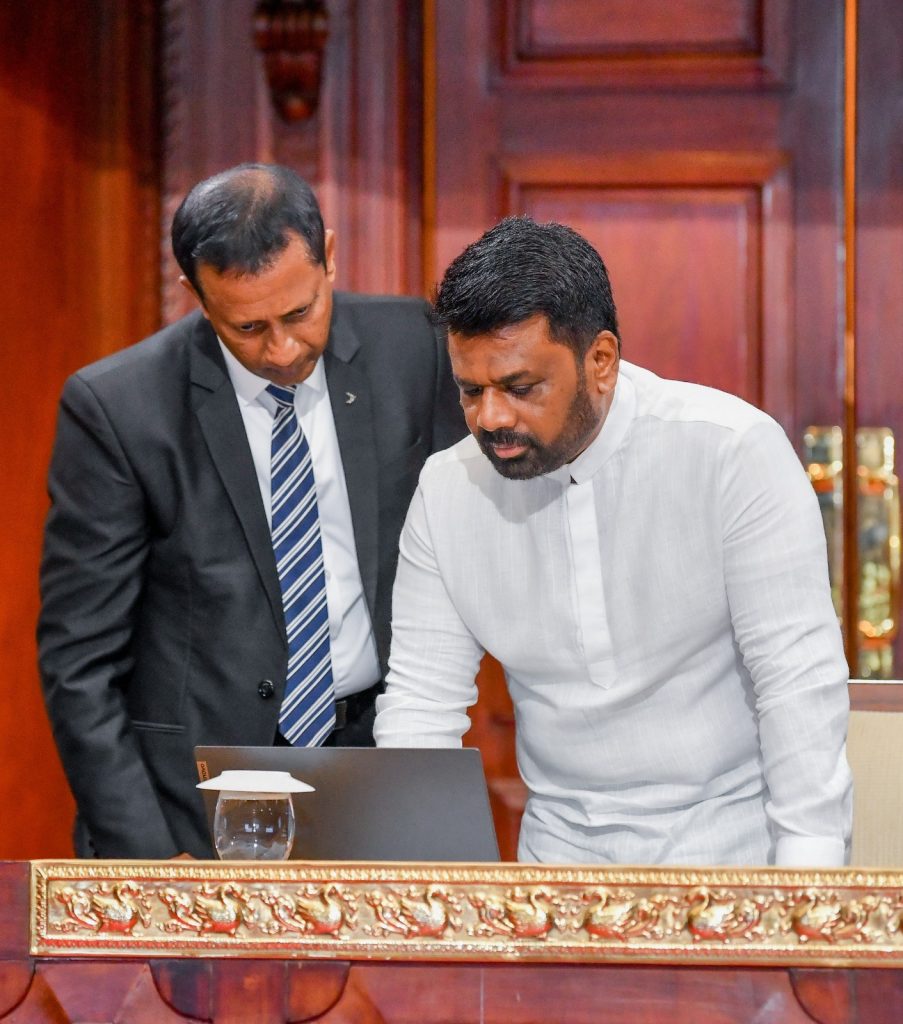
Event: On June 2, President Anura Kumara Dissanayake presided over the launch of the “Badu Shakthi” (“බදු ශක්ති” – trans. Strength Through Taxes programme) as part of the National Tax Week.[1][2][3] The government launched the National Tax Week from June 2 to 7 to broaden the tax base and strengthen tax compliance.[4][5][6]

Photo credits: Facebook page of Daily News
[paywall layout_id=”1906″ service_tags=”TMA,FP” preview=”true”]
Key insights
- The NPP government seems to be becoming an ‘ordinary government’, struggling to exert control over the state sector and focusing more on continuity than on implementing significant policy changes.
- The ‘unlawful’ release of prisoners by prison officials further underscores concerns about the NPP government’s lack of control over state institutions, adding to the doubts about its ability to fulfil its pledge of systemic change.
Analysis
Over the past week, the Sinhala press, TV coverage and social media commentary (as observed through the social monitoring tool Junkipedia) have extended principled support for the declaration of National Tax Week and the collection of taxes.[1]
The Sinhala media coverage of the government programme reveals early signs of growing scepticism toward the government and frustration with Sri Lanka’s tax administration.
What is driving scepticism toward the government in the wake of National Tax Week?
The Sinhala media discourse surrounding National Tax Week suggests that the NPP government is increasingly being viewed as ‘non-exceptional’ or similar to previous governments, rather than a government that is exceptionally different in engaging public expectations as anticipated during the parliamentary elections.
This perception is captured through two prominent narratives in the Sinhala media, which suggest a waning appeal of the NPP government.
Narrative I: A government that focuses on continuity over change
One narrative positions the NPP government as prioritising continuity over change.
As observed in past issues of the MPA, the government has continued to come under scrutiny for seeming to be following in the footsteps of former President Ranil Wickremesinghe, particularly with regard to the country’s economic policies.[2] In particular, the NPP has been criticised for continuing Wickremesinghe’s tax policies rather than reforming them substantially in favour of greater equity, as anticipated in the groundswell of support for the NPP during elections; and for attempting to find solutions to the economic woes of the country mainly through increasing tax revenue, instead of exploring strategies to grow the economy through increased exports, effective economic policies and greater investments.
Thus, there is scepticism, as the government is seen as maintaining the status quo rather than delivering the change it promised during the elections, on the agenda of economic policies that will provide long-term solutions alongside improving equity and reducing injustice.
Narrative II: A government not in full control
Another narrative emerging in the Sinhala media portrays, indirectly, the NPP government as lacking full control over the state sector, and thereby not able to deliver on its governance mandate. President Dissanayake, in his statement at the launch of National Tax Week, highlighted the existence of a “hidden shadow system” long protected by political authorities, including certain “state officials.”[3] This statement seems to have marked the beginning of several government comments pointing to the complicity of state officials in corruption and suggesting that the government is not receiving the necessary support from the state sector to fulfil its political mandate.
While criticism for this predicament is predominantly directed at state officials, indirectly, it seems to also colour the perception of government as having difficulty in delivering on expectations of ‘system change’ that fuelled voter response at elections.
Overall, the narratives work to fuel a perception of the government as lacking either the commitment or the capability to follow through on the convictions that it articulated prior to the national level elections in 2024.
What frustration with tax administration does National Tax Week uncover?
Sinhala media coverage of National Tax Week brought to the forefront two persistent public discontents relating to paying taxes: (1) unfairness in tax collection and (2) misuse of collected taxes. These issues have long contributed to the erosion of public trust in the tax administration among segments of the Sri Lankan public, that have ultimately dissuaded them from fulfilling their tax obligations.
First,the ongoing concerns about tax collection stem from the perception that Sri Lanka’s tax administration enables specific segments of society to avoid their fair share of taxes. Past MPA issues have highlighted instances where previous governments granted tax breaks to affluent businesspersons and failed to address corruption and inefficiency within tax-collecting institutions such as Sri Lanka Customs and the Inland Revenue Department.[4]
Second,there is widespread belief that taxpayers’ money is being misused. Media commentary highlighted that a significant portion of tax revenue is often wasted on non-essential projects and allegedly corrupt activities, providing little tangible benefit to the public.
[1] The MPA team monitored Facebook profiles, TikTok handles and YouTube channels using Junkipedia for the keywords tax, revenue, customs, economy, electricity, Public Utilities Commission of Sri Lanka and Anura in Sinhala, from June 2 to 14, 2025.
[2] See MPA Vol.15, #07 & 08.
[3] For more information, please see https://www.presidentsoffice.gov.lk/your-tax-your-future-badu-shakthi-national-tax-week-launched-to-strengthen-tax-compliance-and-broaden-the-tax-base/.
[4] See TMA Vol.12, #41.
To view this week’s news summaries, please click here.
To view this week’s social media data, please click here.
[/paywall]