June 30, 2025 – July 6, 2025 | Vol.15, #25 | ISSN 3084-9330

Photo credits: Colombo Telegraph
[paywall layout_id=”1906″ service_tags=”TMA,FP” preview=”true”]
Key insights:
- The government is reversing the status quo on corruption by enabling stalled and new investigations, which have strengthened its legitimacy and cushioned it from broader criticism. In contrast, it has maintained continuity in economic structures and policy, which may gradually build contradictions and discontent.
- The “container-release” incident directly challenges the NPP government’s core legitimacy by undermining its anti-corruption credentials. Though largely dissipated as a procedural lapse, it put strain on the “anti-corruption override” that has so far helped deflect criticism in other areas.
- The Tamil media highlighted Chemmani as evidence of state violence, while the Sinhala media downplayed it or blamed the LTTE – revealing a stark divide in the media narratives.
Analysis
Over the past week, criticism directed at the government’s conduct dominated the Sinhala media discourse – across print, television and social media platforms (as observed through the social media monitoring tool Junkipedia).[1]
This week’s analysis is set out under three key headings.
I. Key events that engaged the political psyche?
Two events in the news cycle brought the government under scrutiny:
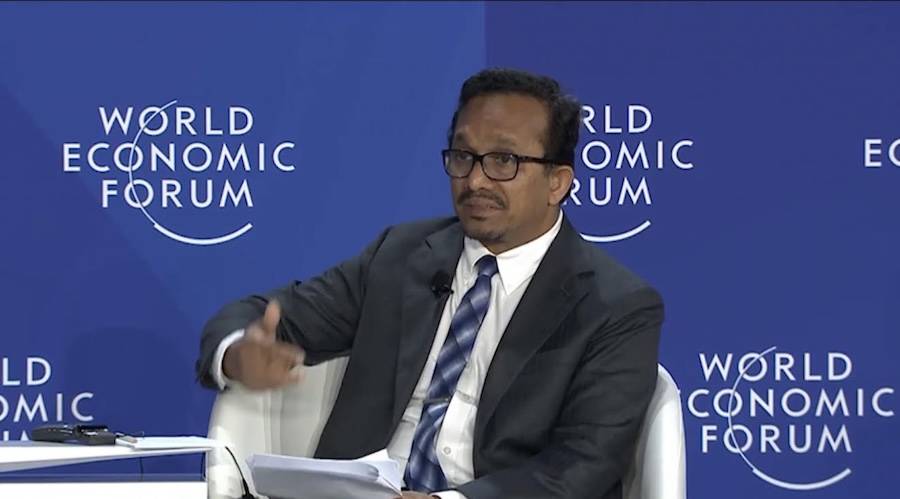
1. The performance of Minister Sunil Handunneththi at the World Economic Forum (WEF)
On June 25, Minister of Industry and Entrepreneurship Development Sunil Handunneththi took part in a panel discussion titled ‘Is Asia’s Century at Risk?’ at the 16th Annual Meeting of the New Champions, hosted by the WEF. [2] The minister came under criticism for his performance at the WEF where he was seen as struggling to articulate his views coherently, communicate effectively in English and respond adequately to questions.
2. The release of “red-labelled” containers without inspection
On January 20, the Customs Trade Union Alliance informed President Anura Kumara Dissanayake that around January 17 and 18 the director general of Sri Lanka Customs had authorised the release of a large consignment of “red-labelled” containers, those marked for mandatory inspection, without inspection.[3] This was later confirmed by a four-member committee appointed by the then Secretary of the Treasury, Mahinda Siriwardana, to investigate the issue.[4] The committee found that 309 such containers had been released without inspection and it recommended disciplinary action against the officials responsible.[5]
Together, these two events raised concerns about the government’s competence and credibility on economic and governance matters.
II. How do these events impact the government?
Two aspects of the Sri Lankan social psyche gave these stories added traction and public engagement.
1. Concern for competence in international representation
On first blush, it could appear that the criticism directed at Handunneththi was around his lack of proficiency in the English language. However, a closer analysis of the discourse suggests otherwise. The criticism was more about his inability to engage sensibly with the questions posed to him (as seen in this week’s memes).
Media commentary focused on his overall coherence and preparedness to represent Sri Lanka on the international stage, particularly in economic matters. This incident contributed to the growing public perception of the government as lacking competence in statecraft.[6]
Some social media responses attempted to frame the criticism as élitist. However, the criticism did not primarily arise from elitist circles. The discourse in the Sinhala media suggests a shift in social psyche beyond viewing English language proficiency as an élite or colonial marker to be resisted, to seeing English proficiency pragmatically as a tool for global engagement and connectedness.
Criticism of government’s competence, not of language proficiency
The criticism was mainly focused on the lack of clarity and credibility in his communication, and not on the traditionally elitist fascination with English diction and vocabulary. The expectation is that international representatives of Sri Lanka must be able to engage meaningfully in whatever language they chose to use – not that they should be able to engage proficiently in English.
It was noted that Minister Handunneththi could have spoken in Sinhala and used an interpreter to convey his views more effectively, instead of appearing incoherent by trying to communicate in a language with which he was not comfortable.
Overall, the speaking of English has gained a pragmatic focus, with a goal of connecting better; and speaking in English has become much less controversial in nationalist sentiment in the halls of public higher education, together with becoming much more aspirational in wider society.
Judgement of the JVP’s postures in the past and present
The backlash also reopened discussion on the JVP’s past opposition to English language education. Historically, the JVP discouraged the use of English, particularly within university education, as part of a broader rejection of “Western cultural imposition”.[7] Today, that legacy is increasingly seen as regressive, with the social shift to regard English as a pragmatic tool for relevance and success in a globalised world.
Handunneththi’s WEF performance has reignited debate about whether JVP members in the government are now attempting to quietly embrace some of the elitist markers they once rejected, while being unable to do so due to the regressive views they adopted in their political and institutional culture.
2. The government’s anti-corruption credibility challenged
Opposition criticism over the release of “red-labelled” containers without proper inspection strikes closer to the core of the government’s legitimacy: its anti-corruption stance.
As highlighted in last week’s MPA, the government has derived a significant portion of its credibility from the perception that it is enabling the independent functioning of anti-corruption institutions.[8] This has created a public narrative in which anti-corruption performance acts as a buffer, an “override”, that mitigates criticism in other areas such as economic hardship (e.g., rising fuel prices).
The “red-labelled” container incident presents the most direct challenge yet to this “anti-corruption override”. Opposition voices, particularly from the SJB, have framed the government’s actions as bypassing established risk management protocols in container release and accused it of failing to take responsibility.
However, so far, the incident has been mainly presented as a procedural lapse rather than a clear-cut case of corruption. This framing has allowed what can be described as the “anti-corruption override” to remain dominant in the public posture towards the government.
III. Forward implications
The government’s current strategy appears to be unfolding along two tracks:
- Reversing status quo on anti-corruption: In the fight against corruption, the government is actively, enabling investigations and prosecutions that were previously stalled or obstructed as well as those that are new.[9] This approach has helped build its core legitimacy and provides a buffer against criticisms in other domains.
- Maintaining status quo on economic management: In managing the economy, the government has opted to maintain the status quo. In past issues of the MPA, the government has come under repeated scrutiny for seemingly following in the footsteps of former President Ranil Wickremesinghe, particularly in relation to the country’s economic policies.[10] This continuity has contributed to a growing public perception of limited capability and competence – with Handunneththi’s performance at the WEF further intensifying these concerns, particularly regarding the government’s ability to represent Sri Lanka effectively on matters of macroeconomic policy and public finance.
In a context where economic structures are often enmeshed with corruption networks, attempting to traverse these two tracks simultaneously: to reform governance while maintaining unreformed economic structures, may generate contradictions that impinge negatively on the government.
[1] The MPA team monitored Facebook profiles, TikTok handles and YouTube channels using Junkipedia for the keywords Sunil, economic summit, fuel, petrol, Shani and container in Sinhala, from June 30 to July 4, 2025.
[2] For more information, see: https://www.youtube.com/watch?v=tz5PpXfR4MY and https://www.ft.lk/business/Minister-Sunil-Handunneththi-represents-Sri-Lanka-at-World-Economic-Forum-in-China/34-778168.
[3] For more information, see: https://www.sundaytimes.lk/250706/columns/red-labelled-cargo-release-casts-shadow-over-npps-clean-image-603345.html and https://ceylontoday.lk/2025/06/07/container-controversy-resurfaces-amidst-president-issuing-stern-warning-against-shadow-systems/.
[4] For more information, see: https://www.sundaytimes.lk/250202/news/committee-appointed-to-probe-container-traffic-backlog-586633.html and https://www.themorning.lk/articles/ByTetaeDlz9aeLLcNGX9.
[5] For more information, see: https://www.sundaytimes.lk/250706/columns/red-labelled-cargo-release-casts-shadow-over-npps-clean-image-603345.html and https://ceylontoday.lk/2025/07/03/report-on-the-release-of-309-containers-submitted-majority-dissent-on-customs-dgs-powers/.
[6] See MPA Vol.15, #21 & 22.
[7] For more information, see: https://slguardian.org/how-the-jvp-learned-english-with-difficulty/ and https://www.newswire.lk/2024/09/18/president-says-jvp-blocked-his-english-education-proposal/.
[8] See MPA Vol.15, #24.
[9] See MPA Vol.15, #24.
[10] See MPA Vol.15, #21 & 22.
To view this week’s news summaries, please click here.
To view this week’s social media data, please click here.
[/paywall]