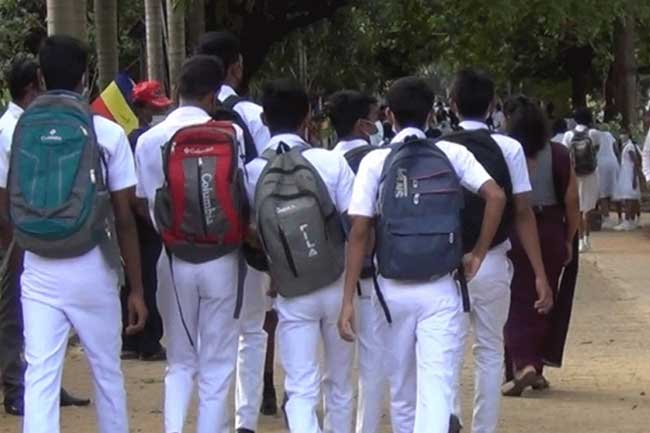
Bill on punishment: The reform takes a beating

September 29, 2025 – October 12, 2025 | Vol.15, #37 & 38 | ISSN 3084-9330

Photo credits: Ada Derana

[paywall layout_id=”1906″ service_tags=”TMA,FP” preview=”true”]

Over the past two weeks, the Sinhala media focused on the Penal Code (Amendment) Bill to prohibit physical and mental punishment of children in Sri Lanka.[1]

This coverage spanned print, television, and social media commentary.[2] Conversations and narratives on social media platforms were tracked and accessed using the monitoring tool Junkipedia.

This week’s analysis is set out under three headings.

1. What was the key event that captured public attention?

September 23: Penal Code (Amendment) Bill to amend Chapter 19 was reviewed and approved by the Sectoral Oversight Committee on Governance, Justice, and Civil Protection.[3]

September 24: Parliament debated the Second Reading of the Bill presented by Minister of Justice Harshana Nanayakkara to amend Chapter 19 of the Penal Code.[4] However, the debate on the Bill was adjourned without being passed into law.[5]  

September 30: In a letter to the president, the Chief Prelates of the Malwatta and Asgiriya Chapters of the Siam Nikaya, and the Amarapura and Ramanna Maha Nikayas, warned that proposed Penal Code amendments criminalising corporal punishment, along with government efforts to promote LGBTQIA+-related tourism, could cause moral anarchy and social crises.[6]

October 1: The Ministry of Education, Higher Education, and Vocational Education submitted a draft Bill to parliament to amend the Penal Code regarding the infliction of physical punishment on children.[7]

October 3: Minister Nanayakkara stated that the proposed amendment to the Penal Code requires a corresponding amendment to the Criminal Procedure Code before it can take full legal effect.[8]

The opposition, religious clergy, professional unions, and some privately owned newspapers, such as Aruna, vigorously challenged the intent, wording, and potential consequences of the Bill.[9]

Thus, the Bill—as intended by the NPP to curb child abuse and protect children’s rights—has become a deeply polarising issue, exposing tensions between legal reform and entrenched social tradition.

2. How does the proposed amendment impact the government?

Despite championing children’s rights, the NPP government finds itself on the defensive—constrained by a powerful counternarrative steeped in cultural and moral anxieties.

The public debate over the amendment has placed the NPP government on the back foot amid mounting criticism. It is now navigating a media discourse dominated by traditional notions of morality, discipline, and social hierarchy, which appear to overshadow substantive policy arguments.

The opposition cast the amendment as harming Sri Lanka’s culture and societal fabric. The opposition’s message—rooted in traditional beliefs about parental and social authority—has struck a strong emotional chord among sections of the Sinhala public. This resonance seems to have forced the government into a reactive posture, repeatedly attempting to counter what it describes as “misinterpretations” and “false propaganda.”

Ultimately, the debate surrounding the amendment highlights that the issue extends beyond legal reform. It reflects a deeper contest over moral perspectives and value systems, setting the stage for an examination of the cultural significance of discipline and corporal punishment in Sri Lankan society.

In Sri Lanka, notions of order and discipline tend to be often intertwined with ideas of firmness and authority. This outlook, which finds expression in support of strict laws and punitive responses to wrongdoing, helps explain the recurring public appeal of leaders who embody decisiveness and control. It also sheds light on periodic calls for harsher penalties, including capital punishment, in moments of social anxiety. These patterns suggest a broader cultural inclination to equate authority with strength and justice with deterrence. This understanding continues to shape how discipline and governance tend to be imagined in the public sphere.

3. How does the debate around the proposed amendment reflect deeper cultural attitudes toward discipline and authority?

Discipline is deeply embedded in Sri Lanka’s social and cultural fabric, resonating strongly with values of authority, family and tradition.  

The public debate over the amendment extends far beyond legal reform—it opens a window into how Sri Lankans understand discipline itself. Deeply intertwined with values of authority, family, and morality, discipline occupies a central place in the country’s social imagination. The debate surrounding punishment thus reveals two contrasting narratives of what discipline means and how it should be exercised. 

Narrative I: Discipline rooted in correction and social order

This narrative rests on the enduring belief that firm discipline, including, at times, corporal punishment, is essential to shaping character and preserving social order. The Sinhala saying හැඳි නොගා හදන කිරි හොද්ද කැටි ගැහෙනවා” (trans. gravy unstirred becomes lumpy) captures this sentiment, implying that children raised without correction may grow undisciplined or lack respect for authority.

From this perspective, critics of the amendment express concern that prohibiting physical punishment could weaken the traditional authority of parents and teachers—figures historically entrusted with guiding moral and social development. Within this view, physical discipline, when used in moderation, is regarded as a corrective tool rather than an act of harm, aimed at fostering responsibility and respect. The familiar saying ගුටි කාපු නිසා තමයි අපි මෙතන ඉන්නේ” (trans. We are where we are today because we were beaten) tends to be often cited to suggest that such practices once played a formative role in building character.

Opposition to the Bill, therefore, reflects broader concerns about changing social norms, particularly the anxiety that removing physical punishment could disrupt traditional structures of discipline and authority. Sinhala-language commentary has echoed these concerns, framing the amendment as a potential challenge to established cultural values and the moral responsibilities of family and educators.

Narrative II: Discipline rooted in guidance and child protection

This counternarrative positions discipline as a form of guidance rather than punishment. Advocates of this perspective—including figures such as Prime Minister Harini Amarasuriya, the National Child Protection Authority, and several state-owned media outlets—present the amendment as part of a broader moral and ethical shift toward strengthening child protection in line with international standards.

From this viewpoint, physical punishment is seen as inconsistent with a child’s dignity, safety, and emotional development, regardless of intent. The proposed reform is thus framed as a step toward affirming that care and violence are fundamentally incompatible within child-rearing practices.

Support for the Bill reflects an understanding that legal reform can foster a culture of non-violence and empathy. Proponents argue that a rights-based approach does not weaken families or authority but rather helps cultivate respect and trust within them—aligning discipline with principles of guidance, protection, and emotional well-being.

Overall, support for the NPP government’s Bill appears to have been overshadowed by the opposition’s messaging and concerns, which tapped into deep-rooted cultural and moral anxieties.


[1] For more information, see: https://www.themorning.lk/articles/NqwYWQTYQr3tWQEiIk0g  and https://www.newswire.lk/2025/06/11/cabinet-approves-ban-on-physical-punishment-across-all-sectors/.

[2]The MPA team monitored Facebook profiles, TikTok handles and YouTube channels using Junkipedia for the keywords punishment, schools and Harini in Sinhala, from September 29 to October 12, 2025.

[3] For more information, see: https://www.parliament.lk/news-en/view/4800 and https://ceylontoday.lk/2025/09/24/second-reading-of-penal-code-amendment-bill-today/.  

[4] For more information, see: https://www.parliament.lk/uploads/bills/gbills/english/6398.pdf and https://island.lk/justice-minister-penal-code-amendment-on-corporal-punishment-not-yet-law/; https://island.lk/justice-minister-penal-code-amendment-on-corporal-punishment-not-yet-law/

[5] https://www.dailynews.lk/2025/10/04/local/869388/bill-thwarting-child-punishments-not-law-yet-minister/ ;

[6] https://www.adaderana.lk/news.php?nid=113087; https://www.themorning.lk/articles/JIBRLV61dbxTieeiQSBx

[7] For more information, see: https://moe.gov.lk/en/the-ministry-of-women-and-child-affairs-has-submitted-to-the-parliament-the-draft-bill-for-amendment-of-the-penal-code-with-regard-to-inflicting-physical-punishments-for-children/ and https://www.parliament.lk/uploads/bills/gbills/english/6398.pdf

[8] For more information, see: https://hirunews.lk/english/423515/bill-on-child-punishment-remains-unenacted-confirms-justice-minister and https://www.dailynews.lk/2025/10/04/local/869388/bill-thwarting-child-punishments-not-law-yet-minister/.

[9] MP Dilith Jayaweera established Liberty Publishers (Pvt) Limited, which is the publisher of three national newspapers – ArunaThe Morning and Thamilan. For more information, see: https://cdn.cse.lk/cmt/upload_report_file/568_1693568870427.pdf.

To view this week’s news summaries, please click here.

To view this week’s social media data, please click here.

[/paywall]