October 13, 2025 – October 19, 2025 | Vol.15, #39 | ISSN 3084-9330

Photo credits: Publishing Facts
[paywall layout_id=”1906″ service_tags=”TMA,FP” preview=”true”]
Key insights
- The lawyer-police altercation over a parking spot escalated into a major public debate that overwhelmingly rejected class-based condescension, with social media siding with the ‘working-class’ constable over the ‘élite’ lawyer.
- The cabinet reshuffle sparked competing narratives: some saw it as image management, while others saw it as power consolidation, highlighting tensions over the government’s reformist image.
Analysis
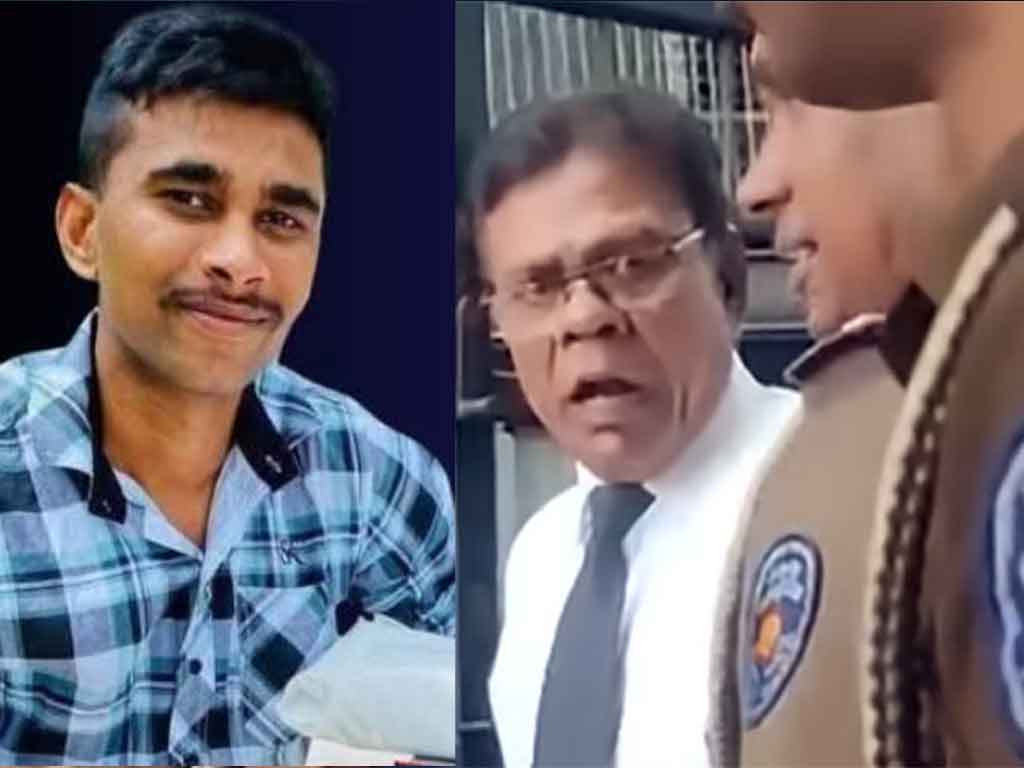
Over the past week, the Sinhala media focused on an altercation between a lawyer and a police officer at the Mount Lavinia Magistrate’s Court premises.
This coverage spanned print, television, and social media commentary. Conversations and narratives on social media platforms were tracked and analysed using the monitoring tool, Junkipedia.[1]
This week’s analysis is set out under three headings.
1. What was the key event that captured public attention?
October 10: An altercation occurred between Attorney-at-Law Gunaratne Wanninayake and Police Constable Tharinda Dilhara at the Mount Lavinia Magistrate’s Court premises, reportedly following a dispute over a car being parked in a space reserved for the prison bus.[2] The lawyer reported the alleged assault to the Mount Lavinia Police Station. [3]
October 11: The accused constable was arrested by the Mount Lavinia Police.[4] The Bar Association of Sri Lanka expressed ‘deep concern’ and ‘utmost outrage’ over ‘the incident.’[5]
October 12: The Mount Lavinia Police launched an inquiry into the conduct of the lawyer and his colleague for allegedly verbally abusing and obstructing the constable in the performance of his duties.[6] When officers visited his residence as part of the inquiry, Wanninayake was not at home.[7]
October 13: The accused constable was released on bail after being produced before the Mount Lavinia Magistrate’s Court.[8]
October 15: Wanninayake surrendered to the Mount Lavinia Magistrate’s Court after being unable to be located by the police in the preceding days and was subsequently released on bail.[9]
October 19: CCTV footage of the altercation was widely circulated on social media, reportedly showing the police constable assaulting the lawyer.[10]
Note: This MPA issue is based on Sinhala media coverage of the altercation between October 10 and 19. Developments after October 19 — including the release of new CCTV footage reportedly showing the constable assaulting the lawyer — fall outside the monitoring period (13–19 October) and are therefore not covered in this analysis.
An analysis of the media discourse suggests that the altercation functioned less as a legal case and more as a lens into deeper questions of class and hierarchy in Sri Lanka.
Social media commentary was overwhelmingly sympathetic towards the constable, in contrast to the mix of support and criticism in the mainstream media.
2. Why was public sentiment in favour of the police?
Public sentiment favoured the police, as the lawyer’s behaviour was perceived as displaying class superiority toward the constable.
The perception that the lawyer’s behaviour was seen as displaying class superiority towards the constable reframed the altercation as a clash not merely between two individuals, but between social hierarchies — the educated élite and the working-class arm of state authority—revealing deep-seated inequalities in Sri Lankan society. Media narratives amplified this framing, transforming the incident into a commentary on how power, respect, and dignity are distributed—and denied—across social lines in Sri Lanka.
In Sri Lanka, the police have long been perceived negatively as corrupt and politically subservient, functioning less as impartial enforcers of the law and more as an instrument of political influence. The Sinhala media frequently reinforces this image, portraying the police as an institution that “thrives on corruption.” Public distrust of the police has thus become a longstanding feature of Sri Lanka’s political culture.
Yet, in this case, sympathy shifted toward the police constable. On social media, the lawyer’s conduct during the altercation—particularly his reference to the constable as a “country bumpkin” (trans. ගම් කබරයා/ gam kabaraya) and his claim that he could have the constable interdicted by calling the IGP—drew strong criticism, revealing the persistence of class hierarchies. Within the police itself, lower-ranking officers such as the accused constable are often colloquially referred to as “smaller ones in the police” (trans. පොලිස්පොඩ්ඩො/ police poddo). The term reflects the entrenched hierarchies within the institution, where constables and junior officers occupy a subordinated position in rank and class perception.
By contrast, lawyers occupy a higher rung in the social hierarchy—commanding prestige, education, and access to justice. Yet, within the Sinhala psyche, they too are widely caricatured as “black-coated fellows/crows” (trans. කළුකෝට්කාරයෝ/කාක්කෝ; kalu coat kaarayo/kaakko), depicting them as élite figures who exploit the misfortunes of the downtrodden for financial gain.
In this context, the lawyer’s perceived problematic conduct reinforces existing public sensitivities about social hierarchy, leading many to view the constable as the victim.
3. What underlying sentiment about social media reactions does this incident bring to light?
The altercation’s coverage revealed scepticism toward social media commentary, with some of the mainstream press viewing it as sensationalist and lacking credibility, while underscoring the broader public rejection of class-based condescension.
Social media users largely framed the constable as the oppressed party — a shift from the traditional pattern where sympathy for the marginalised was more commonly reflected in the mainstream press.
However, this wave of online sympathy also provoked a counter-discourse within mainstream press, which expressed scepticism toward the credibility of social media commentary. Privately-owned mainstream newspapers such as Mawbima, Sunday Lankadeepa and Aruna characterised the online reaction as overly dramatic and sensational, lacking in factual credibility, and inflated by attention dynamics that elevate incidents of limited national significance.[11] This critique reflects a broader ambivalence in Sri Lanka’s media landscape toward the growing influence of social media, often linked to anxieties about misinformation and AI-generated content.
Similar criticism has surfaced in response to other social media-driven stories, such as the coverage of Ishara Sewwandi’s arrest and extradition from Nepal, which some commentators argued glamourised alleged offenders.
Overall, Sinhala-language media discourse—especially on social media—illustrates a consistent pattern in which class-based condescension is publicly condemned and seldom receives wider endorsement.
[1] The MPA team monitored Facebook profiles, TikTok handles and YouTube channels using Junkipedia for the keywords Gunaratne Wanninayake, lawyer, police, constable and Mount Lavinia in Sinhala, from October 13 to 17, 2025.
[2] For more information, see: https://www.hirunews.lk/en/424759/police-constable-remanded-over-assault-on-lawyer-in-mount-lavinia-court-premises and https://www.dailymirror.lk/breaking-news/Police-launch-probe-into-Mount-Lavinia-Court-assault-incident/108-322032#:~:text=Police%20have%20launched%20an%20investigation,of%20the%20Mount%20Lavinia%20Division.
[3] For more information, see: https://www.dailymirror.lk/breaking-news/Police-launch-probe-into-Mount-Lavinia-Court-assault-incident/108-322032 and https://www.adaderana.lk/news.php?nid=113479.
[4] For more information, see: https://www.adaderana.lk/news.php?nid=113479 and https://hirunews.lk/en/424759/police-constable-remanded-over-assault-on-lawyer-in-mount-lavinia-court-premises.
[5] For more information, see: https://basl.lk/basl-statement-issued-in-relation-to-the-incident-that-took-place-today-at-the-mount-lavinia-court-premises-where-an-atrorney-at-law-was-assaulted-by-a-police-officer/ and https://hirunews.lk/en/424849/basl-condemns-attack-on-lawyer.
[6] For more information, see: https://www.dailymirror.lk/breaking-news/Police-launch-probe-into-Mount-Lavinia-Court-assault-incident/108-322032#:~:text=Police%20have%20launched%20an%20investigation,out%20of%20the%20court%20premises and https://hirunews.lk/en/424857/police-launch-investigation-against-senior-lawyer-in-mount-lavinia-court-incident.
[7] For more information, see: https://www.adaderana.lk/news.php?nid=113671 and https://www.newswire.lk/2025/10/12/mlavinia-court-incident-govt-to-take-strong-action-against-senior-lawyer/.
[8] For more information, see: https://www.hirunews.lk/en/425027/pc-granted-bail-in-mount-lavinia-lawyer-assault-case and https://www.newswire.lk/2025/10/12/mount-lavinia-court-incident-inquiry-over-lawyer/.
[9] For more information, see: https://island.lk/court-incident-lawyer-wanninayake-surrenders-to-court/ and https://www.themorning.lk/articles/AGxW7oY9lAu6PGEmDYpe.
[10] For more information, see https://www.youtube.com/watch?v=1gDi9-m9GUU and https://www.newswire.lk/2025/10/19/new-cctv-footage-emerges-over-police-assault-on-lawyer/.
[11] MP Dilith Jayaweera established Liberty Publishers (Pvt) Limited, which is the publisher of three national newspapers – Aruna, The Morning and Thamilan. For more information, see: https://cdn.cse.lk/cmt/upload_report_file/568_1693568870427.pdf; and former MP Tiran Alles and his son Ramantha Alles collectively own Ceylon Newspapers (Pvt) Limited, which is the publisher of two national newspapers – Mawbima and Ceylon Today. For more information, see: https://sri-lanka.mom-gmr.org/en/owners/individual-owners/detail/owner/owner/show/alles-family/.
To view this week’s news summaries, please click here.
To view this week’s social media data, please click here.
[/paywall]