October 20, 2025 – October 26, 2025 | Vol.15, #40 | ISSN 3084-9330

Photo credits: Ada Derana
[paywall layout_id=”1906″ service_tags=”TMA,FP” preview=”true”]
Analysis
Over the past month, the Sinhala mainstream media—across print and television—focused on Sri Lanka’s engagement at the 60th Regular Session of the United Nations Human Rights Council (UNHRC).
This week’s analysis is set out under two headings.
1. What was the key event that captured public attention?
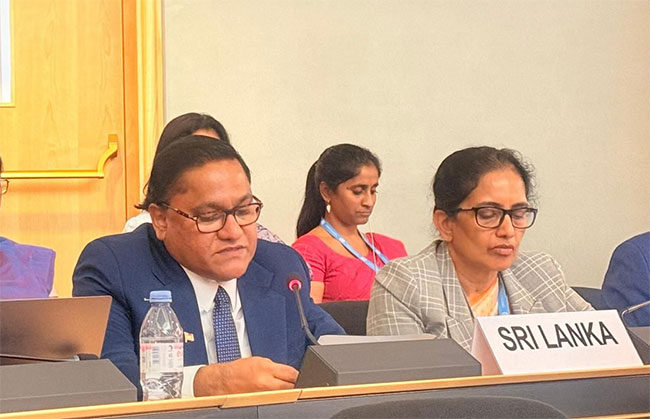
October 6: The UNHRC adopted Resolution A/HRC/60/L.1/Rev.1 titled “Promoting reconciliation, accountability and human rights in Sri Lanka” without a vote.[1] Sri Lanka’s Permanent Representative to the UN in Geneva Himalee Arunatilaka rejected the resolution, reiterating that accountability should remain a domestic process.[2]
As observed in MPA Vol. 15, No. 36, the Tamil media continued to devote significant coverage to the UNHRC session, reflecting ongoing dissatisfaction with both the Sri Lankan government and the UNHRC—particularly regarding questions of accountability (see The Divide published in this week’s MPA).[3]
By contrast, over a month of media monitoring, the resolution received marginal coverage in Sinhala media, mostly in mainstream papers critical of the government. Social media engagement was also minimal, with limited posts and interactions. Narratives were tracked and analysed via Junkipedia.[4]
The Sinhala media discourse on the UNHRC debate centred on a procedural question—whether Sri Lanka should have called for a vote prior to the adoption of the resolution.
2. How did the government’s decision at the UNHRC impact its standing?
The government’s decision not to call for a vote divided interpretations—viewed by some as a measured act of diplomacy, and by others as a sign of weakness and inconsistency.
The government’s decision to forgo a vote led to two contrasting narratives of Sri Lanka’s diplomatic engagement with the UNHRC, outlined briefly below.
Government narrative: A pragmatic approach
The government framed its decision not to call for a vote at the UNHRC as a pragmatic, calculated move to avoid a costly, inevitable defeat. Officials portrayed the decision as a demonstration of diplomatic maturity and independence, emphasising that Sri Lanka’s focus lay on advancing domestic processes of reconciliation and accountability rather than yielding to perceived external interference.
Within this framing, restraint was positioned as strategic—signalling confidence and the ability to manage international scrutiny without confrontation.
Opposition and critical narrative: A perilous approach
Opposition politicians such as MP Dilith Jayaweera and former MP Wimal Weerawansa, along with privately owned newspapers such as Aruna, framed the government’s decision to forgo the vote as strategically perilous.[5] They argued that by allowing the resolution to pass without a vote, Sri Lanka had failed to register formal opposition and missed an opportunity to mobilise international allies in its defence.
Critics also contended that the government had made unnecessary concessions, including agreeing to the establishment of an Independent Prosecutor’s Office, which could later be used to pursue cases against military personnel. Simultaneously, the continued operation of the OHCHR’s Sri Lanka Accountability Project—the external evidence-gathering mechanism—was viewed as a sign of diplomatic passivity rather than prudence.[6]
Within this framing, restraint was interpreted as incompetence—signalling weakness and an inability to preserve national dignity.
Overall, the government’s decision not to call for a vote at the UNHRC session divided interpretations—hailed by some as a display of pragmatic diplomacy and criticised by others as a sign of strategic weakness and inconsistency.
[1] For more information, see: https://docs.un.org/en/A/HRC/60/L.1/Rev.1 and https://www.hrw.org/news/2025/10/06/un-extends-evidence-gathering-mandate-for-sri-lanka-war-crimes.
[2] For more information, see: https://www.ft.lk/front-page/Sri-Lanka-rejects-new-UNHRC-resolution/44-782680 and https://www.themorning.lk/articles/sehxApRvCddC2mz6RB8l.
[3] For more information, see MPA Vol.15, #36 and The Divide posts published over here: https://x.com/verite_tma/status/1980263150835601543; https://x.com/verite_tma/status/1979145633618628986; and https://x.com/verite_tma/status/1978777679899001333.
[4] The MPA team monitored Facebook profiles, TikTok handles and YouTube channels using Junkipedia for the keywords Geneva, government, resolution, 60th UNHRC session and human rights in Sinhala, from October 09 to 24, 2025. However, no links were generated due to the low commentary and limited interaction on posts.
[5] MP Dilith Jayaweera established Liberty Publishers (Pvt) Limited, which is the publisher of three national newspapers – Aruna, The Morning and Thamilan. For more information, see: https://cdn.cse.lk/cmt/upload_report_file/568_1693568870427.pdf.
[6] For more information, see: https://www.ohchr.org/en/hr-bodies/hrc/sri-lanka-accountability/index.
To view this week’s news summaries, please click here.
To view this week’s social media data, please click here.
[/paywall]