November 3, 2025 – November 16, 2025 | Vol.15, #42 & 43 | ISSN 3084-9330

Photo credits: news.lk
[paywall layout_id=”1906″ service_tags=”TMA,FP” preview=”true”]
Key insights:
- A Budget widely recognised as IMF-aligned is still gaining positive traction, shaped by public perceptions of pragmatic crisis management rather than ideological change.
- The Nugegoda rally functions less as a protest against the Government than as a stage for smaller parties to stake their claim to leadership of the anti-government camp.
Analysis
Over the past two weeks, Sinhala media primarily focused on the Budget 2026 discourse.
This coverage spanned print, television, and social media commentary. Conversations and narratives on social media platforms were tracked and analysed using the Junkipedia monitoring tool.[1]
This week’s analysis is set out under two headings.
1. What was the key event that captured public attention?
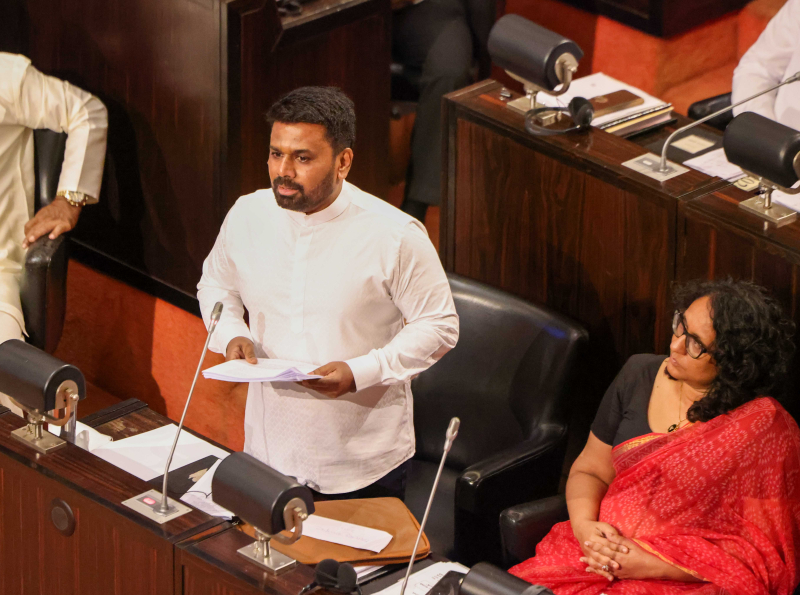
Nov. 7: The second reading of the Appropriation Bill for the year 2026 (the Budget Speech) was presented to Parliament by President Anura Kumara Dissanayake in his capacity as the minister of finance.
Opposition critiques portray the Budget as closely aligned with the IMF-backed programme and as a departure from what they describe as the administration’s historic political and economic ideology. In the lead-up to the 2024 presidential election, President Dissanayaka was widely expected, based on his past positions, to introduce radical changes to the prevailing economic framework.[2] At that time, concerns centred on the risk that such ideological shifts could disrupt the economic stabilisation underway and jeopardise the IMF programme.[3]
The opposition now characterises the Budget as an “IMF Budget” and as a break from the government’s historical ideological commitments.
Despite this narrative, the Budget continues to gain positive traction among the public — and in today’s analysis, we examine why.
2. Why does a Budget that is broadly accepted as being within the IMF framework—which has historically carried a negative perception in Sri Lanka—nevertheless continue to attract positive traction?
The budget is gaining positive traction on three fronts: the NPP is seen as managing an inherited constraint rather than shifting ideology; the IMF’s governance-focused approach aligns with the NPP’s platform; and high public trust in the government shapes how voters interpret its engagement with the IMF.
i. NPP is seen as managing a constraint, not shifting ideology
First, public perception of the IMF has changed significantly since the period before the economic crisis. The earlier scepticism softened as the crisis deepened, creating space for a more pragmatic view. This shift was reinforced, in large part, by the economic stabilisation that came along with the IMF programme and also the outcome of the opposition’s own electoral campaigning, which consistently argued that the continuation of the IMF programme was essential to maintain economic stability.
Second, the government’s counterargument to the opposition’s critique of the Budget is that adherence to the IMF programme is an unavoidable response to an economic crisis inherited from previous administrations. By highlighting the scale of the debt problem and the depth of past mismanagement, the government frames current austerity measures and reforms as structural necessities rather than ideological choices.
In doing so, it shifts responsibility for the austerity measures and structural adjustment to the past while positioning itself as the actor that can responsibly steer the economy back to full recovery.
Third, the public tends to distinguish between the reasons different leaders engage with the IMF. Ranil Wickremesinghe’s adoption of the IMF programme is widely viewed as a deliberate policy choice consistent with his long-standing preference for fiscal consolidation, tighter monetary discipline, and market-oriented reforms.
In contrast, the NPP’s engagement is generally seen as an effort to manage an inherited economic constraint within a limited set of options, rather than a shift in its ideological direction. This makes the government’s alignment with the IMF appear pragmatic rather than ideological, reducing the impact of the opposition’s argument that the NPP has abandoned its core political and economic position
ii. The IMF’s emphasis on governance and anti-corruption reshapes the programme’s political meaning
The current IMF programme emphasises governance and anti-corruption reforms, marking a notable departure from earlier IMF engagements in Sri Lanka, which focused more narrowly on fiscal and macroeconomic adjustments.[4]
This change in emphasis shapes public perception. When the IMF is viewed as advancing transparency, accountability, and anti-corruption measures, its role appears less adversarial and more compatible with popular interests and with the NPP’s platform as well.
Consequently, the opposition’s claim that the government has undergone an ideological capitulation finds limited resonance, as it does not recognise the change in public perception of the current IMF programme in Sri Lanka.
iii. High trust and broader popularity buffer the government
The government continues to command significant public confidence, primarily driven by its active measures to promote governance and accountability, in contrast to previous administrations. For instance, the NPP government’s illicit-drug eradication initiative reinforces a long-standing public perception that successive Sri Lankan governments colluded with—rather than confronted—the criminal establishment.[5]
This generates a credibility buffer: public trust in the government’s anti-corruption efforts shapes how voters interpret the Budget and its alignment with the IMF. Although the Budget maintains broad economic continuity and adheres closely to the IMF programme, it is viewed through a supportive rather than a critical lens. The supportiveness derives from the positive perception of the government as visibly pursuing corruption-related investigations and reforms.
[1] The MPA team monitored Facebook profiles, TikTok handles and YouTube channels using Junkipedia for the keywords budget, salaries, spending, and taxes in Sinhala, and IMF in English, from October 28 to November 15, 2025.
[2] See TMA, Vol. 14, #36; Vol. 14, #37
[3] See TMA, Vol. 14, #36; Vol. 14, #37
[4] For more information, please read https://www.elibrary.imf.org/view/journals/002/2024/162/article-A001-en.xml and https://us.transparency.org/app/uploads/2023/11/TISL-assessment-of-Civil-Society-IMF-diagnostic-reports20.pdf
[5] See MPA, Vol. 15, #41
To view this week’s news summaries, please click here.
To view this week’s social media data, please click here.
[/paywall]