Flood of criticism managed

November 17, 2025 – December 7, 2025 | Vol.15, #44 & 45 | ISSN 3084-9330

Photo credits: Sri Lanka Brief

[paywall layout_id=”1906″ service_tags=”TMA,FP” preview=”true”]

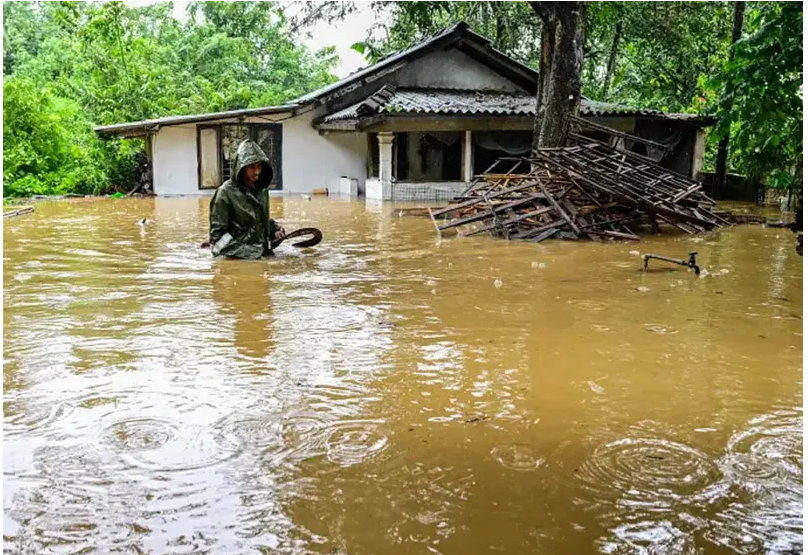
Over the past week, Sinhala media primarily focused on the floods affecting Sri Lanka.
 
This coverage spanned print, television, and social media commentary. Conversations and narratives on social media platforms were tracked and analysed using the Junkipedia monitoring tool.[1]
 
This week’s analysis is set out under two headings.


1. What was the key event that captured public attention?

Nov. 28: Cyclone Ditwah struck Sri Lanka, unleashing the most severe flooding the country has experienced in over 20 years.[2]

On the same day, President Anura Kumara Dissanayake declared a State of Public Emergency in Sri Lanka (rather than a ‘State of Disaster’ under the Disaster Management Act). [3] The president also held an emergency meeting at the Ministry of Defence with party leaders to discuss the disaster situation. [4]

Nov. 30: The president addressed the nation after widespread floods and landslides and announced emergency measures and aid for the people.[5]

Dec. 1: Sri Lanka’s Cabinet approved a proposal to establish the ‘Rebuilding Sri Lanka’ fund, aimed at rebuilding the country following the severe devastation caused by Cyclone Ditwah.[6]

Dec. 8: The Department of Meteorology issued an advisory for severe lightning in the Sabaragamuwa and Southern Provinces and Colombo and Kalutara Districts.[7]
At the time of writing, the death toll had exceeded 600, with more than 200 people still missing.[8]

The opposition frames the government’s handling of the cyclone as a failure of both pre-warning and response, citing overall incompetence and mismanagement. Some actors have also sought to draw parallels with the intelligence lapses preceding the Easter Sunday attacks. However, this effort to frame the disaster as a repeat of past state failures has not gained broader public traction, and this analysis explains why the narrative has not produced substantial negativity toward the government.


2. Despite efforts to portray the government as having failed to pre-warn and take precautionary action, why did this narrative not generate substantial public negativity toward the government?

The explanation is set out by unpacking three strands of discourse that dominate over the contesting narrative of government failure: (i) the president is discursively distanced from administrative lapses; (ii) the opposition is perceived as lacking credibility and moral standing to criticise; and (iii) the uncertainty around the information available to issue prior warnings and take precautionary action.

The discourse dynamics of the dominant narrative

i. On presidential responsibility

Distanced from direct responsibility: In this strand of discourse, the president is positioned less as the direct manager of state machinery and more as a figure standing slightly apart from it. Administrative lapses are attributed to structural constraints—such as entrenched institutional cultures, procedural rigidity, or a legacy of bureaucratic caution—rather than to shortcomings in executive decision-making. These framing positions the president as working against a slow-moving, inherited system, aligning him with public frustration rather than bureaucratic inertia.

Distanced from direct agency:When specific missteps occurred, they were positioned in the media as isolated errors by subordinate actors rather than as consequences of leadership choices. For instance, criticism that the opening of sluice gates contributed to increased flooding was directed at specific bureaucrats, including irrigation engineers. In another instance, Deputy Minister of Public Security Sunil Watagala claimed that if ‘malicious attacks’ continued against the president and the government, Sri Lankan authorities would invoke the Public Security Act. Emergency powers under Section 5 of the Public Security Act allow wide restrictions on information during crises.[9]  However, in the media, the president was portrayed as being distanced from the deputy minister’s actions, with emphasis that the emergency regulations will not be used to curb criticism.  

ii. On the opposition’s credibility

In the dominant discourse, the opposition is often framed—especially on social media—as intertwined with the broader, long-standing problems of governance rather than as a credible alternative to it. Their past record, including allegations of corruption during previous disasters and wider governance failures such as the inability to prevent the Easter Sunday attacks, is frequently invoked to suggest they lack the moral standing to critique the current administration.  

A key dynamic shaping public response is relatively strong trust in the government’s capacity to manage aid without major corruption—or at least more reliably than in past crises such as the 2004 tsunami. This perception acts as a stabilising force: when citizens and international partners believe that incoming assistance will be used effectively, it sustains the narrative of functional governance even amid scrutiny of administrative lapses.

This trust allows the government to present external support not merely as humanitarian relief, but as implicit validation of the state’s integrity. It strengthens the government’s ability to shift the narrative from blame to reconstruction, positioning the state as the most legitimate and reliable channel for recovery efforts.


iii. On information availability

The government was criticised for reportedly failing to use forecasts and warnings effectively. In response, government and pro-government voices highlighted the lack of information available to provide prior warning on the cyclone impacts. They diffused the criticism by framing the events as largely “unexpected” and “unpredictable”.

Government-aligned voices questioned the timing, content, and legitimacy of the warnings that critics assert were disregarded. By introducing uncertainty about the existence of claimed information, when reliable information was available, allegations of negligence and political accountability were diffused.

The contesting narrative

On information availability

The contesting narrative centres on whether the government responded adequately to early meteorological intelligence.[10]

Opposition actors, including the SJB and UNP, contended that authorities had access to credible forecasts, including warnings from the director general of the Department of Meteorology dated as early as November 12 and 25.[11] They also framed the floods as largely “human-made,” linking the scale of destruction to operational decisions rather than natural forces alone. They claimed that simultaneous releases of large volumes of water from reservoirs than staggered pre-emptive releases, caused sudden surges that devastated towns such as Gampola.

However, this perspective remained a contesting narrative and did not dominate the discourse.


Taken together, these dynamics explain why the dominant narrative generally prevails. Amid ongoing contestation, a cross-cutting sensibility has gained ground: that in an acute crisis, the priority should be to support and provide relief for those affected rather than to be finger-pointing. This emphasis on “doing what can be done now” — donating, volunteering, and facilitating assistance — shifted public attention away from the blame narrative and reinforced the view that active participation in recovery was the most urgent concern.


[1] The MPA team monitored Facebook profiles, TikTok handles and YouTube channels using Junkipedia for the keywords Ditwah, aid, landslides, displaced, Anura, government, floods, committee, cyclone, building, Watagala, emergency regulations, in Sinhala, and Rebuilding Sri Lanka in English, from November 26 to December 6, 2025. 

[2] https://geosmart.undp.org/arcgis/apps/storymaps/stories/25866fbc805c4d70b6bf35c23f896daf?_gl=1*kykgu5*_ga*MTg1MzA0NjA0OS4xNzQ5NDU5NTY3*_ga_PBF14M9C6G*czE3NjUyNjAzODIkbzYkZzAkdDE3NjUyNjAzODIkajYwJGwwJGgw and  and https://www.undp.org/asia-pacific/press-releases/one-fifth-sri-lanka-inundated-cyclone-ditwah-undp-analysis

[3] https://www.newsfirst.lk/2025/11/29/president-declares-state-of-public-emergency-in-sri-lanka and https://reliefweb.int/report/sri-lanka/sri-lanka-pad-situation-report-003-emergency-cyclone-ditwah-28th-29th-november-2025

[4] https://economynext.com/sri-lanka-president-party-leaders-officials-discuss-emergency-situation-250526/ and https://sundaytimes.lk/online/news-online/President-holds-special-discussion-with-party-leaders-on-disaster-situation/2-1150816 and https://www.cpalanka.org/statement-on-the-declaration-of-emergency-and-emergency-regulations-promulgated-on-the-28-11-2025/#:~:text=Statement%20on%20the%20Declaration%20of,Officer%20on%201%20December%2C%202025  and https://www.adaderana.lk/news.php?nid=115329#:~:text=Sri%20Lanka%20declares%20State%20of,Public%20Emergency%20across%20the%20country.

[5] https://media.gov.lk/media-gallery/latest-news/3507-full-speech-president-s-address-to-the-nation#:~:text=To%20restore%20these%20sectors%20quickly,misused%20for%20any%20other%20purpose and https://hirunews.lk/en/433520/the-president-to-address-the-nation   

[6] https://economynext.com/sri-lanka-establishes-rebuilding-fund-after-cyclone-ditwah-hit-disaster-251112/ and https://island.lk/cabinet-approves-establishment-of-rebuilding-sri-lanka-fund/

[7] https://www.newswire.lk/2025/12/08/lightning-advisory-red-alert-issued-to-07-districts-3/ and https://www.dailymirror.lk/breaking-news/Severe-lightning-advisory-issued-for-several-districts/108-327262

[8] https://hirunews.lk/en/434465/death-toll-exceeds-600-214-missing and https://www.aljazeera.com/news/2025/12/7/sri-lanka-landslides-feared-as-toll-hits-618-widespread-loss-sweeps-asia

[9] For more information, please see https://www.ifj.org/media-centre/news/detail/category/press-releases/article/sri-lanka-minister-threatens-emergency-powers-to-curb-misinformation and https://srilankabrief.org/emergency-regulations-may-be-enforced-to-counter-online-attacks-on-president-says-minister-watagala/

[10] For more information, please see https://www.themorning.lk/articles/ryDon7DvVmpD8xyVt59b, https://www.newswire.lk/2025/12/06/sajith-premadasa-accuses-government-of-ignoring-early-cyclone-warnings/, https://www.sundaytimes.lk/251207/editorial/nature-will-not-wait-for-sri-lanka-to-get-its-act-together-623241.html and https://www.themorning.lk/articles/0KWTNHlNMuDonMQnuKox 

[11] For more information, please see https://www.themorning.lk/articles/ryDon7DvVmpD8xyVt59b, https://www.newswire.lk/2025/12/06/sajith-premadasa-accuses-government-of-ignoring-early-cyclone-warnings/, https://www.sundaytimes.lk/251207/editorial/nature-will-not-wait-for-sri-lanka-to-get-its-act-together-623241.html and https://www.themorning.lk/articles/0KWTNHlNMuDonMQnuKox 

To view this week’s news summaries, please click here.

To view this week’s social media data, please click here.

[/paywall]