AKD’s remarks in Jaffna: Two framings—and the dynamics that amplify them

January 19, 2026 – January 25, 2026 | Vol.16, #3 | ISSN 3084-9330

Photo credits: Anadolu Ajansi

[paywall layout_id=”1906″ service_tags=”TMA,FP” preview=”true”]

Over the past week, Sinhala media primarily focused on President Anura Kumara Dissanayake’s visit to the Northern Province.

This coverage spanned print, television, and social media commentary. Conversations and narratives on social media platforms were tracked and analysed using specialised monitoring tools.[1]

This week’s analysis is set out under four headings.

What was the key event that captured public attention?

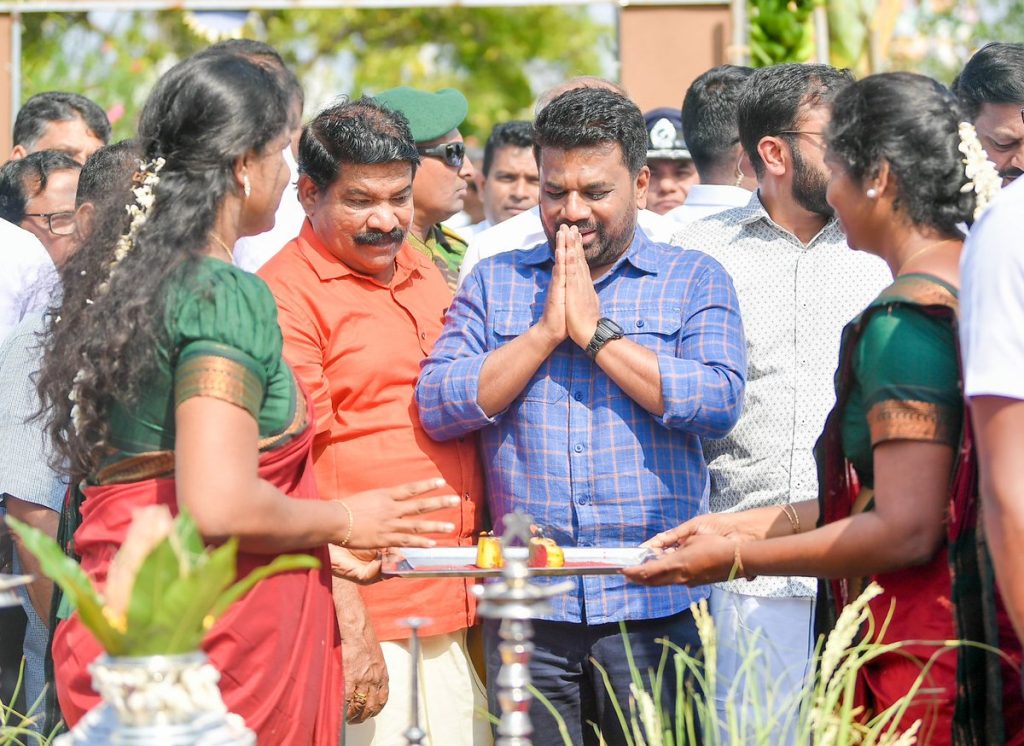
January 15–16: President Anura Kumara Dissanayake participated in a series of official programmes in Mannar and Jaffna.

As part of President Dissanayake’s visit to the Northern Province, two major events were held. These included the Northern Province Thai Pongal Festival at the Aiyanar Kovil grounds in Velanai, and the Northern Province leg of the “Ratama Ekata” (“A United Nation”) national campaign at the Jaffna Technical College grounds. The events aimed to promote communal harmony and address the resurgence of localised racial tensions in the post-war context.

During the proceedings, the president emphasised that his administration would not allow racist tendencies to resurface. He also criticised the mobilisation of religious observances in the North to promote hatred instead of spiritual values. A specific excerpt from the statement soon caught the attention of the media:

“I know that there are twists and turns everywhere. They come to Jaffna after passing the Jaya Sri Maha Bodhi to observe sil (precepts) on Poya days. What is there is not seela (virtue), but vairaya (hatred). […] I have instructed our intelligence agencies to investigate whether any of those individuals screaming there [at the temples] actually own even a single piece of land in those areas.”

The excerpt above was indirectly tied to a contested site in Thaiyiddy, Jaffna. Local residents and Tamil politicians claim that the land on which the military built the Tissa Vihara is private land belonging to war-displaced Tamil families. On each Poya Day, the landowners, activists, and Tamil politicians, including the All Ceylon Tamil Congress (ACTC) led by MP G.G. Ponnambalam, stage a protest demanding the release of the land and opposing the perceived “Sinhalisation/Buddhistisation” of the North and East, while groups of Southern pilgrims attend sil observances that critics view as a territorial and political signal.

The president implicitly criticised these Poya Day practices as politically orchestrated provocations rather than purely devotional acts, saying, “What is there is not virtue, but hatred”. This critique of “politically organised religion” around Tissa Vihara is a key trigger for the reactions analysed in this issue.

In the days after, what appeared to be a coordinated effort of selective clipping and recontextualisation circulated across Sinhala media and social platforms, framing the excerpt as an anti–Sinhala-Buddhist attack.

In today’s analysis, we examine why the president’s remarks were widely positioned as an attack on Sinhala Buddhists, although those remarks could be interpreted as a warning against the return of racism.

Why was the president’s statement interpreted as a “threat” to Sinhala Buddhists?

Criticism of the president’s remarks coalesced around two dominant framings: i) the statement was framed as a challenge to Sinhala-Buddhist recognition and symbolic authority in Northern public space; and ii) it was reframed as an infringement on equal religious freedom and freedom of movement. These two framings reinforced each other, shifting the excerpt from a context-specific warning about political mobilisation in a contested post-war setting into a perceived threat to Sinhala Buddhists.

First, the recognition frame:Within the Sinhala-Buddhist nationalist common sense, the nation is imagined as Sinhala-Buddhist.[2] Within this common sense, Sinhala-Buddhist religious activity—especially organised Poya-day observance in the North—is often taken not just as worship, but as a rightful assertion of the national identity. In this context, the president’s remarks were read as questioning who is entitled to publicly assert national identity in the North.

Second, the reciprocal rights frame: The president’s statement was also reframed as a threat through the lens of equal rights and freedom of movement. The media excerpts cite the president as suggesting that devotional acts are being ethically compromised, emerging as vairaya rather than seela and therefore subject to state suspicion.

Critics argued that Northern residents travelling in groups to Kataragama for religious observances and Sinhala-Buddhist groups going to Northern religious sites are both just normal expressions of religious freedom, thereby challenging the president’s statement from the perspective of reciprocal rights.

Taken together, these framings suggest the president’s remarks were received less as a contextual critique of politicising religious expression (which seems be how it was spoken) and more as an unreasonable rejection of the importance of and freedom for Sinhala Buddhist expression, which in turn has fuelled negative reactions to the president’s statement.

Why is it easy to target religion-based criticism at the JVP/NPP government?

Criticism of the president’s remarks also drew traction from two background dynamics: i) in Sri Lanka/South Asia, “secularism” is often understood less as state neutrality and more as niragama (“empty of spirituality”), with undertones of being without values or moral commitment; and ii) the JVP/NPP is frequently read through a “Marxist” lens in which separating religion and the state is linked not only to neutrality but to suppress religion. Together, these dynamics make context-specific interventions easier to interpret as part of a broader anti-religious agenda, particularly toward Sinhala-Buddhism.

The secularism dynamic: In many Western liberal contexts, secularism is framed as a positive civic commitment.[3] It is linked to governance based on a rational scientific basis (as opposed to religious beliefs), equal treatment and democratic freedoms. Keeping the state separate from organised religion is framed as a way to prevent any single doctrine from dominating law and institutions, and to protect pluralism. In this tradition, secularism is not treated as a lack of morality, but as an institutional arrangement intended to protect equal standing.

In Sri Lanka—and more broadly across parts of South Asia—the sensibility around secularism has developed along a different trajectory and often carries a more negative connotation. It is frequently read through niragama (නිරාගම, “empty of spirituality”, without religion), which can imply that a person is without values, commitment, or moral grounding.

Therefore, in Sri Lanka, the concept of secularism has shifted from a constitutional principle (separating state authority from religious authority) to a socially charged label.  

The suspicion dynamic: In Sri Lanka, secularism is often read through the term niragama (“empty of spirituality”), which carries a negative moral connotation rather than the idea of state neutrality. This creates a vulnerability for the JVP/NPP.

In popular political memory, Marxism is associated not only with stronger religion–state separation, but with the suppression/extinction of religious institutions and public religious life. This history makes religion an especially effective axis for criticism.

In this context, the JVP/NPP is often viewed through a “Marxist” lens, which creates suspicion about its approach to religion. Since secularism is commonly read as niragama (“empty of spirituality”), government interventions—especially those involving public religious observance—are more easily framed as attempts to restrict/suppress Sinhala-Buddhist religious expression.

How did the Sinhala media diverge from the Tamil press?

The Tamil press was broadly optimistic of the president’s visit to the North. Tamil media commentary appears to be positioning the president’s participation as both a symbolic reassurance and an institutional correction.

The participation of an “Executive President” in the official Thai Pongal celebrations in Jaffna was framed as a symbol of the state’s improved alignment with the localised priorities of the Tamil people.

Within this frame, the Jaffna speech was read as an effort to position the presidency as a balancing authority in a contested religious-national landscape, particularly in relation to Thaiyiddy.

The reading is that the president is signalling to two audiences simultaneously: to Northern constituencies, that the state does not support religion being used to settle territorial and heritage disputes through intimidation; to Southern audiences, that religiosity should not be mobilised for majoritarian political ends.


[1] The MPA team monitored Facebook profiles, TikTok handles and YouTube channels using Junkipedia for the keywords Anura, virtue, Jaffna, hatred, Shanakiyan and Aruchuna in Sinhala from January 19 to 24, 2026.
[2] Neil DeVotta, Sinhalese Buddhist Nationalist Ideology: Implications for Politics and Conflict Resolution in Sri Lanka (ISEAS Publishing 2007).
[3] David E. Campbell, Geoffrey C. Layman and John C. Green, Secularism and Civic Engagement (Cambridge University Press, 2021). https://www.cambridge.org/core/books/abs/secular-surge/secularism-and-civic-engagement/757E0C38A09ACAFCB183528BED110B7E

To view this week’s news summaries, please click here.

To view this week’s social media data, please click here.

[/paywall]