February 2, 2026 – February 8, 2026 | Vol.16, #5 | ISSN 3084-9330

Photo credits: Daily Mirror
[paywall layout_id=”1906″ service_tags=”TMA,FP” preview=”true”]
Over the past fortnight, Sinhala media primarily focused on Independence Day. We analysed content across print, television, and social media, using a specialised social media monitoring tool.[1]
What was the key event that captured public attention?
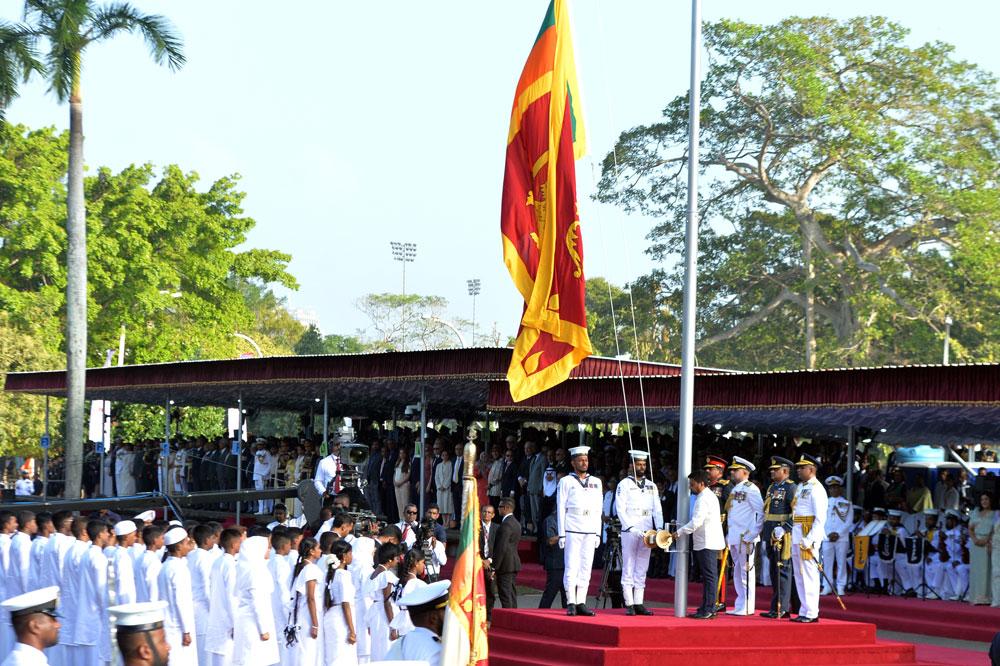
Feb. 4: 78th National Independence Day was celebrated at the Independence Square under the patronage of President Anura Kumara Dissanayake. The ceremony was held under the theme of “Rebuilding Sri Lanka”.
In Sinhala media discourse, Independence Day functioned less as a ceremonial signifier and more as a question of whether the present political moment could meaningfully be described as “independent” in lived terms.
In this issue, we examine the recurring Independence Day framing in Sinhala media and analyse why it has shifted in this instance.
What has been the recurring framing around Independence Day, and how and why has it changed this time?
Independence Day has periodically been used to discuss not only formal independence (the end of colonial rule in 1948) but also independence as lived experience (whether people experience dignity, security, and equal standing in daily life).
Independence Day has periodically been used to discuss not only formal independence (the end of colonial rule in 1948) but also independence as lived experience. From a lived-experience perspective, while 1948 is acknowledged as historically significant, it has traditionally been described as “incomplete” or “false,” primarily through an economic lens—whereby “true independence” is impossible while the nation remains economically beholden or the citizenry remains under economic hardships.
While previous critiques focused on these economic shortcomings, the current discourse has shifted. This shift will be briefly analysed below through two framings.
Framing I: The expanded frame of “incomplete—or ‘false’ independence”
The “incomplete” critique has expanded beyond its traditional focus. Independence is now assessed by whether people experience modern economic security, receive equal treatment by the state, and whether relations across communities improve in ways that support a shared national identity.
Framing II: “Independence as having been achieved”
A new framing has emerged: it presents independence as having, for the first time, been truly achieved under an NPP government. Within this framing, “true independence” is understood as dismantling the traditional political élite’s hold over the state and confronting institutional capture.
By dismantling these internal structures of élite control, the discourse suggests the country has moved from mere “decolonisation” to a “liberation from internal capture.”‘
The evolution of the independence narrative
In the past, national identity was primarily framed through Sinhala-Buddhist primacy, centring Sinhala-Buddhist culture and history as the core of the nation.
In the recent coverage, “social-unity” is presented as a necessary condition for making “independence” meaningful.
In the current discourse, however, a significant redefinition has occurred.
“Social unity” is no longer treated as a secondary goal, but as a primary, necessary condition for independence to be meaningful. This framing aligns with the JVP’s long-standing focus on the fair distribution of resources. Within this perspective, economic progress is measured not by abstract aggregate growth but by the tangible improvement in individual lives and the broadening of opportunity, ensuring that no segment of society is left behind.
Taken together, these framings signal a shift in how independence is evaluated. In one, the concept is expanded to require both economic stability and ethnic harmony. In the other, independence is reinterpreted as freedom from internal capture.
How does Sinhala media discourse diverge from the English press?
Independence Day is treated in the English-language press commentary less as a window into popular sentiment and more as a site where the official national narrative is actively managed.
The Sunday Times’ political column (Feb. 8, 2026) examines how the state frames the day, noting the president’s emphasis on economic progress and unity. It also reports instructions issued to live commentators to use the term “Rana Viruwo” (රණ විරුවෝ/War Heroes) rather than “soldiers,” while notably avoiding mentions of the 2009 war victory—signaling a shift in how the state manages its public image.
[1] The MPA team monitored Facebook, TikTok, and YouTube using Junkipedia for the keywords independence, Anura Kumara, renaissance in Sinhala from February 2 to 8, 2026
To view this week’s news summaries, please click here.
To view this week’s social media data, please click here.
[/paywall]