March 17, 2025 – March 23, 2025 | Vol.15, #12
Event: On March 6, Al Jazeera released a one-on-one interview between former President Ranil Wickremesinghe and Mehdi Hasan.[1][2]
During the interview, Wickremesinghe faced questions on various incidents, including Batalanda, the Central Bank bond scam,[3][4] the Easter Sunday attacks,[5][6] the burning of the Jaffna Library[7][8] and the economic crisis.[9][10]
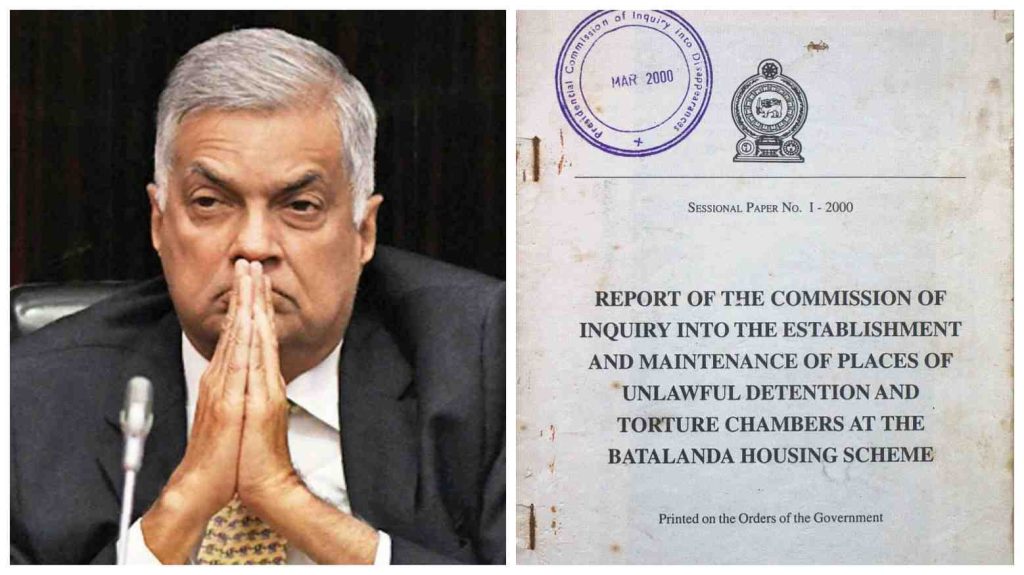
On March 14, the Batalanda Commission report (Report of the Commission of Inquiry into the Establishment and Maintenance of Places of Unlawful Detention and Torture Chambers at the Batalanda Housing Scheme) was presented in parliament by the Leader of the House Minister Bimal Rathnayake.[11][12]

[paywall layout_id=”1906″ service_tags=”TMA,FP” preview=”true”]
Key insights:
- Former President Wickremesinghe remains strongly tainted in connection with the Batalanda report – in the aftermath of the Al Jazeera interview – despite voices supportive of him casting doubt on the report and shifting the criticism towards the JVP.
- The discussion on Batalanda underscored an underlying issue in the uneven response to state violence in the Sinhala media. State violence in the South typically gains widespread condemnation and support for holding perpetrators accountable. In contrast, similar incidents in the North and East (where the majority is non-Sinhala people) are downplayed or ignored.
Analysis
Overview of media coverage
Over the past three weeks, the Sinhala media – including print, television and social media platforms (monitored via Junkipedia, a social media monitoring and analysis tool) – has predominantly featured discourse surrounding the Batalanda Commission report (hereinafter referred to as “the Report”) and Ranil Wickremesinghe’s alleged involvement in the “Batalanda detention centre”.
Wickremesinghe continues to be cast negatively, as analysed in MPA Vol.15,#10, especially in light of the renewed discussion surrounding his alleged involvement in the Batalanda “detention centre” following the Al Jazeera interview.
This week’s MPA unpacks the persistent negative portrayal of Wickremesinghe despite two new developments: (1) to reframe the Report to cast doubt on its content and (2) to divert criticism onto the JVP.
Reframing the Report to cast doubt on its content
Voices including former President Wickremesinghe and voices aligned with him, such as Wajira Abeywardana, reframed the Report in two ways: (1) casting doubt on whether its content implicated Wickremesinghe and (2) casting doubts on its credibility. This line of criticism was also adopted by privately owned newspapers such as Aruna.
Casting doubts on the implications of its content: There were two strands to this reframing – (i) claims that the Report did not directly implicate Wickremesinghe in wrongdoing and (ii) claims that the commission authoring the Report in any case lacked standing to adjudicate on culpability.
Casting doubts on the commission’s credibility: There were two strands to this reframing as well – (i) claims that the Report was politically motivated, and an attempt by former President Chandrika Kumaratunga to discredit her political opponent Ranil Wickremesinghe, who was leader of the opposition at that time and (ii) claims that the Report was analytically flawed, focusing on the tangential presence of Wickremesinghe instead of the focal culpability of other actors and institutions.
However, these reframing attempts to absolve Wickremesinghe of the allegations made against him failed to gain traction in public discourse. For instance, former member of parliament Udaya Gammanpila dismissed the report as “pussak” (translated as empty or lacking substance) on social media. In response, many social media commentators turned the insult back on him, referring to his statement as “pussak” and endorsed the perceived content of the report.
Diverting criticism onto the JVP
Other voices diverted the conversation from the allegations against Wickremesinghe to allegations against the JVP that had mounted a violent struggle against the government at that time.
However, amid renewed discussions around the Batalanda incident, this attempt to divert attention towards allegations against the JVP did not gain widespread public traction. This can be understood in the context of the JVP increasingly being seen as a response to – and a consequence of – the violence perpetrated by the ‘political cabal’: Sri Lanka’s long-entrenched political leadership, primarily comprising the members of the UNP and the SLFP.[1]
Voices from the JVP fraternity and its offshoots, including the FSP, portrayed the JVP as a victim of state violence rather than the sole aggressor. They cited the JVP as a political movement that was subjected to brutal repression, extrajudicial killings and systemic targeting by state forces under the leadership of the older political establishment.
Pressurising the government
The widespread attention around the Report has pressured the government to speak of addressing historical injustices, particularly to take meaningful steps to ensure accountability for the victims of the Batalanda incident.
The suppressed, particularly in relation to incidents such as Batalanda, now find themselves in a position of power and authority as part of the ruling National People’s Power (NPP) party. This shift marks a significant reversal – those who were once persecuted by the government are now entrusted with making the decisions of government.
***
A comparison of the reporting on this issue in the Sinhala and Tamil media also revealed a longstanding and troubling inconsistency in the national approach to justice and reconciliation (see this week’s The Divide).
Discussions and investigations into instances of state violence in the South, as covered by Sinhala and Tamil mainstream media, are typically met with widespread and almost unanimous support for holding perpetrators accountable. There appears to be a clear public consensus in the South that justice must be served in these cases.
By contrast, when similar discussions on accountability arise concerning incidents of state violence in the North, particularly those related to the armed conflict and its aftermath, the public discourse, especially in the Sinhala mainstream media, does not attract much support (see this week’s memes); it is often met with opposition or silence.
[1] See MPA Vol.15, #10.
To view this week’s news summaries, please click here.
To view this week’s social media data, please click here.
[/paywall]