May 26, 2025 – June 1, 2025 | Vol.15, #20 | ISSN 3084-9330
Events:
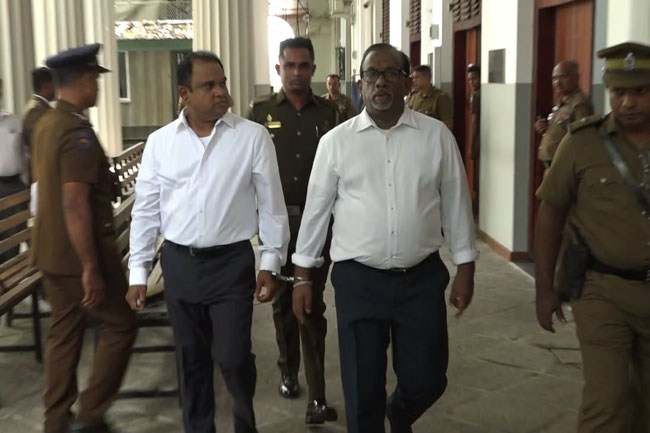
Court verdict on former Minister Mahindananda Aluthgamage and former Chairperson of Sathosa Nalin Fernando
On May 29, former Sports Minister Mahindananda Aluthgamage was sentenced to 20 years of rigorous imprisonment by the Colombo High Court trial-at-bar.[1][2]
The case involved the misappropriation of LKR 53.1 million in public funds through the procurement and distribution of 14,000 carrom boards and 11,000 draughts boards via the state-owned enterprise Sathosa.[3][4][5]The fraudulent activities occurred between September 1 and December 31, 2014, in the lead-up to the 2015 Presidential Election.[6][7]Aluthgamage faced four charges under Section 70 of the Bribery Act.[8][9]He was found guilty on two counts, each carrying a 10-year sentence, totalling 20 years of rigorous imprisonment.[10][11]
Former Sathosa Chairperson and Trade Minister Nalin Fernando was a co-accused in the case and received a 25-year sentence of rigorous imprisonment.[12][13]
The complaint was originally filed by Wasantha Samarasinghe, the current minister of trade, commerce, food security and cooperative development (the then convenor of the Voice Against Corruption movement), with the Commission to Investigate Allegations of Bribery or Corruption (CIABOC).[14][15]The case was subsequently prosecuted by the CIABOC.[16][17]
The rejection of the president’s nominee for the position of auditor general
The Constitutional Council (CC) reportedly rejected President Anura Kumara Dissanayake’s nominee – H. T. P. Chandana – twice for the auditor general post.[18][19][20] On May 22, the CC approved President Anura Kumara Dissanayake’s request to allow the acting Auditor General Dharmapala Gammanpila to remain in the post for six more months.[21][22]

Photo credits: Ada Derana
[paywall layout_id=”1906″ service_tags=”TMA,FP” preview=”true”]
Key insights
- Court verdict on former minister and high official in the carrom board case fostered public approval of the government, reinforcing perceptions of the government as acting against corruption.
- Attempts to appoint a perceived close associate of the president to the position of auditor general generated concerns of nepotism/favouritism and reduced public approval of the government and its credibility on ‘system change’.
Analysis
Overview of the media
Over the past week, two issues gained prominence in the Sinhala media: (i) the rejection of the president’s nominee for the position of auditor general and (ii) the court verdict involving former Ministers Mahindananda Aluthgamage and Nalin Fernando.
Overall, while sentiment about the government improved with the verdict on the carrom board case, there was a noticeable decline in overt support for the government within a larger section of the Sinhala print media, except for state-owned newspapers such as Dinamina and limited privately-owned publications such as Lankadeepa.
As monitored through Junkipedia (a social media monitoring tool and analysis), social media commentary showed mixed reactions: the president’s nomination for auditor general drew largely negative responses, while the court verdict against the two former ministers received predominantly positive ones.[1]
This week’s analysis explores two key drivers behind the shifting momentum of public support for the government: one decreasing support and the other increasing support. Both drivers are rooted in concern over government action on governance and corruption.
What’s driving the decrease in support for the government?
A key source of criticism is the president’s nomination for the position of auditor general. The nominee is reported to be a personal associate of the president and an academic affiliated with the University of Kelaniya, the president’s alma mater. This has prompted accusations of nepotism/favouritism and drawn criticism from opposition figures such as SJB MPs Harshana Rajakaruna and Wijepala Hettiarachchi, and privately-owned media outlets such as Aruna.
Earlier, the appointment of Nandika Sanath Kumanayake – a reportedly longstanding personal friend of President Dissanayake and fellow alumnus of the University of Kelaniya – as presidential secretary also drew similar criticism for perceived favouritism.[2]
This line of criticism echoes what was levelled at former President Gotabaya Rajapaksa. At the time, the Sinhala media coined the term gajamithuruwadaya to describe the pattern of appointing friends and family to key posts. It appears now that a similar taint is affecting President Dissanayake – who is increasingly being perceived as pushing “close associates” into critical positions within the state. These moves are seen not only as compromising the independence of key oversight institutions such as the Auditor General’s Department, but also as falling short of his central election promises of delivering ‘system change’ – with commitments to effective governance, transparency in combatting corruption, merit-based appointments and meaningful progress in economic and institutional reforms.[3]
What’s driving support for the government?
The government continued receiving public backing for its anti-corruption efforts, especially targeting high-profile political figures. In particular, news of the recent court verdict involving former Ministers Mahindananda Aluthgamage and Nalin Fernando has strengthened the perception that the government is taking decisive action on corruption. Such prosecutions are a key driver of public approval, reflecting a widespread demand for the government to address grand corruption and to do so consistently.
A contesting narrative has emerged as the government gains traction with its anti-corruption efforts: a segment of the Opposition interprets its crackdown on corruption as unfairly targeting bureaucrats who are simply fulfilling their duties.
For instance, a lawyer representing former MP Nalin Fernando argued that his client had merely opened letters of credit as chairperson, and no evidence of wrongdoing had been presented. He warned that this case should be a lesson to officials: working efficiently could lead to prosecution. This line of argument echoes sentiments from the yahapaalanaya period, when attempts to enforce accountability and take action against corruption were portrayed as threats to the functioning of the public service.[4]
In conclusion, the two news events analysed pushed public sentiment for the government in opposite directions. While news of taking action against corruption tended to increase public approval, news of the president’s close associates being proposed for key state positions tended to diminish public approval.
[1] The MPA team monitored Facebook profiles, TikTok handles and YouTube channels using Junkipedia for the keywords Mahindananda, electricity, NPP and auditor general in Sinhala from May 26 to 30, 2025.
[2] For more information, read https://mawratanews.lk/politics/controversy-erupts-over-anura-kumara-dissanayakes-initial-appointments/.
[3] For more information, please see https://www.npp.lk/en/policies/npppolicystatement, https://www.reuters.com/world/asia-pacific/sri-lankas-marxist-leaning-dissanayake-promises-change-his-popularity-soars-2024-09-20/, https://www.news.lk/current-affairs/the-npp-government-will-end-the-criminal-underworld-operating-beneath-the-legal-state and https://www.dailymirror.lk/breaking-news/We-need-strong-mandate-to-make-revolutionary-change-Anura-Kumara/108-290103.
[4] See TMA Vol.07, #30; Vol.08, #18.
To view this week’s news summaries, please click here.
To view this week’s social media data, please click here.
[/paywall]