September 1, 2025 – September 7, 2025 | Vol.15, #33 | ISSN 3084-9330

Photo credits: Zira Daily
[paywall layout_id=”1906″ service_tags=”TMA,FP” preview=”true”]
Key insights
- Coverage of the arrests of five high-profile Sri Lankan organised criminals in Indonesia was received not only as a law enforcement success but also as a visible effort to deliver on campaign commitments — even if scepticism about deeper structural change persists.
- Deep public frustration with the nexus between crime, politics, and drugs gave these arrests strong symbolic power.
- The arrests also temporarily improved public perceptions of the police, an institution historically associated with inefficiency and corruption.
- The arrests were portrayed as a break from past practices of complicity and extrajudicial violence, enabling the government to project — whether symbolically or substantively — a more lawful and independent image.
Analysis
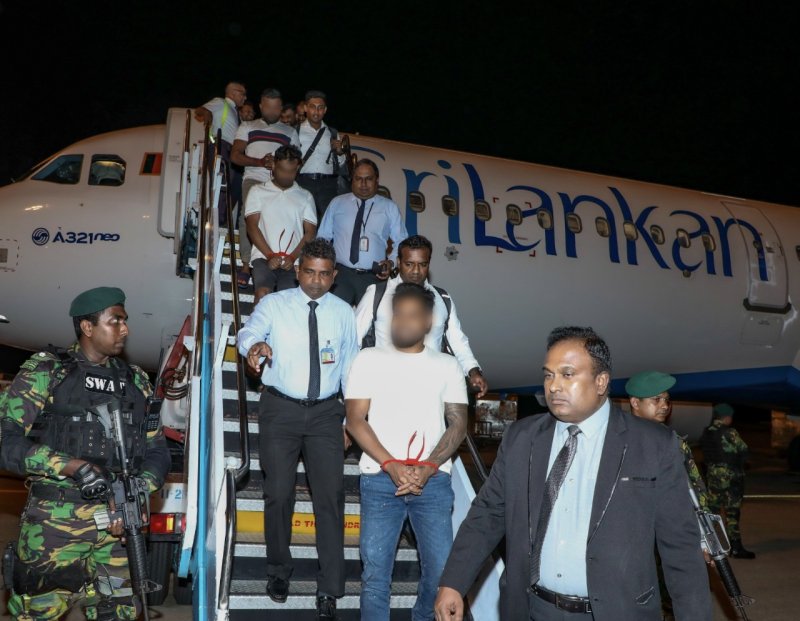
Over the past week, the Sinhala media—across print, television, and social media platforms (analysed through the social media monitoring tool Junkipedia)—allotted extensive, positive coverage to the arrest of five high-profile Sri Lankan organised criminals in Indonesia.[1]
Sinhala media coverage largely framed the arrests as a decisive triumph for law enforcement and the government. A limited counter-narrative—surfacing only in a handful of outlets such as Mawbima and Aruna, as well as on social media—portrayed the government’s actions as media theatrics intended to manufacture political credit.[2] However, this critique remained marginal within Sinhala media spaces.
This week’s analysis is set out under four headings.
1. What was the key event that captured public attention?
August 28: Mandinu Padmasiri Perera (alias Kehelbaddara Padme), Shalintha Madushan Perera (alias Commando Salintha), Nilanga Sampath Silva (alias Panadura Nilanga), Lahiru Madusankha (alias Thambili Lahiru), and N.N. Prasanga (alias Backhoe Saman) were arrested in Indonesia.[3]
August 30: The arrested individuals were extradited to Sri Lanka and were detained under the Prevention of Terrorism Act.[4]
Following their interrogation, the police arrested former SLPP Pradeshiya Sabha member Sampath Manamperi for allegedly possessing raw ingredients to produce crystal methamphetamine (street name ICE).[5]
2. What is the significance of these arrests?
The significance of these arrests lies in their direct response to a key public grievance: the entrenched problem of organised crime in Sri Lanka.
Two central dynamics drive this public concern over organised crime.
- Nexus between criminality and corruption: Organised crime has often thrived under political patronage, raising doubts about the state’s ability to dismantle entrenched networks. Corruption, including bribery, has allowed criminals to evade prosecution, while in return, criminals provide political actors with muscle, intimidation, and financing. This dynamic has fueled public anxieties over justice, and the rule of law.
- Nexus between criminality, political actors, and drugs: Drug trafficking and illicit trade networks are frequently tied to both local gangs and transnational actors, sometimes implicating political figures. This complex web of political and criminal alliances has further complicated state efforts to combat crime.
Owing to these nexuses, some segments of Sri Lankan society have condoned harsh measures, even extrajudicial killings, as a means of eliminating crime and drugs. The Sinhala media has often portrayed organised criminals as an “evil” to be eradicated—a framing that tends to intensify whenever such killings occur, as in the aftermath of the 2012 Welikada Prison massacre.[6]
At present, these arrests resonated strongly with public expectations of the government’s electoral commitment to tackling corruption and the president’s promise to dismantle organised crime.[7] The symbolism of the arrests was further amplified by the perceived political entanglements of the methamphetamine (ICE) trade. Allegations of links between meth networks and the former SLPP member reinforced longstanding public concerns that organised crime, narcotics, and politics are intertwined.
3. How did the arrests impact law enforcement?
The arrests were hailed as a rare success for law enforcement, briefly boosting their public image despite a legacy of inefficiency and corruption.
Law enforcement in Sri Lanka has long been viewed with deep mistrust, a sentiment that has become deeply entrenched over time. Within the social psyche, the police are often linked to corruption, inefficiency, and an enduring inability to curb organised crime. This is a perception rooted in their alleged nexus with criminals.
In contrast, these arrests were hailed as a rare law enforcement success: the high-profile capture of “most wanted criminals” carried out in coordination with international agencies on foreign soil. Sri Lankan Police were portrayed as ‘brave’ and efficient. The positive media reception following the arrests appears to have, at least momentarily, improved the public image of the police, one from corruption to competence.
4. How did the arrests impact the government?
The recent arrests emerge as a potential break from Sri Lanka’s long-standing culture of state complicity with organised crime and the pattern of extrajudicial violence that often follows the capture of underworld figures.
Successive administrations have long faced criticism for corruption and links to criminal networks, with extrajudicial killings drawing particular concern. International human rights organisations have repeatedly highlighted custodial shootings of suspected criminals— commonly justified as suspects “going to show hidden weapons” (āyudha pennanna yanawa/ආයුධ පෙන්නන යනවා) or “trying to escape.” Such incidents are widely perceived as either evidence of government complicity or as pretexts for unlawful killings.
By contrast, these arrests were presented as evidence of the government’s genuine commitment to confronting organised crime. As noted in past MPA issues, media commentary suggested an implicit trust in institutional independence, emphasising that the government appeared to refrain from interfering in police investigations.
[1] The MPA team monitored Facebook profiles, TikTok handles and YouTube channels using Junkipedia for the keywords for Kehelbaddara Padme, underworld, and Ananda Wijepala in Sinhala, from August 29 to September 9, 2025.
[2] MP Dilith Jayaweera established Liberty Publishers (Pvt) Limited, which is the publisher of three national broadsheets – Aruna, The Morning and Thamilan. For more information, please see https://cdn.cse.lk/cmt/upload_report_file/568_1693568870427.pdf; former MP Tiran Alles established Ceylon Newspapers (Pvt) Limited, which is the publisher of Mawbima. For more information, please see: https://sri-lanka.mom-gmr.org/en/media/detail/outlet/mawbima/.
[3] For more information, see: https://www.adaderana.lk/news.php?nid=112111 and https://hirunews.lk/en/417502/police-grills-alleged-organised-criminals.
[4] Ibid.
[5] For more information, see: https://www.newsfirst.lk/2025/09/06/slpp-suspends-membership-of-former-local-councillor-sampath-manamperi-amid-drug-allegations and https://www.adaderana.lk/news.php?nid=112256.
[6] See MPA Vol.14, #14 and https://www.aljazeera.com/news/2012/11/11/sri-lanka-troops-accused-of-prison-massacre.
[7] For more information, see: https://drive.google.com/file/d/1Wm5PQkxGyWtnQEfg2tV-K9owJpXmWbQf/view.
To view this week’s news summaries, please click here.
To view this week’s social media data, please click here.
[/paywall]