July 28, 2025 – August 3, 2025 | Vol.15, #29 | ISSN 3084-9330‘

Photo credits: Newswire
[paywall layout_id=”1906″ service_tags=”TMA,FP” preview=”true”]
Key insights
- Cardinal Ranjith’s remarks on same-sex relationships resonated with certain segments of Sinhala-Buddhist social media commentary, framing the legalisation of such relationships as part of a broader Western agenda antithetical to Sri Lankan cultural values.
- This discourse in social media that has arisen from the cardinal’s statement may be serving to put the government on notice on the type of backlash it could face if it proceeds with proposals to legalise same-sex marriage in Sri Lanka.
Analysis
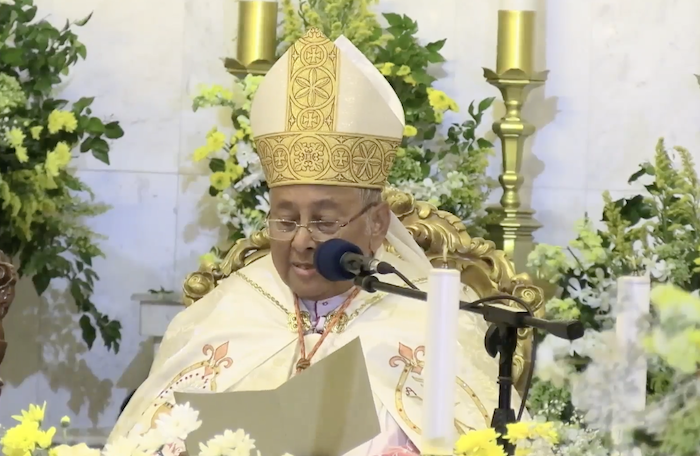
On July 27, Cardinal Malcolm Ranjith delivered a sermon at St. Anne’s Shrine in Beruwala, where he emphasised the need to protect the traditional (heterosexual) family unit.[1] He described same-sex unions as “corrupt ideologies” and claimed that they are “not a human right.”[2]
These remarks gained attention and polarised engagement within the Sinhala-language social media space.[3]
By contrast, Sinhala TV channels and newspapers reported his statements without offering any analysis, critique or alternative viewpoints.
This week’s analysis, which draws exclusively from social media data relating to these remarks, is presented under two headings.
Context: Sri Lanka’s legal framework, inherited from the colonial era, criminalises consensual same-sex acts under Sections 365 and 365A of the Penal Code, though prosecutions are rare.[4]
However, there has been increasing momentum for reform. In May 2023, the Supreme Court ruled that a private member’s bill to decriminalise same-sex sexual activity was not inconsistent with the constitution, allowing it to proceed through parliament.[5]
I. How do the cardinal’s remarks resonate within the Buddhist psyche?
Two dominant framings emerged from social media discussions, particularly among the Buddhist Sinhala-speaking community, suggesting how some segments interpreted the cardinal’s remarks: (1) the depiction of same-sex relationships as a ‘Western cultural value’ and (2) the reassertion of traditional norms over rights-based claims.
Framing 1: Same-sex relationships as a ‘Western cultural value’
This framing presents the acceptance of same-sex relationships as a Western ideological import into Sri Lankan society.
It positions same-sex relationships as a foreign ideological imposition – a Western import that threatens to disrupt the social and cultural fabric of Sri Lankan society.
Underlying this discourse is a notion of cultural superiority: while the West tends to be admired for its economic advancement, it is often perceived as culturally and morally inferior/regressive.
This framing reflects a complex duality of the Sri Lankan psyche – particularly that of the Sinhala Buddhists: on the one hand, the West is seen as a symbol of modernity and progress; on the other, it is viewed with dis-ease – or even disdain – when it comes to cultural and moral values.
Drawing on Sinhala-Buddhist cultural heritage and traditions, the emphasis on moral uprightness positions Sri Lanka as a stronghold of traditional and uncorrupted values.
In this context, the cardinal’s opposition to same-sex unions seems to be viewed as a principled affirmation of cultural and moral values – an effort to preserve purity in the face of what is seen as the moral problems of Western society. Such narratives tend to resonate with the Sinhala-Buddhist worldview, shaped by historical anxieties about cultural erosion from colonial subjugation to contemporary globalisation.
Therefore, the idea of legalising same-sex relationships is often portrayed as part of an external agenda promoted by ‘foreign-funded’ organisations – ‘NGOs’ that are deemed to be meddling in local values and norms.
Framing 2: Reassertion of traditional norms over rights-based claims
The cardinal also advances a biology-based argument in rejecting same-sex marriage. He frames sex and marriage as being for the purpose of procreation, in line with Catholic Church tradition. From this perspective, non-heteronormative relationships are viewed as biologically unnatural and not entitled to rights-based claims.
Such a position resonates with the Buddhist psyche, where ideas of familial continuity and traditional gender roles are firmly embedded in cultural and religious sentiment. The cardinal’s stance resonated with these culturally conservative norms and existing discomfort and resistance toward rights-based claims with regard to same-sex relationships.
Within this discourse, such ‘non-traditional’ structures tend to be depicted as incompatible with the country’s deeply rooted cultural and religious traditions.
II. How does the discourse on same-sex relationships impact the government?
Throughout the past, the JVP/NPP has been portrayed as a secular/atheist party that may undermine Sinhala-Buddhist cultural values or identity.[6]
Throughout the past, the JVP/NPP has often been portrayed as a secular or atheist party that could threaten Buddhist cultural values and identity. This narrative has resurfaced in recent weeks, especially in response to the NPP government’s education reforms. Critics have framed these reforms as ideologically alien, disconnected from the country’s cultural and religious foundations – particularly the Buddhist ethos.[7] In this context, the prime minister, who is associated with more liberal values, has become a focus of criticism from a segment of social media commentary.
Such personal and moralised attacks foreshadow the type of backlash that could arise if the government were to formally advance legislation supporting same-sex marriage in Sri Lanka.
Though marginal, some social media commentary challenged the cardinal’s perspective on same-sex relationships and marriage.[8]
[1] https://www.youtube.com/watch?v=uzfNQdiLM5E and https://ceylontoday.lk/2025/07/28/same-sex-marriage-not-a-human-right-cardinal/.
[2] https://youtu.be/uzfNQdiLM5E?t=54, https://www.facebook.com/watch/?v=762579372877295 and https://ceylontoday.lk/2025/07/28/same-sex-marriage-not-a-human-right-cardinal/.
[3] The MPA team monitored Facebook profiles, TikTok handles and YouTube channels using Junkipedia for the keywords same-sex, gay, Malcolm and cardinal in Sinhala, from July 27 to August 2, 2025.
[4] For more information, please read https://www.humandignitytrust.org/country-profile/sri-lanka/.
[5] For more information, please read https://edition.cnn.com/2023/05/09/asia/sri-lanka-decriminalize-homosexuality-supreme-court-intl-hnk, https://www.apcom.org/skpa-one-step-closer-decriminalize-homosexuality-sri-lanka/, https://economynext.com/bill-to-decriminalise-homosexuality-in-sri-lanka-not-inconsistent-with-constitution-sc-120118/ and https://www.humandignitytrust.org/country-profile/sri-lanka/.
[6] See TMA Vol.09, #38; Vol.07, #22; Vol.13, #02 and 03.
[7] See MPA Vol.15, #27 & 28.
[8] https://www.facebook.com/wara.thiyagaraja/posts/pfbid0141MDoPxb4XvssQ2u6Tq4A7fVGHv6D8cD13QjrPw8KwdHAmJBD5QxWQdMSnBWnhHl, https://www.facebook.com/cjdrox/posts/pfbid02bxsVCiKMjkCHDtQ8BMxa877xN6xX1zCz4rtKEH2QbD9XevPk3XehVxfthbd63VTul and https://www.facebook.com/NewsCenterLka/posts/pfbid02WWi3RDzuwv7QQAb4LqWcxwgnGmuvU2gNoq7wUuC8hAjfPwN8JXANY2o4y3tsNjD2l.
To view this week’s news summaries, please click here.
To view this week’s social media data, please click here.
[/paywall]