January 12, 2026 – January 18, 2026 | Vol.16, #2 | ISSN 3084-9330

Photo credits: lankatruth.com
[paywall layout_id=”1906″ service_tags=”TMA,FP” preview=”true”]
Over the past week, Sinhala media debated on the government’s Rebuilding Sri Lanka programme.
While the topic was featured in print and on television, the most sustained conversation occurred on social media platforms (analysed through specialised monitoring tools).[1]
This week’s analysis is set out under three headings.
What was the key event that captured public attention?
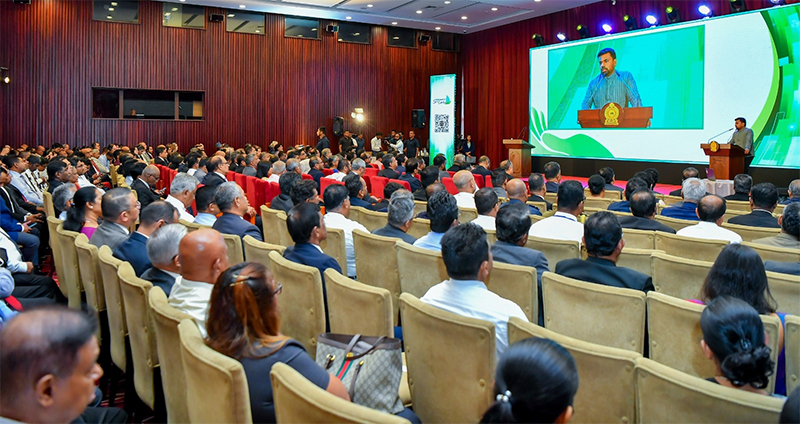
January 13: The Rebuilding Sri Lanka programme was launched in response to the urgent need for a coordinated national recovery mechanism to address post-disaster rehabilitation and reconstruction efforts following the devastation caused by Cyclone Ditwah. The launch was held under the patronage of President Anura Kumara Dissanayaka at the Bandaranaike Memorial International Conference Hall (BMICH).Sinhala mainstream and social media discussions around Rebuilding Sri Lanka offer a useful entry point to understand a familiar frame from decades past that has been gradually re-emerging—especially since Ditwah. In this framing, trust is placed in the sitting president’s intent, while doubt is directed at the circle and state machinery that operates around the president.
In the next section, we examine how this old “good leader, bad circle” frame returns in a new form —and what it implies for President Dissanayake.
How has the “good leader, bad circle” frame returned?
The “good leader, bad circle” frame is reappearing in a new form: criticism is shifting from corruption (Mahinda Rajapaksa/MR-era) to competence (Anura Kumara Dissanayake/AKD-era), with weaknesses in delivery attributed to the president’s surrounding circle and the state machinery expected to implement decisions. However, as in the past, shortcomings attributed to that circle rarely remain contained—over time, they tend to extend to the president as well, reshaping how blame is attributed.
The “good leader, bad circle” frame is a recurring feature of Sri Lankan political sense-making. It allows audiences to separate a leader’s presumed “good intentions” from the conduct—and failures—of the government.
In earlier administrations, this framing often helped preserve a president’s personal legitimacy by shifting responsibility onto advisers, close associates, and the wider governing apparatus. During the tenures of Mahinda and Gotabaya Rajapaksa, for instance, Mahinda Rajapaksa was frequently portrayed as a visionary leader constrained by a problematic surrounding network, while Gotabaya Rajapaksa was framed as a “doer” whose failure was attributed to the system and the team around him rather than to his intent.
Much of that sense-making still gravitates to a familiar storyline: the president is read as credible and well-intentioned, while the surrounding circle and state machinery are treated as the likely point of failure. The leader is personally “good,” but the people around the leader are the problem.
What has changed is not the dynamics of the “good-leader, bad-circle” framing, but the basis on which dissatisfaction is directed at that circle.
- In the MR period, the recurring framing was that MR is good, but those around him are corrupt. The central concern was corruption—deals, capture, and the abuse of power.
- In the AKD period, the emerging framing is that AKD is good, but those around him lack competence. The central concern is competence—whether they can govern, coordinate, and deliver—especially on complex issues such as post-Ditwah recovery and the execution of the Rebuilding Sri Lanka programme.
This is a shift in the basis of criticism: from corruption to competence.
What does this framing imply for President Dissanayake’s legitimacy over time?
The initial separation (“good leader, bad circle”) rarely lasts. Over time, the criticism aimed at the surrounding cast tends to extend to the leader as well.
- With MR, even when he retained positive traction, the corruption associated with those around him increasingly became attached to him, too.
With AKD, competence concerns is likely to follow the same path: if the circle is repeatedly seen as unable to deliver, the president will eventually be held responsible—because he chose them, relies on them, or cannot manage them—so he, too, becomes seen as incompetent. This migration of blame is beginning to manifest in social media commentary. For example, labels such as කයියනායක (kaiyanayaka) and මයික්ටයිසන් (Mike Tyson), terms colloquially used to describe people who talk rather than deliver, are being increasingly applied to the president.
Overall, the content of the political critique has shifted, compared to the past decades, from corruption to competence. But the deeper dynamics of the narrative remain the same: performance is first evaluated by the frame that contrasts the president from the “circle”; but over time, the evaluation begins to conflate rather than contrast the two, gradually placing more and more on the president.
[1] The MPA team monitored Facebook profiles, TikTok handles and YouTube channels using Junkipedia for the keywords Rebuilding Sri Lanka, Ditwah, disaster, and drain in Sinhala from January 12 to 19, 2026.
To view this week’s news summaries, please click here.
To view this week’s social media data, please click here.
[/paywall]