Government short of salt and flavour

May 19, 2025 – May 25, 2025 | Vol.15, #19 | ISSN 3084-9330

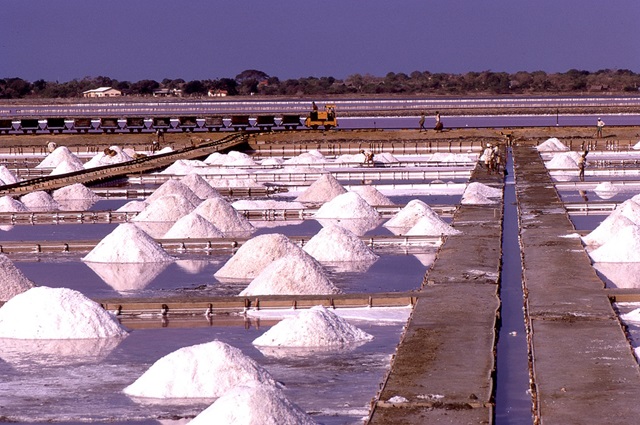
Event: Sri Lanka is reportedly facing a shortage of salt caused by import delays and disruptions to local production.[1][2]

According to Open Market Weekly Average Prices (Colombo District), the price of salt per kilogram increased by approximately 210 percent, rising from Rs. 100 in the third week of May 2024 to Rs. 310 in the third week of May 2025.[3]

Photo credits: Sri Lanka Guardian

[paywall layout_id=”1906″ service_tags=”TMA,FP” preview=”true”]

Over the past week, salt shortages and the spike in salt prices in Sri Lanka received significant attention in the Sinhala media – across print, TV and social media (as observed through the social media monitoring tool Junkipedia).[1] The shortage and price hike have also sparked public criticism of the government.

To better understand this reaction, this week’s MPA explores: (i) the significance of salt in Sri Lankan households and (ii) the shortage’s impact on the government.

Why does salt carry such symbolic weight in the Sri Lankan media?

In Sri Lankan households, salt is more than just a cooking ingredient – it is a culturally symbolic ingredient. Its cultural and symbolic resonance in Sri Lanka might be similar to (though not to the same extent) olive oil in Lebanon or coffee in Italy – each an emotionally resonant ingredient in their respective societies.

The absence of salt in a Sri Lankan household symbolises extreme hardship. The absence of salt in a household signals that the family has slipped below the essential threshold of self-sufficiency, marking it as destined for misfortune (trans: මූසල/moosala). This symbolism is embedded in everyday language. Common Sinhala and Tamil expressions reflect salt’s deeper meaning: phrases such as ලුණුවත් නෑ (lunuwath ne – trans: there is not even salt) or ලුණුයි බතුයි කාල ඉන්න පුළුවන් (lunuyi bathuyi kaala inna puluwan it means that even when all other food items become unaffordable, one can survive on salt and rice) or the Tamil phrase உப்பில்லாப் பண்டம் குப்பையிலே (trans: food without salt should end up in the garbage) underscore the role of salt as a minimum marker of subsistence.

Therefore, the unavailability of salt is not merely an economic inconvenience but also a sign that the government is unable to provide even the most fundamental needs of the public.

How does the salt shortage expose cracks in the NPP’s governance performance?

In Sinhala media discourse, the NPP government is increasingly being portrayed as one marked by contradictions (see MPA Vol.15, #16; Vol.15, #17 & 18) between actions on the ground post-elections and expectations set prior. It is deemed to be the same with regard to handling the supply problem of salt as well. 

Public expectation: is for the government to govern effectively, deliver results and address economic and governance challenges without failing or engaging in corruption. This is the promise made during the NPP’s presidential and parliamentary election campaigns as well.

The reality mismatch: is around perceptions and concerns regarding ineffective governance, mismanagement and possible collusion with private interests.   

The salt shortage and its price hike bring the above concerns to the forefront. Critics make the key allegation that the government has granted a single private distributor permission to import and sell salt, creating a de facto monopoly/mafia. Central to this claim is a conflict of interest: the chair of the private company is also the director of the state-run Puttalam Salt Corporation. This dual role is seen as enabling one individual to monopolise distribution and pricing – processing the salt and selling it at an inflated price.

These allegations of complicity in corruption are seemingly gaining traction in media discourse. As a result, the NPP-led administration tends to be increasingly portrayed as being mired in contradictions and inefficiency. This portrayal undermines both its credibility and its claim to principled governance. Consequently, there is a clear mismatch between public expectations of the government and its performance as perceived at present.

In conclusion, the salt shortage is framed in the media and public discourse not as a mere supply issue but as a litmus test of the NPP government’s capacity and credibility. It highlights the gap between public expectations and government performance, turning the unavailability of a basic necessity into a symbol of broader governance issues.


[1] The MPA team monitored Facebook profiles, TikTok handles and YouTube channels using Junkipedia for multiple keywords in Sinhala for salt and shortage, from May 19 to 23, 2025.


To view this week’s news summaries, please click here.

To view this week’s social media data, please click here.

[/paywall]