January 5, 2026 – January 11, 2026 | Vol.16, #1 | ISSN 3084-9330

Photo credits: VOX News
[paywall layout_id=”1906″ service_tags=”TMA,FP” preview=”true”]
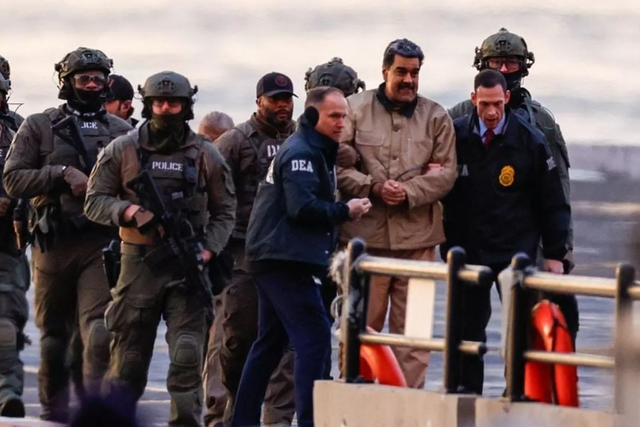
Over the past week, Sinhala media discourse focused on the US operation in Venezuela and the capture of President Nicolás Maduro and First Lady Cilia Flores.
This coverage spanned print, television, and social media commentary, with online narratives tracked and analysed using the monitoring tool Junkipedia.[1]
This week’s analysis is set out under two headings.
What was the key event that captured public attention?
January 3: The US carried out what it described as a “large-scale” strike in Venezuela and captured President Nicolás Maduro and First Lady Cilia Flores.
The Sinhala mainstream and social media discourse surrounding the Maduro Operation was predominantly critical of the US; while sections were also admiring of the US president, Donald Trump
What public sentiments does the Maduro Operation evoke toward the US and international institutions?
Overall, Sinhala-language commentary on the Maduro Operation was characterised by cynical distrust towards international organisations and dismissal towards the US as acting in arrogant over-reach. A smaller current on social media, however, expressed admiration for Trump’s “strongman” decisiveness.
The Sinhala media discourse revealed three sentiments: two negative sentiments that were prominent across mainstream coverage, and a third positive sentiment that was more visible on social media.
Negative sentiments:
Cynical distrust of international organisations: A prominent strand of commentary read the response of international institutions—particularly the UN system, including the Security Council and the Human Rights Council—as politically constrained and ultimately ineffectual. As highlighted in past MPA issues on Sri Lanka’s engagement with the UNHRC, this reinforced the view that these bodies align with powerful states rather than act as neutral guarantors of rules and protection, and that global rules are applied unevenly, with powerful states evading even being seriously questioned on actions that would result in severe sanctions on weaker states.
Dismissal toward the US: Sinhala commentary frequently portrayed the US as arrogant and over-reaching —not as a responsible provider of global security but as a “show-off” making a spectacle of its power. The operation was repeatedly framed as “war as performance,” a framing that often prompted mockery and scepticism rather than strengthening perceptions of US credibility or authority. This sentiment was further reinforced by broader perceptions of US currently lacking respect in its diplomatic relationships, including references to past public remarks by US officials about the English proficiency of African leaders during official visits.
Positive sentiment:
Admiration for Trump’s strongman decisiveness: Social media commentary expressed admiration of Trump’s decisiveness and “strict” leadership style, reading the operation as proof that “hard power” works. This is an outlook that is impatient with institutional constraints and diplomacy, which are seen as ineffectual, and favours strong actions as the means of delivering outcomes.
In that sense, the admiration functions as a projection of a deeper local political desire: a recurring sentiment among segments of the Sri Lankan population for a leader who can “cut through” procedure, override objections, and deliver swift, tangible results in their favour.
[1] The MPA team monitored Facebook profiles, TikTok handles and YouTube channels using Junkipedia for the keywords Venezuela, invasion, Maduro, America, Trump and oil in Sinhala from January 5 to 9, 2026.
To view this week’s news summaries, please click here.
To view this week’s social media data, please click here.
[/paywall]