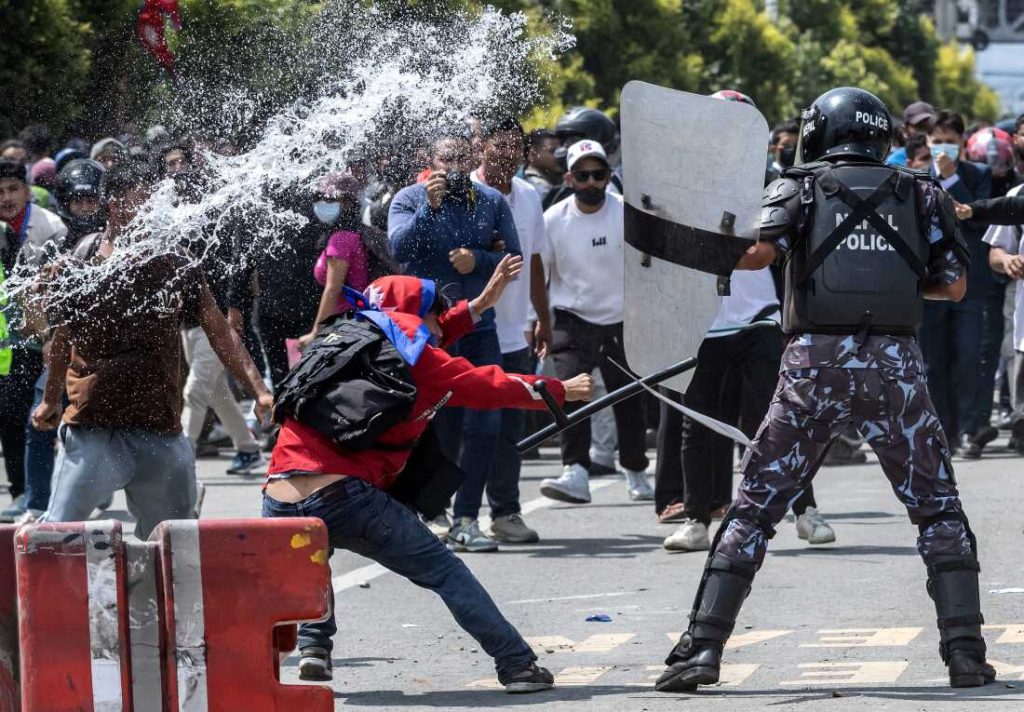
Nepali protests through the Sri Lankan lens

September 15, 2025 – September 21, 2025 | Vol.15, #35 | ISSN 3084-9330

Photo credits: Prabin Ranabhat/ AFP via NPR

[paywall layout_id=”1906″ service_tags=”TMA,FP” preview=”true”]

During the past two weeks, Sinhala media, including press, TV news and social media (as tracked by Junkipedia),[1] featured discourse on the recent unrest in Nepal.

This week’s analysis is set out under three headings.


1. What incidents captured the Sinhala media’s attention?

September 4: Nepal’s government imposed a ban on Facebook and other major social media platforms that failed to register with the Ministry of Communication and Information Technology within the given deadline.[2]

September 8: Following the social media ban, protests erupted, with many young people storming the parliament in the capital, Kathmandu.[3]

September 9: The Nepalese Federal Parliament Building was set on fire.[4] Following the protests, the Nepali Prime Minister KP Sharma Oli resigned.[5]

At least 70 people were killed during the period of unrest.[6]

In Sinhala media coverage and commentary on events in Nepal, there was a strong resonance with Sri Lanka’s own experience of the aragalaya (mass uprisings that took place in 2022), reflecting shared anxieties about legitimacy, leadership and stability during mass uprisings.

2. Who is portrayed as the ‘hero’ in Sri Lanka through Sinhala social media on Nepal’s unrest, and why?

In Sinhala social media discussions of Nepal’s unrest, Ranil Wickremesinghe emerged as a ‘heroic’ figure—particularly in the narratives among segments of the Sinhala middle class.

The above framing drew on his role as president in the aftermath of the aragalaya and his perceived success in restoring stability.

In the Sinhala media, factions of the aragalaya at Galle Face Green (Gota-Go-Gama) are portrayed as peaceful, disciplined, and decentralised mobilisation united around the shared vision of ousting former president Gotabaya Rajapaksa. The middle class were early supporters of this mobilisation, seeing it as a vehicle to channel their frustrations with economic hardship, corruption and political dysfunction.

As the protests wore on, however, outbreaks of violence—associated with the JVP—began to alter this perception. Fearing disorder and instability of the political order and the country’s economic recovery, parts of the middle class shifted from supporting dissent to seeking continuity and stability.  This shift—from fostering dissent to fearing disorder—created the space for Wickremesinghe’s reframing of the aragalaya as hijacked by “dangerous elements” that threatened economic recovery and stability. This framing helped transform him, in the eyes of many, into a leader who has shielded Sri Lankans from descending into turmoil.  

Against this backdrop, Nepal’s unrest became a point of contrast.  In social media commentary, Nepal’s unrest was frequently invoked to retrospectively validate Wickremesinghe’s leadership in the aftermath of the aragalaya. In this context, he was imagined as a figure who delivered on continuity and stability.


3. How is the protest in Nepal being compared with Sri Lanka’s aragalaya?

Sinhala media highlighted three key parallels between Sri Lanka’s aragalaya and the protests in Nepal, revealing public anxieties about government legitimacy and conduct.


i. Contesting legitimacy

The first parallel lies in the contestation of legitimacy.

Governments that emerge from upheavals—such as those in Nepal—tend to be depicted as lacking the competence to govern effectively.

In Sri Lanka, similar anxieties have surfaced in critiques of the  NPP government. Critical voices portray it as immature or inexperienced, unprepared for the demands of governance. These criticisms echo—rather than directly replicate—the anxieties that are projected onto Nepal.

The parallel, however, does not rest on a direct comparison of the two contexts. Instead, it is constructed within Sri Lanka, where debates about legitimacy are extended outward: critics suggest that, just as Nepal is portrayed as unstable, a government in Sri Lanka emerging from upheaval—such as the NPP—might similarly lack the maturity or capacity to govern. In this way, the anxieties voiced about Nepal serve less as commentary on Nepal itself, and more a reflection of how Sri Lanka’s own contestations of legitimacy and competence.

ii. Externalising blame

The second parallel concerns the externalisation of blame for protest movements.

Specific segments of the public and media have viewed the aragalaya through a lens of suspicion, believing it to have been influenced and orchestrated by foreign powers.[7]

Adopting this lens, media voices attributed the protests in Nepal to similar external actors.

 iii. A cyclical relationship with dissent

Political leadership in Sri Lanka tends to reveal a cyclical pattern in its relationship with dissent.

While in opposition, leaders tend to valourise criticism and cast dissent as vital to democratic accountability. Yet, once in power, the very same dissent tend to be frequently reinterpreted as destabilising or even subversive.

Commentary on the NPP government suggests that it, too, risks being drawn into this familiar cycle. Critics point out that, although the NPP once condemned the Prevention of Terrorism Act (PTA) as repressive, it is now perceived as resorting to that very law to police dissent. This framing positions the NPP not as breaking with precedent, but as reproducing the same ambivalence toward dissent that has long characterised Sri Lankan political practice.


[1] The MPA team monitored Facebook profiles, TikTok handles and YouTube channels using Junkipedia for the keywords for Nepal, protests, rap, in Nepal in Sinhala, from September 8 to 21, 2025.

[2] https://kathmandupost.com/national/2025/09/04/nepal-bans-facebook-and-other-major-social-media-platforms-over-non-compliance and https://www.nytimes.com/2025/09/07/world/asia/nepal-bans-social-media-platforms.html

[3] https://www.aljazeera.com/news/2025/9/8/six-killed-in-nepal-amid-gen-z-protests-after-social-media-ban-all-to-know and  https://www.bbc.com/news/articles/cp98n1eg443o

[4] https://www.youtube.com/watch?v=XzxJOyyR7Nk and https://www.youtube.com/watch?v=H2kat-prRZo

[5] https://edition.cnn.com/2025/09/10/asia/nepal-protests-gen-z-outcome-intl-hnk and https://www.bbc.com/news/articles/c0m4vjwrdwgo

[6] https://www.bbc.com/news/articles/cm2zkmxlkm9o and https://www.reuters.com/world/asia-pacific/death-toll-nepals-anti-corruption-protests-raised-72-2025-09-14/

[7] See TMA, Vol. 14, #42

To view this week’s news summaries, please click here.

To view this week’s social media data, please click here.

[/paywall]