NPP winning elections yet losing political mileage

June 16, 2025 – June 22, 2025 | Vol.15, #23 | ISSN 3084-9330

Events: June 13: The NPP secured the chairpersonship of the Medawachchiya Pradeshiya Sabha after reportedly forming a coalition with the SLPP.[1][2]

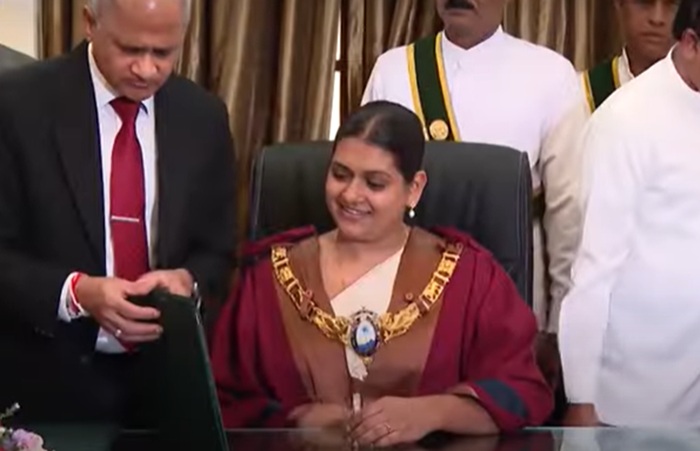
June 16: NPP’s Vraîe Cally Balthazaar was elected as Colombo’s mayor during the Colombo Municipal Council (CMC) inaugural session, with 61 votes as against 54 secured by the opposition candidate Riza Zarook.[3][4]

June 17: The President of the Ceylon Workers’ Congress (CWC) Senthil Thondaman claimed that the NPP has supported the CWC in securing the pradeshiya sabhas in Kotagala and Agarapathana and that the CWC will support the NPP in forming administrations in other hung councils in the Nuwara Eliya District.[5][6]

June 20: ITAK MP Shanakiyan Rasamanickam alleged that the NPP assisted the Tamil Makkal Viduthalai Pulikal (TMVP), led by the notorious former MP Sivanesathurai Chandrakanthan (alias Pillayan), in gaining control of the Vakarai Pradeshiya Sabha.[7][8The NPP also secured the chairpersonship of the Galle Municipal Council after reportedly gaining the votes of the SLPP members.[9][10]

Photo credits: Newswire

[paywall layout_id=”1906″ service_tags=”TMA,FP” preview=”true”]

The moral high ground that underpinned the NPP’s political appeal following the 2024 national elections has seen sustained erosion through media reports of statements and actions of the party pre- and post-local government elections.

Mainstream media cynical about the government but social media more positive: Over the past week, the elections held to choose the office-bearers, including the mayor of the Colombo Municipal Council (CMC), gained prominence in the Sinhala press, TV coverage and social media commentary.[1] Social media commentary on these election outcomes was largely positive on the government, but continuing the past patterns mainstream media coverage expressed increasing cynicism.

NPP increasing hard-power at the cost of soft-power: The media reported the NPP as compromising its explicitly stated principled positions and engaging in questionable behaviour and alliances to secure the chairpersonship in several local councils, including the CMC. While the victories increase the NPP’s administrative hard-power, they appear to have also eroded its image as a party fostering principled politics. This is particularly relevant as the NPP’s public appeal has been anchored in its moral posture – positioning itself as a principled alternative to the traditional political establishment.

This week’s MPA issue on the Sinhala media discourse on the CMC election is yet another window into the growing cynicism towards the NPP.[2]

Why did the CMC election attract so much attention?

The CMC is considered Sri Lanka’s oldest and largest local government body.[3] In this context, it is widely perceived as politically significant and symbolic.

Historically, the CMC has been a traditional stronghold of the UNP for most of its existence. Since gaining independence in 1948, the CMC, except on two occasions, has been under the direct control of the UNP.[4] 

The change in guard from the UNP to the NPP was perceived as a ‘tremendous political victory’.  Some voices in the Sinhala press asserted that the NPP was even able to win the CMC, a UNP stronghold that even the Rajapaksas at the height of their popularity – following the end of the armed conflict in 2009 – could not gain control of.

What drives cynicism towards the NPP in mainstream media?

Despite the NPP securing the CMC, its conduct surrounding the CMC election is increasingly perceived as a compromise on its own moral principles and as contradictory to the expectations it set prior to the election. This growing cynicism, as reflected in Sinhala mainstream media, emerges along three key lines.

Gaps in ethics and transparency: First, some voices in the Sinhala print and TV coverage raised issue with the NPP’s ethical conduct and transparency. These critics asserted that the government was contradicting the expectations it had set before securing power.

No deal for ‘deal politics’: During the election, the NPP promised to transform the country’s political culture and to engage in ‘clean politics’ and to not form alliances with what it calls “rejected” political parties and independent groups.

However, the NPP’s behaviour during the CMC election was widely perceived as the party engaging in ‘deal politics’, particularly with individuals and political groups that the NPP itself had previously dismissed as corrupt and proxies of defeated traditional political parties (refer to the memes published in this issue of MPA).

The MPA issue soon after the 2025 Local Government Elections was the first to signal the growing public anxiety in relation to the NPP’s actions to align with such individuals and groups to secure control in local government bodies.[5]

Problems of procedure in council elections: The NPP was called into question for consistently demanding a secret ballot procedure (as opposed to an open ballot), positioning the party as possibly seeking to secure votes from the opposition and independent groups under the cover of anonymity.

The NPP was also questioned based on the perception that the Local Government Commissioner for the Western Province Sagarika Jayasundara was acting in the interests of the government (refer to the memes published in this issue of MPA).

Overall, the negative media commentary surrounding the NPP’s conduct around the CMC election is fostered by the growing perception that the party has compromised on the very moral principles that once set it apart. As highlighted in this and last week’s MPA issues, the NPP is increasingly viewed as ‘non-exceptional’ – behaving in ways that echo the traditional political actors it pledged to replace.

What drives positive traction for the NPP on social media?

Outside of the cynicism about the government’s conduct in the mainstream media, the NPP garnered mostly positive traction on social media, underpinned by two key drivers.

First, some social media commentary prioritised delivery and development over concerns regarding the election procedure. For this segment of Sinhala society, the NPP was viewed as the party capable of addressing the problems afflicting Colombo, including poverty, corruption and crime – particularly drug trafficking.

Second, some social media commentary appeared to express a sense of disillusionment with the opposition, including the SJB and the SLPP. For these voices, the opposition was not perceived as a viable alternative to the NPP government. The low confidence in the opposition appears to have deterred criticisms of the government, particularly in the absence of a strong alternative for the public to rally behind.


[1] The MPA team monitored Facebook profiles, TikTok handles and YouTube channels using Junkipedia for the keywords Vraîe, Sagarika, Colombo, commissioner, secret ballot and municipal council in Sinhala, from June 16 to 21, 2025.

[2] See MPA Vol.15, #21 & 22; Vol.15, #20; Vol.15, #17 & 18.

[3] For more information, see: https://www.colombo.mc.gov.lk/city-council.php

[4] In 1954, the Lanka Sama Samaja Party under N. M. Perera defeated the UNP to secure the CMC. Meanwhile, in 2006, when the UNP’s nomination list was rejected it backed independent member Uvais Imitiyas to secure control in the CMC. For more information, see: https://www.dailynews.lk/2025/06/19/featured/798976/npp-ends-unps-long-reign-at-cmc/ and https://island.lk/first-leftist-mayor-after-nm-sjb-unp-beaten-at-their-own-game/

[5] See MPA Vol.15, #17 & 18.

To view this week’s news summaries, please click here.

To view this week’s social media data, please click here.

[/paywall]