September 22, 2025 – September 28, 2025 | Vol.15, #36 | ISSN 3084-9330

Photo credits: Sri Lanka Mirror
[paywall layout_id=”1906″ service_tags=”TMA,FP” preview=”true”]
Analysis
Over the past week, the Sinhala media reflected on President Anura Kumara Dissanayake’s first year in office.
This coverage spanned print, television, and social media commentary.[1] Using the monitoring tool Junkipedia, conversations and narratives on social media platforms were tracked and assessed separately.
This week’s analysis is set out under four headings.
1. What was the key event that captured public attention?
September 21: The day marked one year since the election of Sri Lanka’s Ninth Executive President, Anura Kumara Dissanayake, at the 2024 Presidential Election.[2]
The Sinhala media largely celebrated the government’s performance in its first year in office. Yet, a parallel strand of dissent—led by opposition politicians, affiliated voices, and a handful of privately-owned newspapers—questioned this narrative of progress during the inaugural year.
2. How did media discourse on the government’s performance reflect on the government?
The NPP’s first year in office was cast as a moral reset, anchored in anti-corruption and institutional integrity.
In much of the Sinhala media, the NPP’s first year in office was portrayed as a moral reset, with emphasis placed on its anti-corruption drive and the promise of greater institutional integrity. The coverage often suggested that the government had disrupted Sri Lanka’s entrenched political culture, positioning the administration as a departure from the privilege and corruption associated with the ‘old guard.’
Such celebratory framings appeared to resonate with sections of the public and the NPP’s core constituency, who had invested their hopes in a broader ‘system change.’ In particular, reforming the country’s entrenched political culture was a key electoral pledge of the NPP in the run-up to the 2024 Presidential and General Elections.[3]
3. How was the government’s performance criticised?
A parallel narrative of criticism framed the government’s first year around gaps in competence and integrity, as well as continuity with the policies of its predecessor. Opposition politicians and some privately-owned newspapers, including Aruna and Mawbima, were especially vocal in advancing these views.[4]
The opponents. Political opponents cast the NPP government as struggling with both integrity and competence, citing incidents that they argue expose deeper flaws. The curtailing of presidential privileges, for instance, was framed as a political vendetta rather than reform. Questions of integrity were also raised through public disclosures of personal wealth, including those of Minister Wasantha Samarasinghe, which appeared to contradict the NPP’s long-cultivated image of collective sacrifice and moral distinction. These were not the only incidents, but they were taken as illustrative of inconsistencies that undermined the party’s claim to moral superiority. Alongside these criticisms, the government was frequently framed as inexperienced or immature, unable to govern effectively. Taken together, such criticisms resonated with those who viewed the government’s integrity as compromised and its competence as unproven during its first year in office.
The sceptics: Sceptics cast the government as continuing the economic direction set under Ranil Wickremesinghe, with the IMF-led stabilisation programme held up as the clearest example of policy continuity. The absence of any notable differences in economic strategy appears to have become a focal point of critique. This line of criticism resonated with those who had expected a decisive departure, as well as with groups that perceive IMF programmes as harmful to the poor or actively frame them as exacerbating hardship for vulnerable sections of society.
4. How was the president portrayed?
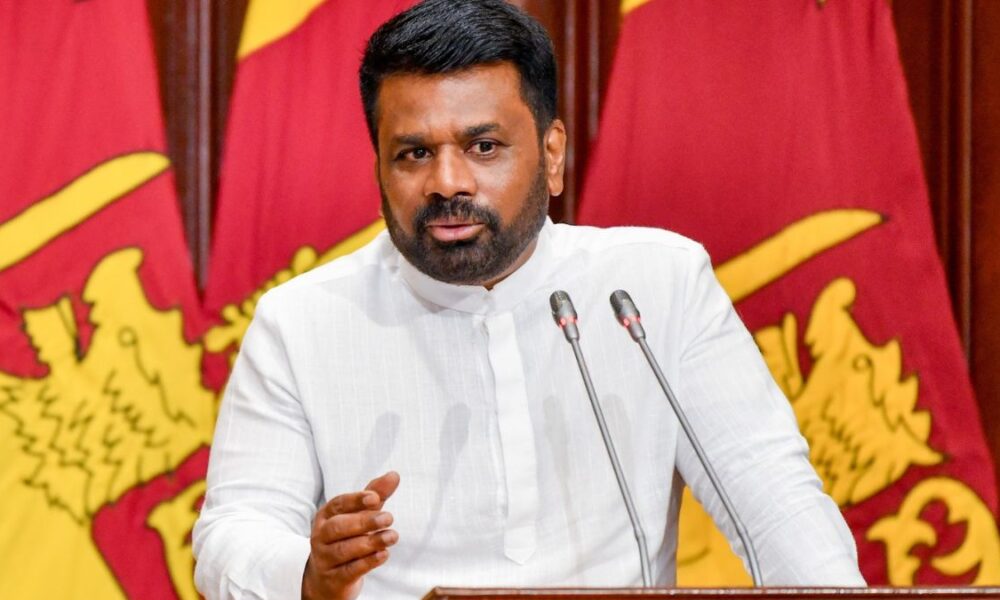
President Dissanayake was portrayed in a highly positive light, with his personal reputation serving as a key source of legitimacy for the NPP government.
The Sinhala media—particularly social media commentary—expressed strong approval of President Dissanayake, highlighting his leadership style and perceived ‘humble’ and ‘non-élite’ background. As unpacked in past MPA issues, Dissanayake’s personal credibility has become a key asset, enabling the government to navigate discontent, reframe its position through his perceived integrity and rebuild public trust.[5]
Thus, Dissanayake’s personal credibility strengthens the government’s standing, with the Sinhala media discourse on its first anniversary reflecting a broader pattern where his personality serves as a reputational anchor for the administration.
[1]The MPA team monitored Facebook profiles, TikTok handles and YouTube channels using Junkipedia for the keywords one year, Anura Kumara, bread and Handunnetti in Sinhala, from September 22 to 26, 2025.
[2] For more information, see: https://www.themorning.lk/articles/ZBm7eF30xGH9Bo57CA2D and https://www.dailynews.lk/2025/09/25/featured/863506/akds-first-year-politics-of-transformation/.
[3] For more information, see: https://drive.google.com/file/d/1Wm5PQkxGyWtnQEfg2tV-K9owJpXmWbQf/view and https://www.newswire.lk/2024/09/18/akd-promises-new-political-culture-where-leaders-stand-equal-with-citizens/.
[4] MP Dilith Jayaweera established Liberty Publishers (Pvt) Limited, which is the publisher of three national newspapers – Aruna, The Morning and Thamilan. For more information, see: https://cdn.cse.lk/cmt/upload_report_file/568_1693568870427.pdf; and former MP Tiran Alles and his son Ramantha Alles collectively own Ceylon Newspapers (Pvt) Limited, which is the publisher of two national newspapers – Mawbima and Ceylon Today. For more information, see: https://sri-lanka.mom-gmr.org/en/owners/individual-owners/detail/owner/owner/show/alles-family/
[5] See MPA Vol.15, #27 & 28.
To view this week’s news summaries, please click here.
To view this week’s social media data, please click here.
[/paywall]