August 4, 2025 – August 10, 2025 | Vol.15, #30 | ISSN 3084-9330

Photo credits: Newswire
[paywall layout_id=”1906″ service_tags=”TMA,FP” preview=”true”]
Analysis
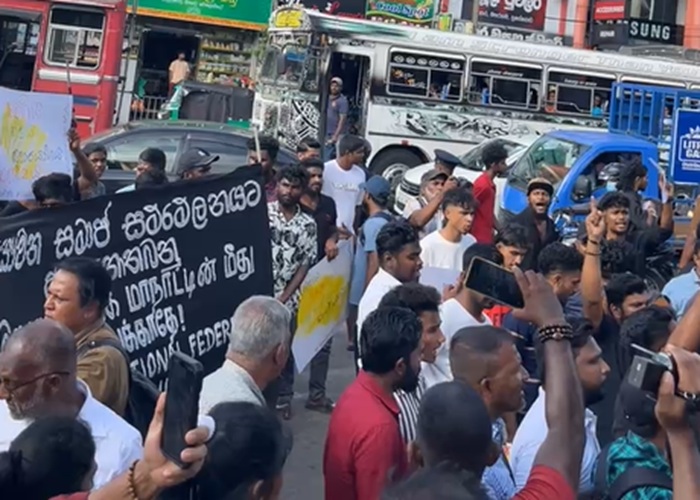
Over the past week, the Sinhala media – including print, television and social media – has featured discussions on the government’s reported intervention in youth clubs in Sri Lanka.
This week’s analysis on this issue is set out under three headings.
1. What incidents gained media attention?
May 23: The National Youth Services Council (NYSC) launched the ‘Connect 2025 Youth Clubs’ initiative, rolling out youth clubs across 14,033 grama niladhari divisions – aiming for comprehensive islandwide youth engagement.[1]
The announcement on the above was made on May 22, 2025 at a press conference at the Department of Government Information, attended by Deputy Minister of Youth Affairs Eranga Gunasekara, NYSC Chairperson and Director General Supun Wijeratne and Council Director Jana Selvaraj.[2]
Allegations have surfaced that the government, particularly the Janatha Vimukthi Peramuna (JVP), is systematically interfering in the electoral processes of youth clubs under the NYSC.[3]
A brief overview of the NYSC
The origin and formation
The National Youth Services Council (NYSC) was established based on the 1967 Levy Committee recommendations, led by Israeli youth service expert Brig. Ariyeh Levy, to tackle high school dropout rates and engage youth in national development.[4] Acting on these recommendations, J. R. Jayewardene, then minister of state, introduced the Voluntary National Youth Services Act No. 11 of 1967,[5] which created the NYSC and established its council structure. [6]
Key milestones
- 1968 – 1969: Inception and first programmes
The NYSC convened its first meeting on October 11, 1968 and was formally gazetted on January 23, 1969. In April that year it launched its inaugural National Service Programme in Algama, Dedigama, sending trained youth to support district-level national development projects. Early initiatives focused on literacy campaigns, agricultural activities and infrastructure development.[7] - 1970s: Collective farming and political shift
Under the post-1970 government’s emphasis on food production, the NYSC pioneered collective farming schemes inspired by the Soviet and Chinese models. However, allegations of the ‘politicisation’ of the youth movement – particularly under the banner of ‘Jana Vegaya’ – triggered c criticism and reduced public support by the mid-1970s.[8] - 1979 – 1980: Transformation into a statutory authority
The National Youth Services Act No. 69 of 1979 repealed the earlier act and elevated the NYSC to statutory authority status, effective January 1, 1980. This reform decentralised operations via district and provincial offices, and broadened activities to include cultural, sports, vocational and leadership programmes.[9] - 1983:The first-ever National Youth Conference was held on May 23, 1983, a historic event that inspired the annual observance of National Youth Day in Sri Lanka.[10]
- 1980s – Present: Expansion and enduring influence
Over subsequent decades, the NYSC diversified its portfolio to include entrepreneurship training, international exchange programmes and youth leadership development. It continues to serve as Sri Lanka’s largest structured youth mobilisation platform.[11]
2. What is different this time about how the youth club leadership is selected?
Historically, the leadership in youth clubs has been appointed by the NYSC under the guidance of the governing parties – a distinctly top-down process. Current allegations suggest a reversal of this dynamic, with political influence now appearing to originate at the grassroots, rising through village-level youth councils. This emerging bottom-up pattern may risk embedding partisan loyalties more firmly within local youth structures, shifting their orientation from state-administered frameworks to networks aligned with political parties.
3. How does public discourse surrounding youth clubs influence perceptions of the government and the opposition?
First, media discourse suggests concerns about political overreach, particularly the control over youth clubs. The opposition, including MP Sajith Premadasa, MP Namal Rajapaksa and former MP Wimal Weerwansa, allege that the current government is attempting to turn these youth clubs into political tools.
This alleged move raises a concern/risk often associated with the JVP: the systematic capture of power at all tiers, following a Leninist-style approach, geared towards consolidating control in the direction of a one-party state. Such restructuring not only “manufactures” grassroots support but also risks undermining the independence of youth-led institutions and extending political-party dominance deep into community structures.
Second, the criticism of the government by the opposition seems to boomerang on certain factions of the opposition, especially on MP Namal Rajapaksa. Social media comments show that when certain factions of the opposition were in government their youth organisations were allegedly used for partisan purposes. For instance, the Nil Balakaya (Blue Brigade) – founded by MP Namal Rajapaksa in 2010 – served as a unifying youth organisation for the alliance, incorporating the Sri Lanka Freedom Party’s youth front. The group became controversial after being accused of involvement in civil disturbances, intimidation and abuse of power, leading to its dissolution by the Sirisena government in February 2015.[12]
The past record of opposition factions critical of the government has undermined their current criticism, as government-aligned voices – among others – frame it as hypocritical.
In sum, public discourse portrays the government as politicising youth clubs, but the charge boomerangs on the opposition, given its past record, with negative implications for the credibility of both sides of the public divide.
[1] https://sundaytimes.lk/online/news-online/Youth-clubs-are-to-be-formed-islandwide/2-1149293 and https://www.dailymirror.lk/print/front-page/Connect-2025-Youth-Club-Programme-launched-today/238-309603.
[2] Ibid.
[3] https://www.themorning.lk/articles/5DysN67bXvGQR59cPtBg; https://www.dailymirror.lk/breaking-news/Youth-clubs-used-for-political-agendas-during-their-time-Minister-responds-to-Ranil/108-316388 and https://www.themorning.lk/articles/CwSTlqaAws3I4E92LnEU.
[4] For more information, please read https://www.sundaytimes.lk/190113/news/tracing-nyscs-fifty-year-ambitious-journey-in-empowering-lankas-youth-329960.html?utm_source=chatgpt.com.
[5] For more information, please see https://www.srilankalaw.lk/n/807-national-youth-services-act.html.
[6] Ibid.
[7] https://www.sundaytimes.lk/190113/news/tracing-nyscs-fifty-year-ambitious-journey-in-empowering-lankas-youth-329960.html and https://www.parliament.lk/uploads/documents/paperspresented/1636533405062275.pdf.
[8] https://www.sundaytimes.lk/190113/news/tracing-nyscs-fifty-year-ambitious-journey-in-empowering-lankas-youth-329960.html.
[9] https://www.parliament.lk/uploads/documents/paperspresented/1738816554086699.pdf and https://www.nysc.lk/page/view/nysco.
[10] For more information, please see https://ziradaily.com/news/100642.
[11] https://www.nysc.lk/page/view/international-youth-relations-division and https://themorningtelegraph.com/31169/?utm_source=chatgpt.com.
[12] For more information, please see https://archives.sundayobserver.lk/2010/01/24/spe07.asp and https://www.dailymirror.lk/print/breaking-news/nil-balakaya-changed-to-nidahas-tharuna-peramuna/108-63915.
To view this week’s news summaries, please click here.
To view this week’s social media data, please click here.
[/paywall]