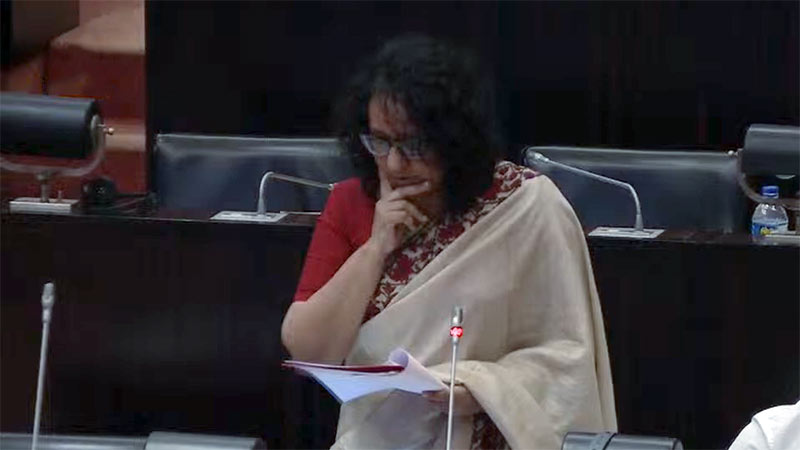
PM’s info on “Chichi’s rocket” explodes on take-off

August 4, 2025 – August 10, 2025 | Vol.15, #30 | ISSN 3084-9330

Photo credits: ONLANKA

[paywall layout_id=”1906″ service_tags=”TMA,FP” preview=”true”]

Over the past week, the Sinhala media – across print, television and social media platforms (as analysed through Junkipedia) – covered SupremeSAT, better known as “Chichi’s rocket” (Chichi is the nickname for Rohitha Rajapaksa, the youngest son of Mahinda Rajapaksa).[1]

This communications satellite was launched in November 2012 from the Xichang Satellite Launch Centre in China.

This week’s analysis is set out under three headings.

I. What were the key events that captured public attention?

August 6: In response to a question posed by SLPP MP D. V. Chanaka in parliament, Prime Minister (PM) Harini Amarasuriya provided an oral response to parliamentary questions that SupremeSAT Ltd. has earned around Rs. 343 billion from 2015 to the first half of 2023, without any financial support from the Sri Lankan government.[2]

In making this statement, the prime minister cited data provided by the Board of Investment (BOI).

August 7: Minister of Trade, Commerce, Food Security and Cooperative Development Wasantha Samarasinghe mentioned that the BOI has given the wrong statistics to the PM over “Chichi’s rocket”.

The minister corrected the figures quoted by the prime minister to Rs. 343.9 million, not billion, a discrepancy by a factor of roughly 1,000, and stated that it was concerning the ‘SupremeSAT’ company as a whole and not only the rocket.[3]

II. Why did it attract media attention?

Three drivers contributed to the prominence the incident gained in the media:

i. Conflicting official/government narratives

The primary driver of the widespread media attention was the correction of the prime minister’s statement in parliament by a cabinet minister.

Social media comments in particular, somewhat implausibly, framed the correction by the minister of the data provided by the prime minister as an ‘internal tussle’ between the JVP and NPP factions of the government.  

ii. Confidence in institutional integrity

The incident has also raised questions about the credibility of key government institutions.

The prime minister’s initial statement relied on data from the BOI, a central government agency responsible for attracting foreign investment. When the minister later challenged this data as inaccurate, it sparked serious concerns about the credibility of the BOI.

iii. Corruption allegations renewed

Following the incident, and the questions raised around the data, there is also renewed interest in investigating corruption allegations against the Rajapaksa family members.

The Rajapaksa administrations (2005 – 2015 and 2019 – 2022) were strongly associated with corruption in relation to infrastructure projects, in particular.[4]  The Rajapaksas and their close associates were accused of exploiting political power, extracting public funds and engaging in high-level corruption.[5]

III. How does this issue impact the government?

The fact that a minister publicly corrected the prime minister seems to be negatively impacting the government on two fronts. 

i. Currency for the ‘pacha aanduwa’ narrative

Previously, a narrative that has gained momentum is that the government has misled the public, particularly by making promises that it did not intend to keep and by backtracking on its commitments. This criticism has been amplified by the use of the Sinhala term පච/පචයා (pacha/pachaya – a derogatory way of referring to the telling of lies). The term ‘pacha aanduwa’ has gained momentum on social media and is used to portray the government as lacking integrity. There are many instances in which the issue of misleading statements has been flagged, and has fuelled the narrative of the government misleading the public.  

Confusion on the accuracy of the claims seems to have generated currency for the narrative of ‘pacha aanduwa’. Social media commentators, in particular, pointed to a trend in the government to have ‘misled’ the public with its allegations.

ii. The legitimacy of the prime minister questioned

Over the past few weeks, the PM came under heavy criticism as the central figure associated with the proposed education reforms and discourse on same-sex relationships.[6] Within both these discourses, the PM was framed as a liberal élite – positioned as somewhat removed from the cultural values of the Sinhala-Buddhist majority. [7]

Within this context, the public correction of the PM by a minister – widely regarded as a close associate of the president – has been interpreted by some voices, including social media commentators, as indicative of deeper tensions within the government, specifically a potential “JVP-NPP conflict.” Hence, the correction of the statistics by the minister, rather than by the PM herself, is seen as a calculated move intended to undermine the authority of her office and erode her personal credibility.


[1] The MPA team monitored Facebook profiles, TikTok handles and YouTube channels using Junkipedia for the keywords Harini, Chichi, rockets and SupremeSAT in Sinhala, from August 1 to 9, 2025.

[2] https://ceylontoday.lk/2025/08/06/supreme-sat-ltd-earns-rs-309-billion-in-8-years-pm/, https://www.dailymirror.lk/breaking-news/Govt-makes-U-turn-Chichis-rocket-goes-missing-again/108-316293 and https://www.youtube.com/watch?v=9m6QwSK_frg.

[3] https://www.dailymirror.lk/top-story/PM-given-wrong-figures-on-Chichi-s-rocket-Wasantha-Samarasinghe/155-316237 and https://mawratanews.lk/news/minister-questions-supreme-sat-revenue-claims-amid-conflicting-statements/.

[4] See TMA Vol.07, #33; Vol.10, #05 & 06; Vol.04, #47; Vol.04, #46; Vol.04, #11; Vol.11, #36.

[5] Ibid

[6] See MPA,Vol.15, #26;Vol.15, #29.

[7] See MPA,Vol.15, #26;Vol.15, #29.

To view this week’s news summaries, please click here.

To view this week’s social media data, please click here.

[/paywall]