August 11, 2025 – August 17, 2025 | Vol.15, #31 | ISSN 3084-9330

Photo credits: Lanka Leader.lk
[paywall layout_id=”1906″ service_tags=”TMA,FP” preview=”true”]
Key insights
- The move to revoke presidential privileges is less about its financial impact and more about symbolically rejecting Sri Lanka’s old political culture of entitlement.
- The move signals the new government’s commitment to reform and a break from the privileges enjoyed by past leaders. However, some critics argue it may be driven by political retaliation and victimisation rather than genuine reform.
- These critics, primarily consisting of Rajapaksa-aligned voices, employ a strategy of political valorisation to reframe the Bill, portraying the Rajapaksas as deserving of exceptional treatment due to their perceived contributions to the nation.
Analysis
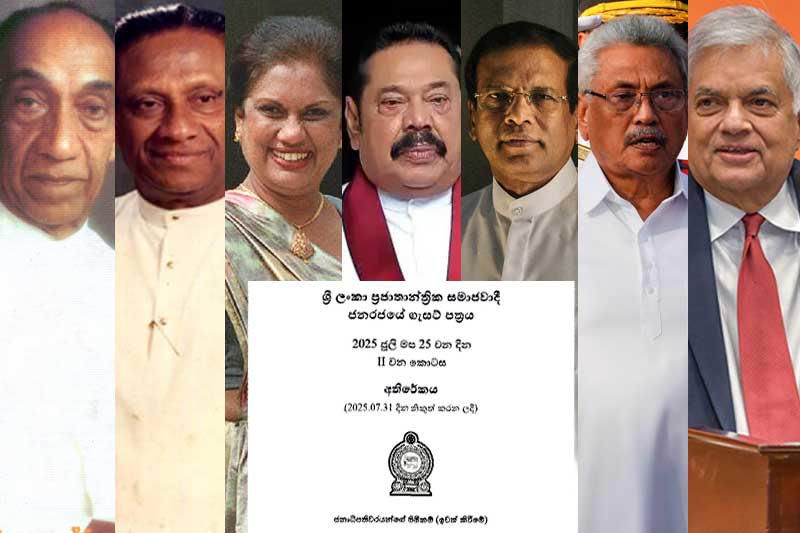
Over the past week, the Sinhala media—covering print, TV, and social media platforms (analysed through Junkipedia)—discussed efforts by the government to remove presidential privileges.[1]
A key pledge in President Anura Kumara Dissanayake’s 2024 election campaign was the removal of presidential and ministerial privileges.[2]
Context
Oct. 2024: The Cabinet of Ministers approved the appointment of a committee chaired by retired Supreme Court Judge K.T. Chithrasiri to assess and review the limitations of claims, allowances, and privileges granted to members of parliament, ministers, and former presidents.[3]
Dec. 2024: The report by the committee was submitted to President Dissanayake at the Presidential Secretariat.[4]
Jan. 2025: Minister Nalinda Jayatissa suggested that, following the court ruling on former President Maithripala Sirisena’s residence, former President Mahinda Rajapaksa should vacate his official residence in Wijerama voluntarily, without the need for an official request from the government.[5]
This week’s analysis is set out under four headings.
1. What events were reported on this issue?
Aug. 7: Minister Harshana Nanayakkara tabled in Parliament a Bill to repeal the President’s Entitlements Act, No. 4 of 1986.[6]
Aug. 11: SLPP Administrative Secretary Renuka Perera filed a petition before the Supreme Court to challenge the bill presented to Parliament by the government seeking to revoke the privileges of former presidents.[7]
Aug. 13: Former President Chandrika Bandaranaike Kumaratunga said that she would not resort to any legal action against the government’s decision to abolish the privileges granted to former presidents.[8]
Subsequently, former President Ranil Wickremesinghe reportedly notified the UNP that he would not pursue legal action regarding the revocation of privileges granted to former presidents.[9]
2. Why is this issue significant?
The move to repeal presidential privileges is significant not for its financial effect but for its symbolic value.
While the material benefits of these privileges are relatively modest, their removal carries much weight in the political landscape. The removal signifies a dismantling of the culture of privilege enjoyed by politicians—a key expectation of those who voted for the current government.
Sri Lankan presidents and politicians in the past few decades—the “old guard”—have been seen as granting themselves excessive perks at the expense of the public. This sentiment has fueled public resentment, creating a perception of political leaders as detached and indulgent.[10]
A key electoral pledge of the NPP was to challenge this entrenched privilege within traditional politics. By moving to strip away these privileges, the “new guard” sends a strong message: it rejects the old guard’s culture of entitlement and is responding to the public demand for fairness and equality. This move thus signals that the government is committed to upholding public interests and fulfilling its promises of dismantling the old system.
3. What are the sources of resistance to the Bill
Critics, including former JVP member Nandana Gunathilaka and Sunanda Madduma Bandara, have voiced opposition to the Bill. Their resistance stems from two concerns.
First, a key line of resistance holds that the bill is not about genuine reform, but rather a continuation of Sri Lanka’s entrenched pattern of political retaliation and victimisation. Critics argue that, instead of introducing genuine accountability, the Bill is a part of an entrenched cycle in Sri Lankan politics where each incoming administration weaponises state mechanisms to punish its predecessors. In this view, the bill is seen less as structural reform and more as an act of partisan political punishment against those who lost the election.
Second, another line of resistance emerges from Rajapaksa-aligned voices, who reframe the bill as personal attack against former President Mahinda Rajapaksa. He is cast as deserving exceptional treatment, for his service in “ending the war,” and as deserving continued valorisation. Their camp frames the revocation of privileges as an unjust attack on the former president, who is portrayed as having made exceptional contributions to the nation. By invoking the Rajapaksas’ valorisation, critics seek to delegitimise the bill, positioning it as an attempt to humiliate figures who still command popular loyalty.
4. How does this issue reflect on different political stakeholders?
Despite securing a two-thirds majority in Parliament, the government appears to have hesitated in utilising its political capital to counter the significant support that was drummed up for former President Mahinda Rajapaksa.
Reducing political privileges was a central promise during the election campaigns, and the government’s attempt to strip Rajapaksa of his Wijerama residence was presented as an effort to fulfil this commitment. In this respect, the move to bring a Bill to repeal privileges is politically positive for the government, as it is seen as materialising a key electoral promise to dismantle the political culture of privilege. Simultaneously, this action frames the opposing “old guard” negatively, portraying them as having enjoyed these privileges.
However, rather than directly implementing the reduction of privileges, the government has increasingly tied these reforms to legal measures. This shift—from taking direct executive action to relying on legal frameworks—suggests a more cautious approach. This strategy indicates a reluctance to confront Rajapaksa’s popularity head-on, opting instead for a more indirect method.
While this approach may shield the government from immediate political backlash, it carries the possibility of diminishing its credibility. If the government is perceived as avoiding direct action, it may face criticism for failing to deliver on its reformist promises.
[1] The MPA team monitored Facebook profiles, TikTok handles and YouTube channels using Junkipedia for the keywords privileges, petition, benefits, pohottuwa, and president in Sinhala, from August 11 to 17, 2025.
[2] For more information, please see https://www.english.slbcnews.lk/?p=1254 and https://themorningtelegraph.com/11336/
[3] https://www.adaderana.lk/news.php?nid=102371 and https://hirunews.lk/goldfmnews/383591/cabinet-approves-committee-to-review-privileges-of-mps-ministers-and-former-presidents
[4] https://www.presidentsoffice.gov.lk/committee-report-on-mps-ministers-and-former-presidents-allowances-submitted-to-president/ and https://www.adaderana.lk/news.php?nid=103930
[5] https://www.newswire.lk/2025/02/05/why-is-the-govt-not-taking-action-over-mrs-house; https://island.lk/govt-says-no-need-to-ask-mr-to-vacate-his-official-residence/?noamp=mobile; https://ceylontoday.lk/2025/01/22/mr-to-leave-wijerama-residence/; https://www.adaderana.lk/news.php?nid=105116 and https://www.themorning.lk/articles/k2uyIWbxfccvSyChPZUt
[6] https://www.parliament.lk/uploads/bills/gbills/english/6399.pdf and https://www.themorning.lk/articles/QP8EJxSUMEHCSfx2kbiN
[7] https://www.adaderana.lk/news.php?nid=111359 and https://www.themorning.lk/articles/zkXYC1yMwlF9q8M2nX8i
[8] https://www.themorning.lk/articles/8ZZWgsYYqscyCLDBgox2 and https://www.adaderana.lk/news.php?nid=111407
[9] https://lankaleader.lk/news/14959-ranil-says-no-to-legal-action-against-removal-of-privileges-of-ex-presidents and https://asianmirror.lk/news/8254/rw-declines-legal-action-over-slashing-former-presidents-privileges/
[10] See TMA, Vol. 11, #33 & 34
To view this week’s news summaries, please click here.
To view this week’s social media data, please click here.
[/paywall]