Remembrance Day: AKD misfires in the media

May 19, 2025 – May 25, 2025 | Vol.15, #19 | ISSN 3084-9330

Events: On May 10, a Tamil Genocide Monument, dedicated to the victims and survivors of the alleged genocide perpetrated by the Sri Lankan state in the final phase of the armed conflict, was inaugurated in Brampton, Canada.[1][2]
 
On May 16, at a press conference convened by the Ministry of Defence, it was announced that Deputy Minister of Defence Major General (Retd.) Aruna Jayasekara will represent President Anura Kumara Dissanayake at the 16th National War Heroes’ Commemoration ceremony.[3][4]

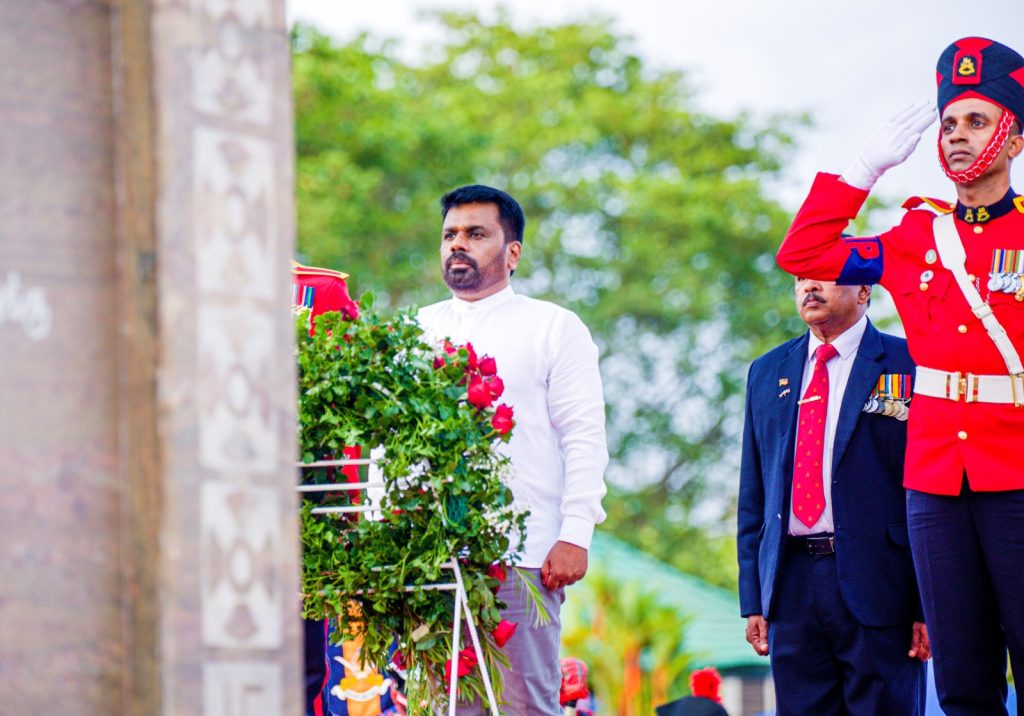
On May 19, President Dissanayake hosted a Remembrance Day ceremony – also known as National War Heroes’ Commemoration Day – at the war heroes’ memorial in Battaramulla.[5][6][7][8][9]

Photo credits: Newswire

[paywall layout_id=”1906″ service_tags=”TMA,FP” preview=”true”]

Over the past week, President Anura Kumara Dissanayake and his government faced intense criticism in the Sinhala media for their handling of events surrounding the Remembrance Day.[1] Specifically, the president came under scrutiny on two counts: (a) his actions leading up to the ceremony and (b) the framing, particularly his choice of words, during his speech at the ceremony. Notably, much of this criticism originated from segments of the Sinhala media that have traditionally reflected and appealed to strong Sinhala-nationalist sentiment.

Media discourse showed that President Dissanayake’s actions and words sent mixed signals to Sinhala Buddhist and Tamil communities in Sri Lanka, trying to appease contrary interests.

On the one hand, his actions appeared to appease the majority Sinhala Buddhist voter base by personally attending the commemoration. On the other hand, the language used in his speech appeared to be carefully calibrated to tacitly appease the Tamil community in Sri Lanka.

This dual positioning was not well received in the Sinhala media; instead, it invited criticism, and was widely interpreted as a sign of weak leadership and a lack of coherent and confident direction from the president and his administration. This week’s analysis briefly explores these actions and statements, and how they have sparked a backlash in the Sinhala media.

What actions appear aimed at appeasing the Sinhala-nationalist polity?

The government initially announced that the Remembrance Day ceremony would be held under the aegis of the Deputy Minister of Defence Major General (Retd.) Aruna Jayasekara as a representative of the president. This announcement drew considerable criticism, particularly on social media (please refer to memes published in this week’s issue of MPA), as lacking solidarity with Sri Lanka’s war veterans (“heroes”).   

President Dissanayake then changed plans and attended the ceremony at the war heroes’ memorial in Battaramulla. This reversal, rather than neutralising the criticism, fuelled further scepticism. Critics questioned the authenticity of his attendance, interpreting it as a reactive move in response to the backlash. But, at the same time, others who had supported his initial position were critical of the change and framed it as an appeasement of the Sinhala-nationalist polity.  

What language did he use to break away from past Sinhala-nationalist rhetoric?

In his speech at the ceremony, President Dissanayake chose his words carefully when referring to the end of the armed conflict. Notably, he used the term සොල්දාදුවා (trans: soldier) – instead of the traditionally employed Sinhala term රණවිරුවා/ranaviruwa (trans: war hero) – to honour those who died during the armed conflict.

The significance of this shift in language becomes clear when viewed against past reporting and speeches by successive presidents. For the past 15 years, mainstream media and political figures have consistently used – or at least not contested – the term “war hero” when discussing “war victory celebrations”. During this period, Sinhala media and successive presidents largely adopted a triumphalist tone, “glorifying” war heroes, detailing military operations and highlighting their “victory”. For instance, in 2020, then-Prime Minister Mahinda Rajapaksa even compared the rana viru (war hero) to the historical pancha maha bala wegaya (five great forces) of Sri Lanka.[2]

The only comparable break from this nationalist language occurred in 2015, under the yahapaalanaya government led by former President Maithripala Sirisena and then-Prime Minister Ranil Wickremesinghe. That year, Sinhala media discourse reflected a significant shift in how the end of Sri Lanka’s armed conflict was framed. The government officially changed the commemoration to Remembrance Day from the previous term Victory Day coined during the Rajapaksa era.[3] The media also increasingly referred to May 19 as Remembrance Day. The government also – for the first time since the end of the armed conflict – allowed public commemoration of the deceased among the Tamil community.[4]

The key difference between the current president’s actions and the yahapaalanaya government lies in the nature of the messaging. During the yahapaalanaya period, the government adopted an official and principled approach to reshape the narrative around the end of the armed conflict, reframing it as a day of collective remembrance rather than only a military victory.  By contrast, President Dissanayake’s initial decision to not attend, followed by a last-minute reversal to attend, and then the calibration of his speech to not offend resulted in a mixed message with no clear position. It has created the impression that he is trying to “play both sides”. This concern about dual, inconsistent messaging has become a central focus of criticism directed at the president and his government.


[1] The MPA team monitored Facebook profiles, TikTok handles and YouTube channels using Junkipedia for the keywords soldier, war hero, victory and kayyinayaka in Sinhala from May 19 to 23, 2025.

[2] See TMA Vol.10, #21.

[3] See TMA Vol.05, #20.

[4] For more information, please see https://www.dailymirror.lk/print/breaking-news/may-19-is-remembrance-day-rajitha/108-72667 and https://www.ft.lk/front-page/19-may-is-remembrance-day-no-longer-victory-day-govt/44-421441.

To view this week’s news summaries, please click here.

To view this week’s social media data, please click here.

[/paywall]