February 26, 2026 – March 3, 2026 | Vol.16, #9 | ISSN 3084-9330

Photo credits: Lanka Leader.lk
[paywall layout_id=”1906″ service_tags=”TMA,FP” preview=”true”]
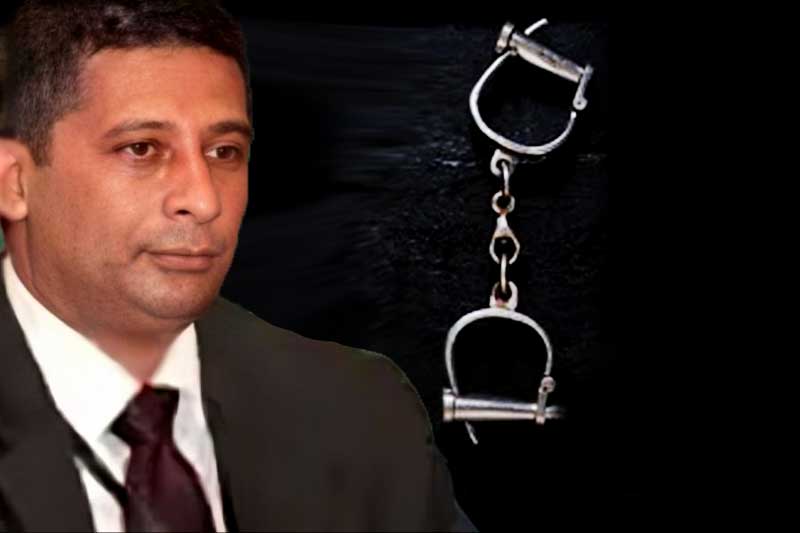
Over the past week, Sinhala media focused on the arrest of former State Intelligence Service (SIS) Director Major General (Retd.) Suresh Sallay, in connection with investigations into the Easter Sunday attacks.
The coverage spanned print, television, and social media commentary. Social media narratives and conversations were monitored and analysed using specialised digital tracking tools.[1]
This week’s analysis is set out under four headings.
1. What was the key event that captured public attention?
Feb. 25: The CID arrested Sallay under the Prevention of Terrorism Act (PTA) and stated that he would be detained for 72 hours for questioning in connection with investigations into the Easter Sunday attacks.
Feb. 27: Police stated that the CID had obtained a 90-day detention order under the PTA to continue questioning Sallay.
The Sinhala media discourse following Sallay’s arrest coalesced around two opposing narratives—mirror-opposite interpretations reflecting two distinct camps: the “hero-victim” narrative and the “deep state” villain narrative. The “deep state” villain narrative seems to have gained significantly greater resonance within the Sinhala public psyche.
In this week’s MPA, we will examine these competing narratives and explain why one achieved greater traction than the other.
2. What were the two opposing narratives surrounding Sallay’s arrest?
Two mirror-opposite narratives dominated Sinhala media discourse following Sallay’s arrest. The discourse cast Sallay either as a “hero-victim” facing political targeting, or as a “shadow operative” linked to a deeper pattern of impunity.
An analysis of social media reactions indicates that the “shadow operative” narrative gained the most traction, overshadowing the “hero-victim” portrayal in the public sphere.
Table 1: Sinhala media narratives surrounding Sallay’s arrest

3. Why did the “shadow operative” narrative gain wider public resonance?
The narrative casting Sallay as a “shadow operative” gained wider public resonance because it drew on two pre-existing perceptions: first, that he belongs to a “deep state” linked to past impunity; and second, that domestic political complicity in the Easter attacks is widely believed.
First, this narrative taps into a collective memory that places Sallay within a “deep state” apparatus. By linking him to the high-profile 2009 assassination of Lasantha Wickrematunge, the 2012 murder of Wasim Thajudeen, and the 2010 disappearance of Prageeth Ekneligoda, Sinhala media discourse recasts Sallay’s alleged actions as part of a broader pattern of systemic violence. This portrayal casts Sallay as a “systemic villain” whose influence spans political eras, implying that the intelligence structures he led served as a shadow power, able to silence dissent with impunity.
Second, its resonance draws on a widespread reading of the Easter Sunday attacks as a calculated outcome that served domestic political interests orchestrated by the very deep state Sallay is perceived to represent. In this context, the NPP government’s move to arrest Sallay aligns with a pre-existing public belief that local political forces were involved in the attacks, strengthening the plausibility of this interpretation within Sinhala public consciousness.
4. How is the government impacted?
Sallay’s arrest provides the NPP government with immediate trust capital by signalling alignment with public demand for accountability on the Easter Sunday attacks.
The NPP government’s move to arrest Sallay aligns with a deep-seated public perception: Verité Research’s Syndicated Surveys administered in October 2023 show that more than half of Sri Lankans believe local political forces were involved in the Easter attacks (see Figure 1).
In this light, Sallay’s arrest serves as a significant signal of the government’s intent to pursue figures long considered ‘untouchable,’ marking a departure from previous administrations perceived as shielding the security establishment.
This alignment also weakens the opposition’s “hero-victim” narrative by treating the case as a question of criminal accountability rather than national security.
Figure 1: Findings from the Syndicated Surveys by Verité Research
By pursuing those previously considered “untouchable”, the government has marked a definitive departure from the past and appears to have gained significant points in the public psyche.
[1] The MPA team monitored Facebook, TikTok, and YouTube using Junkipedia for the keyword Sallay in Sinhala from February 23 to March 3, 2026.
To view this week’s news summaries, please click here.
To view this week’s social media data, please click here.
[/paywall]