February 16, 2026 – February 24, 2026 | Vol.16, #8 | ISSN 3084-9330

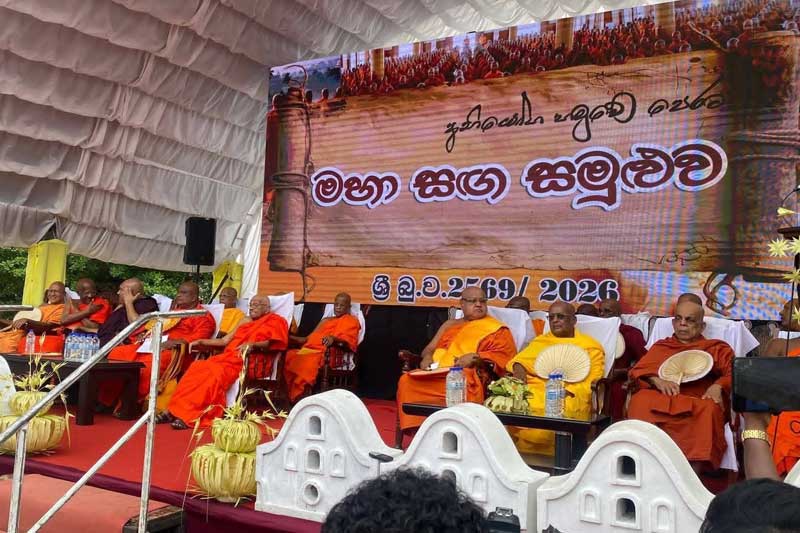
Photo credits: Lanka Leader.lk
[paywall layout_id=”1906″ service_tags=”TMA,FP” preview=”true”]
Over the past week, Sinhala media focused on a “Maha Sangha Convention” convened by a group of Buddhist monks in Colombo. This coverage spanned print, television, and social media commentary. Conversations and narratives on social media platforms were tracked and analysed using specialised social media monitoring tools.[1]
This week’s analysis is set out under four headings.
1. What was the key event that captured public attention?
Feb. 20: A group of Buddhist monks convened a “Maha Sangha Convention” (මහා සඝ සමුළුව/maha sangha samuluwa) at the All-Ceylon Buddhist Congress in Colombo. The chairperson of the “Mawubima Surakeeme Sanvidhanaya” (Organisation for Protecting the Motherland), Ven. Murutthettuwe Ananda Thera, said that the event is not aligned with party politics and is not meant to back any politician or group.
The clergy raised concerns about perceived threats to Buddhism, the monkhood, and wider socio-cultural developments, among other issues, and adopted a 10-point declaration calling on the government to take measures to protect Buddhism in Sri Lanka.
Context: In Sri Lanka, Sangha conventions are typically convened when sections of the Buddhist clergy seek to collectively assert positions on issues framed as affecting Buddhism—often during constitutional debates, anti-conversion proposals, or periods of communal tension, among others. These conventions are ad hoc, and are organised by specific monk networks, unlike the traditional nikāyas (the Siyam/Amarapura/Rāmañña Nikāyas with recognised officeholders and more durable institutional authority in state–religion relations).
2. What is the significance of this convention?
This convention represents a notable departure from historical trends, where such gatherings typically resonated with a broad segment of society. In contrast, this instance seems not to have gained traction within the wider Buddhist community or the general public.
In the past, clergy-led mobilisations framed around issues such as protecting Buddhism have tended to generate broader Sinhala-Buddhist consolidation. However, this convention has attracted notably limited resonance in the media discourse.
The limited traction and uptake can be seen in the media discourse. While some television channels provided airtime, others notably omitted the event from their primary broadcasts (see the post published by the Ethics Eye platform on this issue for more details). This selective coverage, combined with the critical lens of social media, appears to have shaped the public consciousness around the convention.
Consequently, the convention serves as a litmus test of clerical influence in the post-aragalaya (mass uprisings that took place in 2022) NPP governance era, and in this Special Issue of MPA, we examine why.
3. Why did the convention have limited resonance in media discourse?
The convention’s reception appears to have been shaped by the post-aragalaya rejection of the “chauvinist political establishment,” extending heightened scepticism to authority figures—including sections of the clergy—perceived as aligned with that order. It appears to have encountered three interrelated credibility constraints: first, organisers were framed as proxies for the traditional political establishment rejected in 2022; second, public tolerance for monastic exceptionalism appears to have diminished; and third, segments of the clergy were perceived as out of step with prevailing cultural attitudes toward reform.
The 2022 uprising marked a systemic rejection of what MPA has coined the “chauvinist politician,” an archetype defined by the unruly, privileged “strongman” perceived as operating above the law and inherently corrupt.[2]
In the aftermath of the aragalaya, authority figures associated with the chauvinist political establishment are viewed with heightened scepticism,including sections of the clergy—perceived as aligned with that order. Several of the convention’s organisers were portrayed in Sinhala media commentary as extensions of, or enablers of, that traditional political establishment, and were therefore interpreted through a broader lens of systemic refusal.
Just as the public withdrew its consent from the traditional political establishment in 2022, the ‘traditional monk perceived’ as mirroring those traits is similarly delegitimised due to a perceived lack of credibility.
In this context, the convention appears to have encountered three credibility constraints:
Credibility constraint I: Proxy for the traditional political establishment
Media discourse surrounding the convention suggests the convention was discredited for the perception that it was a proxy mobilisation for the SLPP and Rajapaksa-linked vested interests. Because the aragalaya marked a systemic rejection of that political order, affiliated clergy were seen as inheriting its associated trust deficit.
Consequently, public refusal to engage with the traditional political establishment extended to the clergy, who were perceived as its enablers, and was viewed as an attempt to preserve a discredited status quo rather than as an independent religious initiative.
Credibility constraint II: Diminishing tolerance for monastic exceptionalism
Historically, the Buddhist clergy enjoyed a degree of socio-political exceptionalism that shielded them from scrutiny.
However, the post-aragalaya climate seems to have challenged this immunity, with the public no longer readily granting automatic respect based on religious status. This reaction underscores a growing insistence on a single standard of accountability for both religious and non-religious leadership.
Credibility constraint III: Out of step with the cultural milieu
The convention was further weakened by perceptions that segments of the clergy are increasingly out of step with the current cultural milieu. Public pushback suggests that certain traditional stances are now viewed as barriers to progressive reform rather than as moral safeguards.
Specifically, remarks by speakers—including Ven. Kotapitiye Rahula Thera—criticising aspects of educational reform, such as sex education —faced widespread rejection. Rather than sparking a serious policy debate, these interventions became the subjects of sustained social media ridicule (please refer to the memes published in this issue of MPA). This reaction underscores a growing ideological disconnect between a conservative clerical establishment and a public increasingly receptive to modernised frameworks.
4. How is the government impacted?
In the post-aragalaya context, the convention’s limited agenda-setting traction constrained its capacity to generate sustained pressure, resulting in limited political cost for the government.
The Sinhala media discourse surrounding the convention reflects a widening gap between elements of the traditional political order and a recalibrated political consciousness post-aragalaya. The rejection of the chauvinist politician in 2022 appears to have extended—by association—to segments of the clergy perceived as aligned with that order.
This dynamic seems to have isolated the “old clergy” represented at the convention, constraining their capacity to translate symbolic mobilisation into broad public traction.
Taken together, these credibility constraints appear to have limited the political impact on the government.
[1] The MPA team monitored Facebook, TikTok, and YouTube using Junkipedia for the keywords sangha, sangha convention, sex and train in Sinhala from February 16 to 24, 2026. The terms sex and train were searched based on the references made by some Buddhist monks.
[2] See MPA Vol.11, #33 & 34.
To view this week’s news summaries, please click here.
To view this week’s social media data, please click here.
[/paywall]