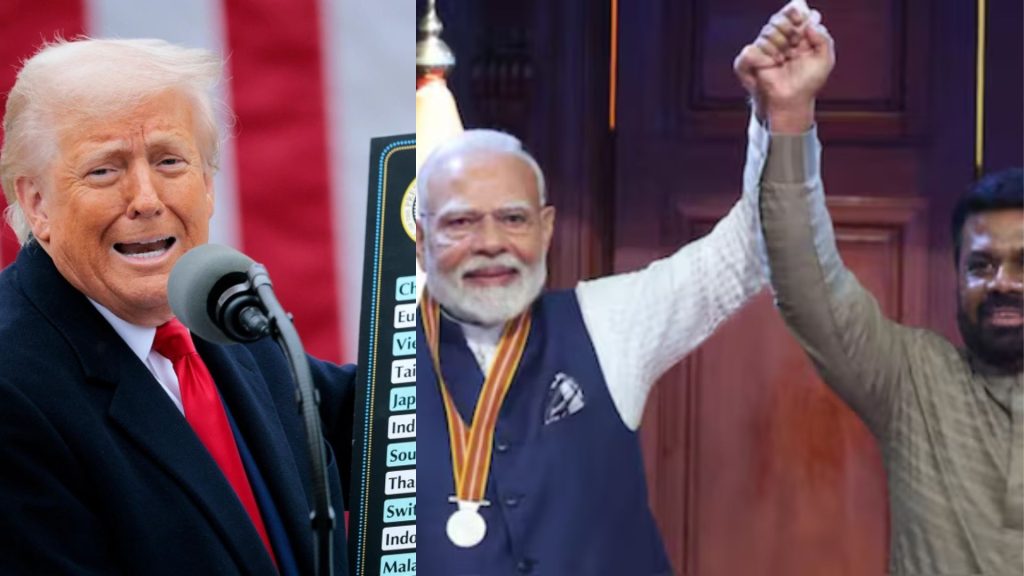
March 31, 2025 – April 6, 2025 | Vol.15, #14
Events: On April 2, President Donald Trump announced he was signing an executive order “instituting reciprocal tariffs on countries worldwide. Reciprocal – that means they do it to us and we do it to them.”[1][2]
On April 3, President Anura Kumara Dissanayake appointed a committee to conduct an in-depth study on potential issues that may arise due to the new reciprocal tariff system introduced by the U.S. president.[3][4]
On April 7, Minister of Labour and Deputy Minister of Economic Development Dr. Anil Jayantha and Finance and Planning Deputy Minister Dr. Harshana Suriyapperuma revealed that the government has engaged with the U.S. to mitigate the impact of proposed tariffs.[5][6] During the media briefing, the government yesterday confirmed that the U.S. has officially requested to propose ways to reduce Sri Lanka’s trade deficit with the U.S.[7][8]
On April 4, Prime Minister of India Narendra Modi arrived in Sri Lanka for a two-day visit.[9][10] During the visit, several projects were inaugurated and defence and energy agreements were signed by President Dissanayake and Prime Minister Narendra Modi.[11][12][13]

[paywall layout_id=”1906″ service_tags=”TMA,FP” preview=”true”]
Key insights:
- The NPP, in contrast to its past, is seen to have shifted towards an outward-facing approach, where international engagement is seen as more of an opportunity rather than a threat.
- The discontent with the traditional political establishment resurfaces when the opposition criticises the government – and the criticism seems to boomerang on the opposition itself more than weakening support for the government.
- The NPP is positioned to retain its support base from the general election, in the Sinhala majority areas, for the upcoming local government elections as well.
Analysis
Overview of media coverage
Last week, two key developments dominated the Sinhala media (including print, television and social media)[1]: Indian Prime Minister Narendra Modi’s visit to Sri Lanka and U.S. President Donald Trump’s announcement of reciprocal tariffs, including tariffs on Sri Lanka’s exports to the U.S.
How did government engagement with international powers shape the political mind?
Government engagement with international powers influenced the present political psyche in two ways: (1) an increased acceptance of an outward-facing approach to foreign engagement and (2) a decreased acceptance of criticism from the political opposition. This week’s MPA will explore these two key trends and their implications for Sri Lanka’s political dynamics.
The JVP’s outward-facing shift:
A past feature of the JVP’s political activism has been its opposition to the perceived hegemony of India, Sri Lanka’s largest neighbour (see memes published in this issue of MPA). Historically, the party has also tended to advocate for inward-oriented policies focused on critiquing free trade, favouring import substitution policies, resisting Western normative frameworks and cautioning against threats to Sri Lanka’s sovereignty.[2]
However, this inward-facing approach appears to have softened significantly in the context of becoming the ruling party, and this is exemplified in the recent engagement with India and the U.S. The present engagements show a shift towards a more outward-facing approach, where international engagement is viewed as an opportunity, and not as a threat.
This shift aligns with the broader dynamics of Sri Lanka’s political landscape, which tends to oscillate between inward- and outward-facing political stances. In periods of national strength or when addressing specific issues, such as human rights concerns, the public mindset can lean towards an inward-facing approach (where the external actors are seen as a threat). Conversely, when facing an economic crisis or vulnerability, such as in the present context, the public mindset can lean towards an outward-facing approach, as it turns to external aid and international partnerships for support.
The foreign engagement strategy of the present government is seen as adopting an outward-facing approach, which also appears to have traction, at the moment, with a public that is more receptive to global engagement, particularly in the context of the ongoing economic crisis.
The opposition’s dilemma: A decreased acceptance of criticism from the political opposition
Criticism of the government’s engagement with India and the U.S. – voiced by figures including Ranil Wickremesinghe, Wimal Weerawansa and Udaya Gammanpila – appears to be boomeranging on the opposition itself.
The opposition has reduced legitimacy for criticism: The rejection of the dominant political parties (now in the Opposition) at the recent election signalled strong public resentment with the status quo they represented. Those sentiments seem to arise afresh when the opposition engages to criticise the government (see the memes published in this issue of MPA). Therefore, opposition criticism of the government, instead of weakening support for the government, tends to have a ‘boomerang effect’ on the opposition itself. The Mood of the Nation survey by Verité Research in February 2025 showed that the support for the government has remained steady at 62 percent since the election.
Looking ahead: What’s in store for the government at the upcoming LG elections?
On March 20, the National Election Commission announced that the Local Government (LG) elections will be held on May 6, 2025. Given the government’s continuing public approval, and the boomerang effect of opposition criticism, the NPP seems positioned to perform well in the upcoming elections – outside of the Tamil dominated districts in the North and East. The NPP has held on to its support by continuing to be seen as ushering in a change in political culture and taking a firm stand against political corruption.
[1] The MPA team monitored Facebook profiles, TikTok handles and YouTube channels using Junkipedia for the keywords India, Modi, visit, electricity, agreements, Anura, America, taxes, Trump, 44% and apparel in Sinhala from March 31 to April 4, 2025.
[2] See TMA Vol.09, #31.
To view this week’s news summaries, please click here.
To view this week’s social media data, please click here.
[/paywall]