February 10, 2025 – February 23, 2025 | Vol.15, #07 & 08
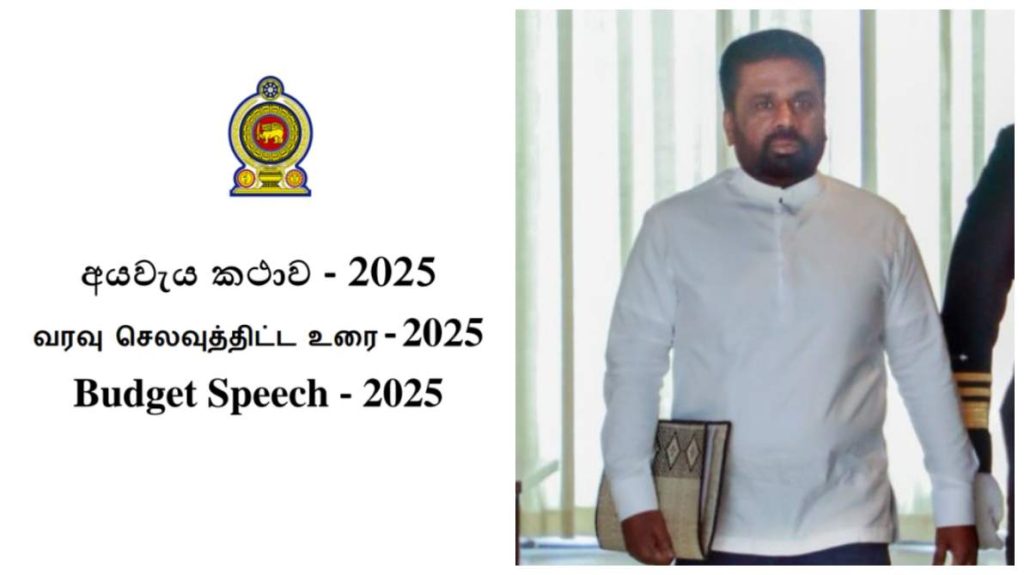
Events: On February 17, President Anura Kumara Dissanayake delivered the budget speech for 2025.[1][2][3]
On February 18, Aruna Vidanagamage, alias Meegas-Aré Kajja, was targeted by armed gunmen.[4][5] He was shot dead along with his six-year-old daughter and nine-year-old son.[6][7]
On February 19, a suspect in organised crime – Sanjeewa Kumara alias Ganemulla Sanjeewa – was shot dead following a shooting incident at the Colombo Hulftsdorp Court Complex.[8][9]
On February 22, at a media briefing, the Acting Inspector General of Police Priyantha Weerasooriya noted that there have been 17 reported incidents of shooting and five fatal stabbings totalling 22 incidents so far in 2025.[10][11]

[paywall layout_id=”1906″ service_tags=”TMA,FP” preview=”true”]
Key insights:
- Mainstream media and social media diverged in their evaluations of the economic policy direction outlined in the 2025 Budget.
- The government’s tendency to blame previous administrations for the country’s problems was widely accepted in economic matters but not in governance related issues such as safety and security.
- The way in which the current government was blamed for national security lapses was different from how previous administrations have been blamed for the same.
Analysis
Introduction
Over the past week, the government faced heightened media scrutiny following two major events: 1) President Dissanayake’s maiden budget speech and (2) the shooting of a suspect linked to organised crime at the Colombo Hulftsdorp Court Complex.
Overview of the media coverage on the budget speech
Mainstream media (print and TV) and social media commentary (analysed using the social media monitoring tool Junkipedia) diverged in their concerns about economic stability and recovery following the 2025 Budget speech. Privately-owned outlets such as Aruna owned by MP Dilith Jayaweera,[1] Mawbima owned by former minister Tiran Alles [2] and Hiru TV news bulletins were largely critical of the policy directions signalled by the budget.
By contrast, social media sentiment on the budget was predominantly positive.[3]
Overview of the media coverage on the shooting at the court complex
In contrast to the divergent media coverage on the budget speech, commentary on the court complex shooting that took place in the same week showed convergence of the mainstream and social media.[4]
This week’s analysis will unpack the contrast in public acceptance of government justifications.
Contrast in public acceptance of the government narrative
Government supporters, including the minister of labour and the deputy minister of economic development, explained the 2025 Budget as being constrained by the country’s economic hardships and mismanagement of past administrations. This narrative was widely accepted by the public, with many acknowledging economic challenges under previous governments as a contributing factor of the present hardships.
In contrast, the government’s similar deflection of blame onto previous administrations for security lapses did not receive public acceptance. With regard to concerns over national security, the focus was on the present government’s accountability, rather than past failures.
The divergence of the types of media and the difference in the coverage of the issues are explored below.
Divergence of mainstream and social media on economic policy concerns
The current government faced three key criticisms in the mainstream media.
First, the 2025 Budget was seen as a continuation of former president Ranil Wickremesinghe’s previous budgets. Second, that the budget remains within an IMF policy framework. Third, that the budget lacks bold economic reforms, in keeping with the ‘radical’ or left-leaning identification of the government.
In response to these criticisms, voices supportive of the government explained the policy direction of the 2025 Budget as constrained by the current state of the economy that is due to the policies of previous administrations. This justificatory narrative appears to have been widely accepted by the public. This acceptance was reflected in social media commentary, which contrasted with the criticisms found in the mainstream media. The social media commentary did not perceive the points made as criticism in the mainstream media as a negative assessment of the government; instead, the cautious, circumspect approach to change reflected in the budget was viewed positively.
Convergence of mainstream and social media on national security concerns
Criticism of the government’s failure to ensure national security following the court complex shooting was deeply rooted in three entrenched concerns within the Sinhala social psyche. These concerns generally tend to override other political narratives and shape public reactions to crime and governance.
First, there is a deep-seated societal aversion to drugs and intoxicants in Sri Lanka, as they are widely associated with vice, criminality and social decay.[5] Second, individuals involved in drug and underworld criminal activities are often portrayed as an embodiment of ‘evil’ that needs to be ‘done away with’.[6] During former president Mahinda Rajapaksa’s administration, this hostility translated into broad public acceptance of extrajudicial killings, which were seen as a ‘necessary (counter) evil’.[7] Third, following the Easter Sunday attacks, ensuring national security remained a top public priority.
In this context, the government – specifically Deputy Minister of Public Security and Parliamentary Affairs Sunil Watagala – sought to shift blame onto the Rajapaksa regimes and previous administrations. For instance, the deputy minister referred to the assassination of Lasantha Wickrematunge, the murder of Thajudeen and the disappearance of Eknaligoda as part of the Rajapaksa family’s ‘legacy’ of using the underworld to carry out such crimes.
However, this excuse did not seem to resonate with the public. The social media commentary held the current government accountable for public safety and security and any lapses in that regard.
But the way in which the current government was blamed was different from how past governments have been blamed in similar situations. The current government was questioned on its competence rather than on its collusion with criminals.
In the past, successive governments have been blamed for rising crime and deteriorating national security, with public criticism often attributing these issues to political ties with criminal networks. Therefore, the Sinhala media has frequently highlighted how politicians have maintained “mutually beneficial relationships” with criminal elements.[8] The perception largely has been that political patronage obstructs efforts to dismantle organised crime, including drug trafficking.
Unlike previous administrations, the current government was not perceived as corrupt or linked to the underworld. Despite this, the government’s competence in addressing crime and public safety and security seemed to be viewed with some lack of confidence.
[1] For more information, please see https://cdn.cse.lk/cmt/upload_report_file/568_1693568870427.pdf.
[2] For more information, please see https://sri-lanka.mom-gmr.org/en/media/detail/outlet/mawbima/.
[3] The MPA team monitored Facebook profiles, TikTok handles and YouTube channels using Junkipedia for the keywords NPP, Ranil, budget, public service employee and IMF. The monitoring period was February 10 to February 22, 2025.
[4] The MPA team monitored Facebook profiles, TikTok handles and YouTube channels using Junkipedia for the keywords underworld, Ganemulla, Sanjeewa, Aluthkade, courts and security. The monitoring period was February 10 to February 22, 2025.
[5] See TMA Vol.14, #05.
[6] See TMA Vol.02, #41; Vol.07, #09; Vol.08, #32; Vol.14, #28, 29 & 30.
[7] See TMA Vol.07, #09; Vol.14, #28, 29 & 30.
[8] See TMA Vol.07, #09; Vol.10, #43.
To view this week’s news summaries, please click here.
[/paywall]