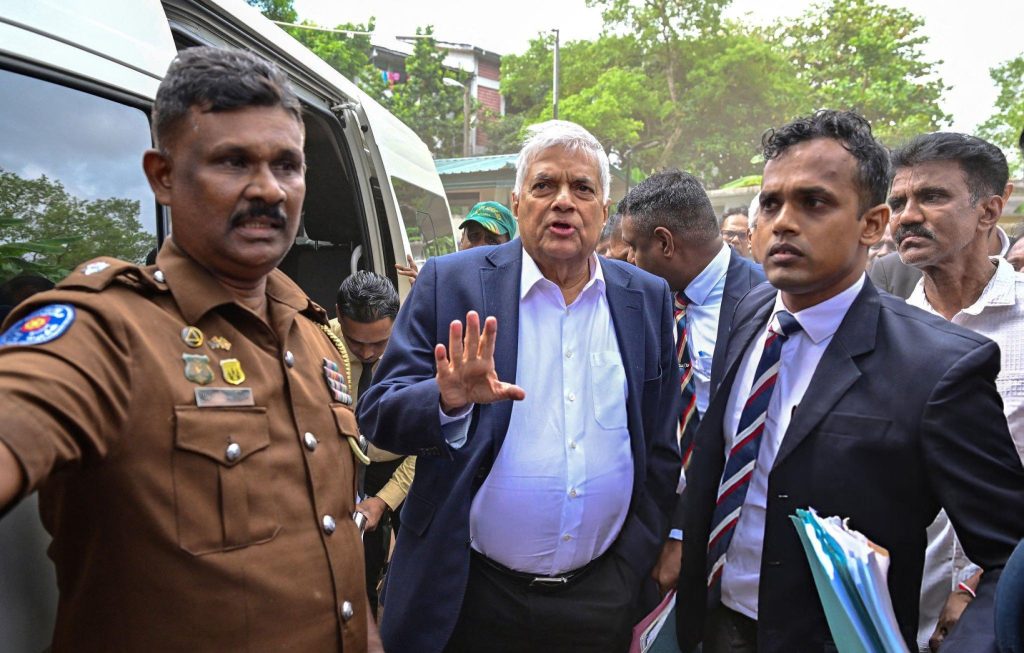
Support for the RW arrest arrested by questions and sympathy

August 22, 2025 – August 31, 2025 | Vol.15, #32 | ISSN 3084-9330

Photo credits: Tamil Guardian

[paywall layout_id=”1906″ service_tags=”TMA,FP” preview=”true”]

Over the past week, Sinhala media across print, television, and social platforms (as tracked by Junkipedia) devoted extensive coverage to the arrest of former President Ranil Wickremesinghe.[1]

This week’s analysis is set out under three headings.

1. What was the key event that captured public attention?

On Friday afternoon, August 22, the Criminal Investigation Department arrested Sri Lanka’s eighth Executive President, Ranil Wickremesinghe, on charges of misusing public funds.[2] On the same night, Wickremesinghe was produced before the Colombo Fort Magistrate and remanded until August 26. Four days later, on Tuesday, the Colombo Fort Magistrate’s Court granted him bail. This marked the first time a former Sri Lankan president had been arrested since the office was established in 1972.

The Sinhala media discourse on Wickremesinghe’s arrest revealed two competing narratives. The dominant narrative—driven by government voices and echoed on social media—framed the arrest as evidence of the equal application of law. By contrast, the contesting narrative—advanced largely by opposition politicians and echoed in the mainstream press and on TV—cast the arrest as politically motivated. Although many welcomed the arrest as a landmark step against corruption, it simultaneously generated sympathy for Wickremesinghe among certain segments of society.

2. Why did Wickremesinghe’s arrest, despite corruption allegations, generate sympathy among certain groups?

Despite broad public support for the government’s anti-corruption agenda, sympathy for Wickremesinghe arose among some groups who believed the arrest was politically motivated, and disproportionate in relation to the charges.

The NPP won the 2024 elections on a platform of holding corrupt ‘thieves’ accountable, regardless of their political ties.[3] The arrest of Wickremesinghe galvanised public support for the government, particularly among the middle and lower classes and JVP/NPP loyalists, who have long criticised élite politicians for abusing power for personal gain while remaining largely ‘untouchable.’ In this context, Wickremesinghe’s arrest was widely seen as signalling the government’s determination to confront the longstanding impunity enjoyed by political actors from the traditional establishment.

At the same time, Wickremesinghe has garnered sympathy from specific segments of the Sri Lankan polity. For these groups, his arrest does not amount to a decisive political breakthrough. Their sympathy appears to stem from three distinct sources.

i. Political decision behind the arrest: Following Wickremesinghe’s arrest, the government maintained that the judiciary and law enforcement acted independently, without political interference. However, it is not expected that such high-profile arrests could happen without political involvement in the decision. Concerns deepened when commentators noted that YouTuber Sudaththa Thilaksiri—closely aligned with the NPP—had publicly demanded and “prophesied” Wickremesinghe’s arrest before the authorities took action.[4]

ii. Political theatrics surrounding the arrest: The government was criticised for engaging in political theatrics, particularly concerning the timing of Wickremesinghe’s arrest and the nature of the legal actions brought against him.

First, the timing of his arrest on a Friday afternoon, with the remand hearing extending late into the night, drew criticism from some quarters. Critics deemed the timing ill-advised, as the five-day work week of the Sri Lankan court system meant that there was no immediate opportunity to seek bail, which then resulted in remand custody over the weekend.  In the past, similar arrests on a Friday evening, have been seen as part of a playbook of political punishment – due to it resulting in remand custody, even when immediate bail might have been permissible.[5]

Second, some commentators questioned why Wickremesinghe was charged under the Public Property Act and the Penal Code, which effectively restricts bail to exceptional circumstances.[6] Critics suggested that by using these specific laws rather than others, such as the Anti-Corruption Act—which allows for a greater scope of obtaining bail—the government appeared intent on ensuring that bail would be denied.  

Drawing on this context, critics seemed to characterise the government’s actions as political theatrics, suggesting a deliberate echo of previous administrations’ tactics.

iii. Political (in)significance of the charge: The decision to arrest Wickremesinghe on charges of misusing Rs. 16.6 million in public funds during a visit to the United Kingdom in 2023 drew significant criticism from opposition politicians. Critics called the Rs. 16.6 million misuse charge trivial, especially when compared to unresolved allegations related to Wickremesinghe, such as the Batalanda Detention Centre and Central Bank Bond scandal.  

Wickremesinghe attended the University of Wolverhampton convocation in honour of his spouse, Maithree Wickremesinghe, who is widely admired for her education, intellect, and modesty as a distinguished academic and a former First Lady.[7] Thus, the government came under scrutiny for appearing to overreact to a minor charge instead of pursuing more serious, high-profile cases, leading critics to view the action as misguided.

3. What are the broader political implications arising from the arrest?

Wickremesinghe’s arrest has given the NPP government the space to distance itself from being associated with following his economic policies, while it brought disparate opposition forces under a common slogan.

The arrest seems to have created a political space for the NPP government to strategically distance itself from Wickremesinghe’s policy orientation—particularly in economic policy, where the government has been repeatedly accused of maintaining the status quo rather than implementing transformative reforms.[8] In this context, Wickremesinghe’s arrest appears to provide the government with an opportunity to distance itself from the former president.

The arrest has also had the unintentional effect of bringing together disparate opposition forces under a single banner/slogan, a development that some critics dismiss as an ‘opportunistic’ and ‘unholy’ alliance. However, the durability and political weight of this coalition reflect a convergence of short-term interests rather than a sustainable partnership.


[1] The MPA team monitored Facebook profiles, TikTok handles and YouTube channels using Junkipedia for the keywords for Ranil, Ranil Wickremesinghe, on behalf of Ranil, former president, JVP, Anura, AKD, democracy and Suda (Sudaththa Thilaksiri the YouTuber) in Sinhala, from August 22 to 29, 2025.

[2] For more information, see: https://www.dailymirror.lk/opinion/The-arrest-and-remand-of-former-President-Ranil-Wickremesinghe/172-317489; https://www.aljazeera.com/news/2025/8/26/sri-lankas-ex-president-wickremesinghe-granted-bail-in-embezzlement-case and https://www.bbc.com/news/articles/cwye3y3dyn6o.   

[3] For more information, see: https://www.newswire.lk/2024/10/19/watch-over-400-corruption-files-reopened-president-akd/

[4] For more information, see: https://www.youtube.com/watch?v=j4q6B8lVSxg; https://www.dailymirror.lk/breaking-news/SJBs-Lihini-Fernando-condemns-YouTubers-remarks-on-Ranils-arrest/108-317335 and https://www.newsfirst.lk/2025/08/25/cid-probes-youtuber-over-pre-arrest-claim-on-ranil.

[5] For more information, see: https://www.theguardian.com/world/2018/oct/27/sri-lanka-political-crisis-mahinda-rajapaksa-prime-minister-sacked and https://time.com/5437457/sri-lanka-mahinda-rajapaksa-president-crisis/

[6] For more information, see: https://www.ft.lk/columns/Due-process-and-power-Lessons-from-arrest-of-Ranil-Wickremesinghe/4-780953; https://www.parliament.lk/uploads/acts/gbills/english/3024.pdf and https://www.newswire.lk/2025/08/23/sumanthiran-arresting-ranil-on-a-friday-denying-bail-ill-advised/.    

[7] For more information, see: https://www.wercsl.org/prof-maithree-wickramasinghe/ and https://www.sundaytimes.lk/250824/columns/justice-will-prevail-for-martyred-ranil-swear-unp-and-opposition-supporters-609665.html.

[8] See MPA Vol.15, #21 & 22 and Vol.15, #07 & 08.

To view this week’s news summaries, please click here.

To view this week’s social media data, please click here.

[/paywall]