July 14, 2025 – July 20, 2025 | Vol.15, #26 | ISSN 3084-9330

Photo credits: Sri Lanka Mirror
[paywall layout_id=”1906″ service_tags=”TMA,FP” preview=”true”]
Analysis
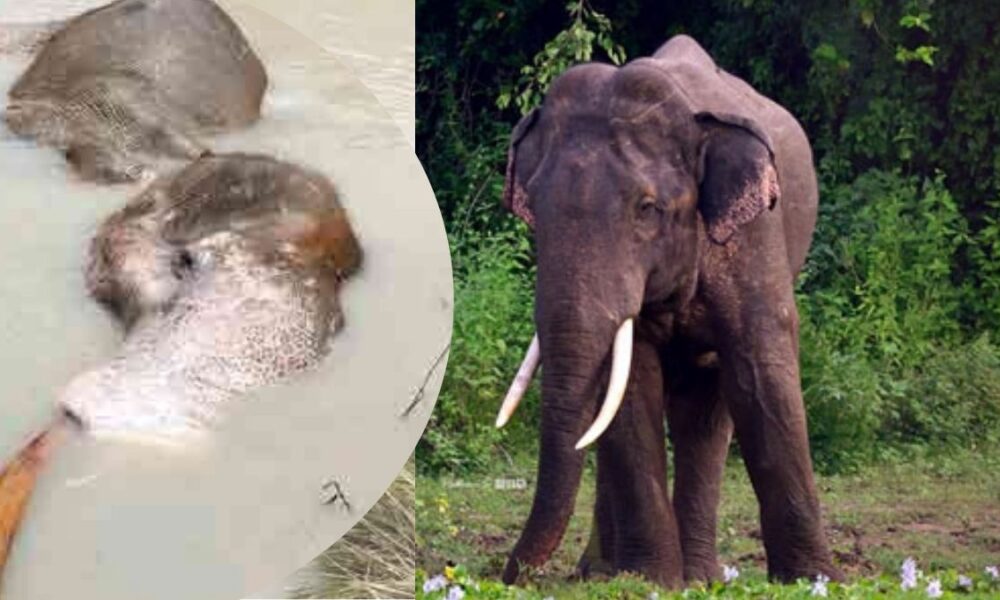
Over the past week, the death of the wild tusker known as Bhathiya dominated discourse in the Sinhala media across print, television and social media (as observed through the social media monitoring tool Junkipedia).[1]
This week’s analysis of the death of Bhathiya is presented under four headings.
What was the key event that captured media attention?
On July 15, a well-known tusker in the Nikaweratiya Wildlife Zone, named Bhathiya, was found dead in a muddy pit in the Polpithigama area.[2] He had been under intensive veterinary care due to multiple gunshot wounds.[3] Bhathiya had previously been sighted with such injuries on two occasions, first in February and again in May, raising serious concerns about repeated attacks before his death.[4]
Bhathiya’s slow and painful death was turned into a media spectacle, with dramatic coverage across the media.
Why was Bhathiya’s death a moment of national significance?
Bhathiya’s death was framed in the media not as the isolated loss of the life of an animal, but as an incident that triggered deeper cultural and economic concerns. Tuskers hold a revered position in Sri Lankan society, with their significance deeply rooted in the country’s history, religion and rituals.
In the Sinhala social psyche, they are closely associated with royalty, and play a central role in religious processions such as the Kandy Esala Perahera, where they carry the sacred tooth relic of the Buddha.
Beyond their religious and cultural value, their presence also holds considerable economic value, attracting tourists who are eager to witness them in their natural habitat (e.g. wildlife safaris).
Despite this high religious and cultural esteem, the number of tuskers in Sri Lanka remains remarkably low, a fact that may be attributed to centuries of human activities, including the capture of tuskers from the wild. The deep cultural integration of tuskers into Sri Lankan society fosters a strong emotional connection, amplifying the public impact of incidents such as Bhathiya’s death.
In this light, Bhathiya’s passing represents not just the loss of a magnificent creature, but the diminishing of a national treasure and a living emblem of Sri Lanka’s cultural and natural heritage.
How did the public respond to the death of Bhathiya?
Bhathiya’s death sparked widespread public anger and frustration, much of it directed at government authorities.
Criticism over Bhathiya’s death was primarily levelled at the Department of Wildlife Conservation for failing to provide adequate care and for not protecting the broader wildlife against poachers. This criticism was echoed across multiple platforms, including social media commentary, editorials in the privately-owned newspapers Aruna and Mawbima and statements by Chairperson of the Surakimu Sri Lanka Association Ven. Pahiyangala Ananda Sagara Thera and Opposition figures such as Sajith Premadasa.
The incident was framed not as an isolated failure, but as symptomatic of the state’s broader inability to manage the human-elephant conflict – an ongoing issue that continues to endanger both rural communities and elephant populations.
How did it affect the credibility of the government?
Bhathiya’s death was interpreted within public discourse as emblematic of broader systemic neglect. It came to symbolise state neglect across multiple domains: wildlife protection, cultural stewardship and rural safety.
The incident was contextualised as part of a broader pattern of perceived government inefficiency – characterised by weak institutional coordination, poor policy execution and an absence of accountability. Public discourse framed the death explicitly as a failure of the state, reinforcing the narrative of declining trust in the government’s capacity to safeguard both national heritage and community wellbeing.
[1] The MPA team monitored Facebook profiles, TikTok handles and YouTube channels using Junkipedia for the keywords Bhathiya, tusker and wildlife in Sinhala, from July 14 to 18, 2025.
[2] https://www.newswire.lk/2025/07/17/what-happened-to-bhathiya-dwc-explains/#:~:text=Approval%20was%20expedited%20through%20the,that%20the%20postmortem%20revealed%20osteomyelitis and https://english.newsfirst.lk/2025/07/15/bhathiya-the-elephant-dies-after-long-struggle-with-gunshot-wounds.
[3] https://www.newswire.lk/2025/07/17/what-happened-to-bhathiya-dwc-explains/#:~:text=Approval%20was%20expedited%20through%20the,that%20the%20postmortem%20revealed%20osteomyelitis and https://english.newsfirst.lk/2025/07/15/bhathiya-the-elephant-dies-after-long-struggle-with-gunshot-wounds.
[4] https://www.newsfirst.lk/2025/07/15/bhathiya-the-elephant-dies-after-long-struggle-with-gunshot-wounds and https://www.adaderana.lk/news.php?nid=110490.
To view this week’s news summaries, please click here.
To view this week’s social media data, please click here.
[/paywall]