September 8, 2025 – September 14, 2025 | Vol.15, #34 | ISSN 3084-9330

Photo credits: Newswire
[paywall layout_id=”1906″ service_tags=”TMA,FP” preview=”true”]
Analysis
Over the past week, Sinhala media across print, television, and social media platforms (as tracked by Junkipedia) devoted extensive coverage to the repeal of the President’s Entitlements Act, No. 4 of 1986, in parliament.[1]
This week’s analysis is set out under three headings.
1. What was the key event that captured public attention?
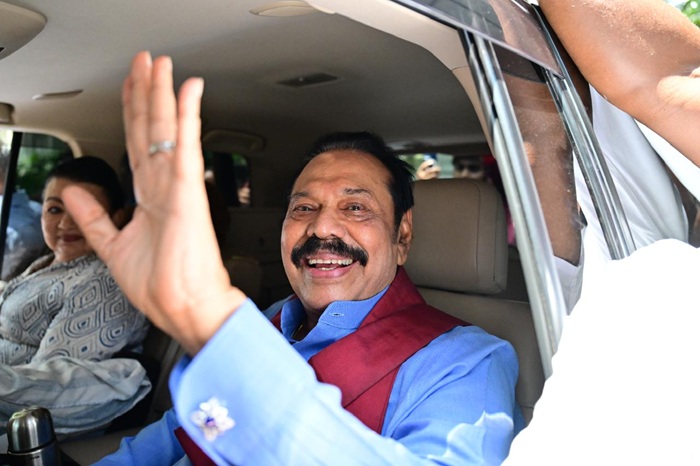
On September 10, the parliament enacted the Presidents’ Entitlements (Repeal) Bill with 151 votes in favour and one vote against.[2] The following day, former President Mahinda Rajapaksa vacated his residence on Wijerama Road and returned to the Carlton House in Tangalle.[3]
The dominant narrative across print, television, and social media commentary echoed the government’s position and extended support for the repeal of these entitlements.
By contrast, a contesting narrative, advanced by SLPP and NDF politicians and echoed by some mainstream media outlets such as privately owned Hiru TV, TV Derana, and Aruna, was critical of Rajapaksa being asked to vacate his official residence and expressed sympathy for him.[4]
For his followers, it was the act of being forced out of the residence—not the repeal—that struck a humiliating blow.
The sympathy stemmed from the perception of Rajapaksa as an exceptional figure, someone who had long survived and achieved what others could not. His departure from Wijerama Road, therefore, became more than a loss of privileges; it symbolised a confrontation between the entrenched political old guard he represents and the NPP government that has sought to challenge that establishment.
2. How did the narrative around this event impact the government?
The narratives around the former president vacating the residence have had a dual effect on the government.
On the positive side, it consolidated the NPP’s core support base. For these supporters, the departure from the residence symbolised a decisive break from the entrenched political culture of privilege. It was celebrated as a long-overdue rejection of the extravagant perks historically enjoyed by the political élite. It reinforced the idea that political office is a public trust rather than a personal entitlement, aligning with the broader reform agenda of “system change” promised by the government.
On the negative side, it generated criticism from the old guard and voices sympathetic to Rajapaksa, who viewed it as politically motivated and ungrateful.
3. Why does Mahinda Rajapaksa, in particular, garner sympathy?
The sympathy directed toward Mahinda Rajapaksa reflects how his symbolic value has been leveraged to frame the NPP’s policy reforms as politically motivated attacks.
Unlike his predecessors, who were also required to vacate their official residences, Rajapaksa support base actively rallied behind him. This base—comprising SLPP and NDF politicians, sections of the Buddhist clergy—framed the repeal as a deliberate act of targeting and disrespect. For these voices, the requirement to vacate his residence was seen as a form of “primitive politics of hatred” adopted by the NPP government.
Within this base, Rajapaksa continues to enjoy special reverence. He is valorised as the leader who defeated the LTTE and ended nearly three decades of armed conflict. His wartime credentials thus remain a powerful tool for shaping public sentiment, allowing critics of the repeal to frame it as a betrayal of national gratitude toward a leader credited with delivering peace—regardless of the corruption charges that shadow him.
This narrative draws heavily on Rajapaksa’s cultivated symbolic role within the SLPP as a paternal figure—“appachi”/අප්පච්චි —and resonates with broader cultural norms in Sri Lanka, where expressing gratitude, particularly toward leaders perceived to have made historic contributions, can be invoked as a societal value.
By invoking this cultural logic, opponents of the repeal cast the stripping of presidential entitlements not merely as a legal or political decision but as an affront to collective memory, loyalty, and national gratitude.
[1] The MPA team monitored Facebook profiles, TikTok handles and YouTube channels using Junkipedia for the keywords for Mahinda, official, Tangalle and Carlton in Sinhala, from September 8 to 14, 2025.
[2] For more information, see: https://www.parliament.lk/news-en/view/4774 and https://www.adaderana.lk/news.php?nid=112361.
[3] For more information, see: https://www.dailynews.lk/2025/09/11/admin-catagories/breaking-news/854574/mahinda-vacates-residence-at-wijerama-road-heads-to-carlton-home/ and https://www.adaderana.lk/news.php?nid=112402.
[4] MP Dilith Jayaweera established Liberty Publishers (Pvt) Limited, which is the publisher of three national broadsheets – Aruna, The Morning and Thamilan. For more information, please see https://cdn.cse.lk/cmt/upload_report_file/568_1693568870427.pdf; and Hiru TV is fully owned by Rayynor Silva, the brother of former MP Duminda Silva. For more information, see: https://sri-lanka.mom-gmr.org/en/media/detail/outlet/hiru-tv/.
To view this week’s news summaries, please click here.
To view this week’s social media data, please click here.
[/paywall]