July 7, 2025 – July 27, 2025 | Vol.15, #27 & 28 | ISSN 3084-9330

Photo credits: La Derecha Diario
[paywall layout_id=”1906″ service_tags=”TMA,FP” preview=”true”]
Analysis
Over the past two weeks, the Sinhala media – including print, television and social media platforms (as analysed through Junkipedia) – reported on the imposition of tariffs on Sri Lanka.
This analysis is set out under three headings.
What are the key events that attracted media attention?
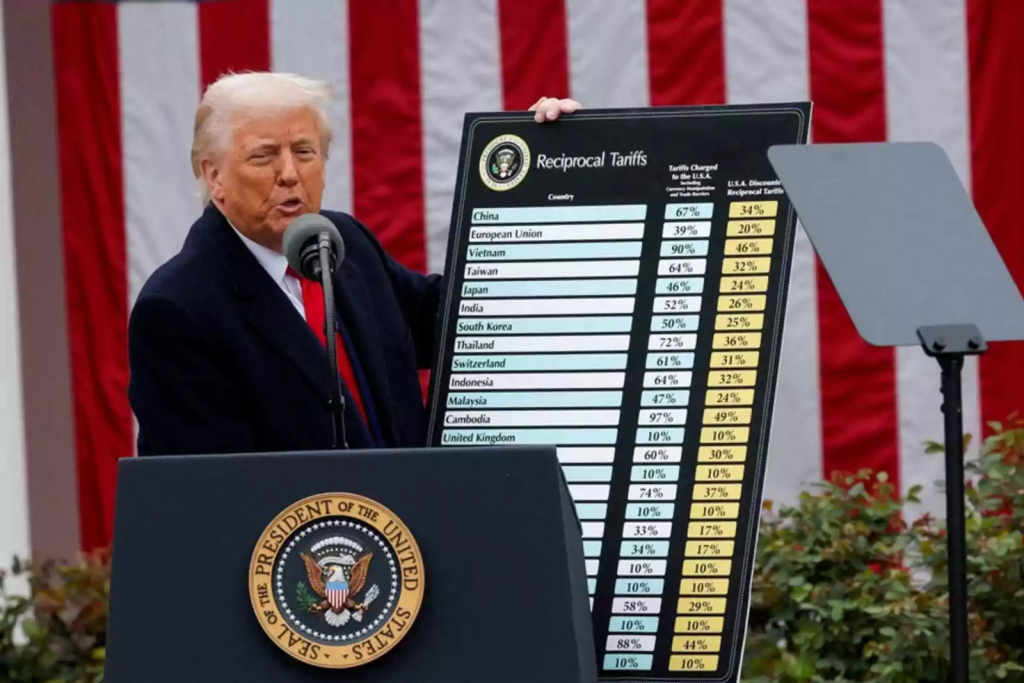
April 2: The U.S. president announced a 44 percent reciprocal tariff on Sri Lankan imports, granting a grace period for its implementation. The grace period ended on July 9.[1]
July 9: In a letter addressed to President Anura Kumara Dissanayake, the White House announced a 30 percent reciprocal tariff, reduced from the initial 44 percent, on Sri Lankan products.[2]
How has the 30 percent reciprocal tariff been received in the media?
The Sinhala media engagement with the 30 percent reciprocal tariff has largely clustered around two overarching narrative frames: narratives of negotiation and narratives of consequences.
Each of these frames reveals two competing narratives.
1. Narratives of negotiation: Victory or vulnerability?
This first narrative frame focuses on two highly politicised narratives, contrasting how the government and the opposition have sought to define the outcome of the tariff negotiations.
i. Victory narrative from the government
Key government officials, including the secretary of the Ministry of Finance and the Central Bank, present the outcome of the tariff negotiations as a significant diplomatic achievement.
Their argument rests on a counterfactual comparison: that Sri Lanka was originally facing a 44 percent tariff, and the negotiated reduction to 30 percent marks a 14-percentage-point decrease. This reduction is presented as tangible proof of skilful negotiation. To strengthen this narrative, Sri Lanka is presented as now facing a lower tariff burden than its regional peers such as Laos, Cambodia and Bangladesh. This comparative framing is used to underscore the perceived competence of the government in navigating international economic challenges.
ii. [Governmental] failure narrative from the opposition
In contrast, the opposition voices, including Opposition Leader Sajith Premadasa and General Secretary of the SLPP Sagara Kariyawasam, view the tariff outcome as a significant failure, rejecting the government’s framing. For the opposition, the proper comparison is not with the initially proposed 44 percent, but rather the pre-Trump tariff rate of around 10 percent. From this point of view the 30 percent rate represents a threefold increase, hence not a diplomatic win but a policy setback.
In this context, two concerns have been raised.
First, they question the competence of the government’s negotiating team, referring to it as “textbook experts” disconnected from real-world diplomacy.
Second, voices such as the privately owned Divaina have raised concerns about the lack of transparency in the negotiation process. Specifically, they demand clarity on what concessions the government may have made behind closed doors to secure the new tariff rate – moves that, without public scrutiny, risk leaving the country exposed and vulnerable to external pressures.
2. Narratives of consequences: Reform or rejection?
This second narrative frame centres on managing the consequences of the tariff negotiations.
Rather than focusing on the negotiation process itself, the two narratives of consequences highlight the practical implications of the 30 percent tariff for the Sri Lankan economy.
i. The technocratic “reality check” narrative
A broad consensus among economists and academics – including Wasantha Athukorala and Priyanga Dunusinghe – recognises that while the tariff was reduced from a proposed 44 percent to 30 percent, the new rate still poses a serious threat to Sri Lanka’s export-driven sectors, particularly apparel and rubber. Rather than celebrating the reduction, they urge a pragmatic reassessment of strategy, warning of potential job losses and economic downturn. Their recommendations include diversifying export markets, fast-tracking trade agreements and boosting competitiveness to reduce long-term vulnerability.
ii. The localist “self-reliance” narrative
In contrast, a marginal nationalist-leaning (pro-localisation) strand of commentary – represented by figures such as MP Dilith Jayaweera among others – uses the imposition of tariffs to advocate for greater economic self-reliance. They argue that the imposition of punitive tariffs underscores the risks of dependence on Western markets, particularly the United States. Rather than seeking re-entry into these markets under new conditions, they propose a strategic pivot toward economic self-sufficiency which would include developing indigenous industries. This perspective taps into a broader nationalist sentiment that has long shaped Sri Lanka’s political discourse.
Implications for the government: A two-front battle for narrative control
In sum, the government faces pressure to defend its narrative on two critical fronts.
Domestically, the portrayal of the reduction as an achievement seems to be challenged, particularly in light of mounting concerns over job losses.
Internationally, persistent domestic scepticism, especially allegations of weak negotiation and secret concessions, seems to undermine the government’s credibility with key international partners, which may complicate future diplomacy and trade negotiations.
[1] https://www.reuters.com/world/us/trump-unveils-global-reciprocal-tariffs-2025-04-02/ and https://www.youtube.com/watch?v=m5HkGDAFaqM.
[2] https://adaderana.lk/news.php?nid=110343, https://www.dailymirror.lk/breaking-news/US-tariff-hits-SL-at-30/108-313848 and https://www.newsfirst.lk/2025/07/11/us-lowers-tariffs-on-sri-lankan-exports-to-30-govt-continues-trade-talks.
To view this week’s news summaries, please click here.
To view this week’s social media data, please click here.
[/paywall]