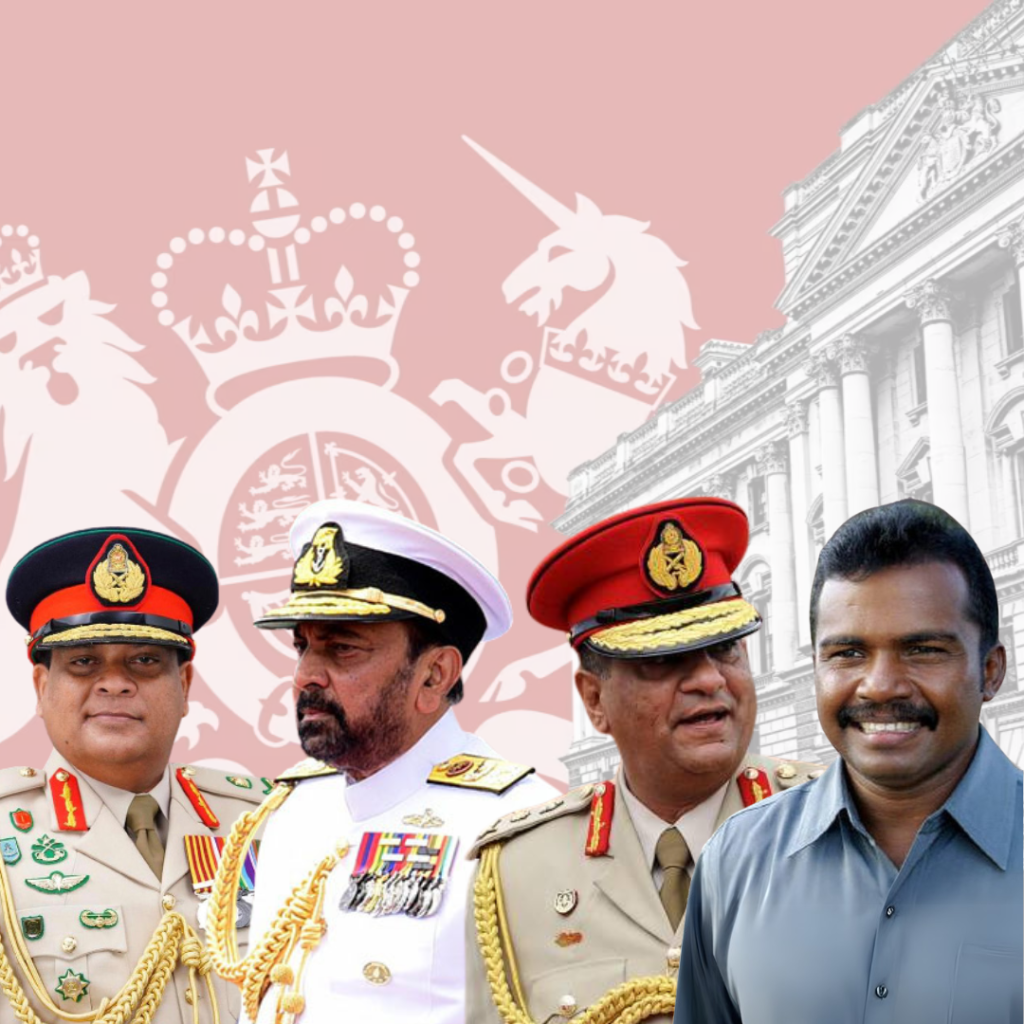
UK sanctions: Reactions reveal changed dynamics

March 24, 2025 – March 30, 2025 | Vol.15, #13

Event: On March 24, the UK imposed sanctions on four individuals responsible for alleged human rights violations and abuses during the armed conflict in Sri Lanka.[1][2][3]

These sanctions included travel bans to the UK and asset freezes that were placed on former Head of the Sri Lankan Armed Forces Shavendra Silva, former Navy Commander Wasantha Karannagoda, former Commander of the Sri Lankan Army Jagath Jayasuriya and former military commander of the LTTE and former MP of the UPFA Vinayagamoorthy Muralitharan, also known as Karuna Amman.
[4][5][6]

[paywall layout_id=”1906″ service_tags=”TMA,FP” preview=”true”]

Overview of media coverage

Over the past week, the UK sanctions imposed on Sri Lankan military leaders received minimal attention in the Sinhala media, including print, television and social media commentary (observed via Junkipedia – a social media monitoring and analysis tool). This is a departure from previous instances where similar issues have received prominent coverage.[1]

In this limited reportage, reactions to the sanctions clarify the current dynamics in Sri Lanka’s stance on accountability and reconciliation following the change in government.

This week’s MPA unpacks the reactions to the UK sanctions as seen through two lenses, social and political, to highlight how each has evolved (or not) in response to these developments.

Social response: Focus on corruption accountability, but not on conflict accountability

Sri Lanka’s recent political shift, through presidential and general elections, was driven by promises to displace the traditional political élite and to fight corruption (see TMA Vol.14, #40). This has translated into greater public interest in reducing corruption. Despite strong public interest in corruption accountability, conflict accountability has not gained the same level of attention.

The following two criticisms in the media – which reflect deeply ingrained aspects of the public psyche – illustrate that societal attitudes toward conflict accountability have remained largely unchanged.
 
First, the Sinhala media echoed past criticisms of Western frameworks on accountability, viewing them as unjust and unequal.[2] These criticisms focus on the perceived double standards, where powerful nations seem to be able to act with impunity whereas ‘smaller’ states such as Sri Lanka are selectively called to account on human rights standards.[3]

Second, the Sinhala media cast doubt on the motive behind the UK sanctions. Critics argued that the sanctions were intended to politically appease the Tamil diaspora in the West. Similar criticisms have previously been levelled against countries such as the U.S. and Canada,[4] framing the sanctions as a means of securing votes rather than addressing justice or accountability in Sri Lanka.

Political response:  Unsupportive acceptance

The government’s political response marks a notable shift in how the NPP administration addresses accountability and reconciliation. When international accountability measures were mooted in the past, the Rajapaksas-led governments strongly rejected them, while the yahapaalanaya government supportively accepted them. The current NPP government has adopted a more neutral position. The government’s response to the sanctions can be described as “unsupportive acceptance”.[5]

The “unsupportive” nature of the response is reflected in the government’s response that highlighted that the sanctions decision by the UK was “unilateral” and was not done in consultation with the government.[6] The (tacit) “acceptance” aspect of the response is reflected in the lack of any explicit rejection of the sanctions actions.

Overall, the muted response of “unsupportive acceptance” at the political level has served to also mute the potentially oppositional social response – by the government not being a foil for the strongly nationalist voices (which are also aligned to opposition political parties) to engage social sensibility against the government. Neither did social movements get the support of government actors, as they have done in the past few years in similar cases, to protest the external action. The loss of public legitimacy around strongly nationalist politicians such as Udaya Gammanpila and Wimal Weerawansa has also contributed to muting social opposition.[7]


[1] The MPA team monitored Facebook profiles, TikTok handles and YouTube channels using Junkipedia for the keywords British, Eelam, diaspora, war, Shavendra and Amman in Sinhala from March 24 to 28, 2025. 

[2] See TMA Vol.10, #09, Vol.11, #07 and Vol.12, #10.

[3] Ibid.

[4] See TMA Vol.10, #08.

[5] See TMA Vol.09, #09, Vol.10, #09, Vol.11, #33 & 34 and Vol.12, #10.

[6] For more information, see: https://mfa.gov.lk/en/uk-fcdo-press-release-entitled-uk-sanctions-for-human-rights-violations-and-abuses-during-the-sri-lankan-civil-war/ and  https://www.newswire.lk/2025/03/26/sri-lanka-govt-responds-to-uk-sanctioning-4-sri-lankans-over-human-rights-abuses/.

[7] See TMA Vol.14, #42.

To view this week’s news summaries, please click here.

To view this week’s social media data, please click here.

[/paywall]