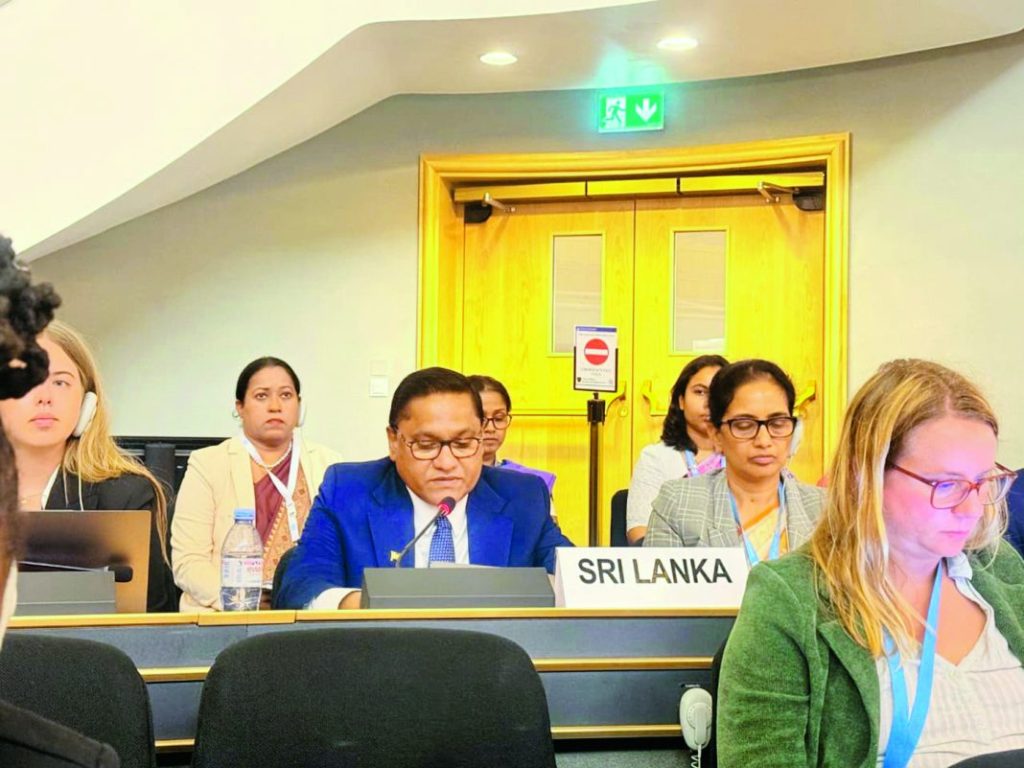
UNHRC: Celebrating rejection; consolidating support

September 22, 2025 – September 28, 2025 | Vol.15, #36 | ISSN 3084-9330

Photo credits: Ceylon Today

[paywall layout_id=”1906″ service_tags=”TMA,FP” preview=”true”]

Over the past three weeks, the Sinhala media—covering print, television, and social media platforms (analysed through the social media monitoring tool Junkipedia)—focused on the ongoing 60th Regular Session of the United Nations Human Rights Council (UNHRC).[1]

This week’s analysis is set out under four headings.

1. What was the key event that captured public attention?

September 8: The 60th Regular Session of the UNHRC commenced in Geneva, Switzerland.[2]

On the same day, United Nations High Commissioner for Human Rights Volker Türk presented his report on the “Situation of Human Rights in Sri Lanka,” with reflections from his visit to the country in June 2025.[3] Minister of Foreign Affairs Vijitha Herath responded to Türk’s report, reaffirming Sri Lanka’s commitment to pursuing a domestic accountability mechanism.[4]

September 23: The Core Group on Sri Lanka comprising Canada, Malawi, Montenegro, North Macedonia, and the United Kingdom tabled Resolution A/HRC/60/L.1/Rev.1 on “Promoting reconciliation, accountability and human rights in Sri Lanka.”[5]

The Sinhala media allotted a moderate level of coverage to these events, with greater prominence given to the government’s stance at the UNHRC. 

By contrast, and consistent with past reporting patterns, the Tamil media gave the issue significant coverage—focusing on the government’s stance at the UNHRC, international advocacy efforts to advance accountability, and the plight and perspectives of victims of past atrocities.


2. How does the UNHRC session impact the government?

The NPP’s dual-track response to the UNHRC resolution—rejecting external accountability while pledging domestic reforms—
strengthened government support by consolidating nationalist constituencies and limiting space for opposition criticism.

The NPP government’s rejection of an external mechanism appears anchored in a sovereignty-first frame. They dismissed international (“external”) accountability mechanisms while advancing a state-led reform agenda, including the establishment of a Truth and Reconciliation Commission and the strengthening of institutions such as the Office on Missing Persons and the Office for Reparations.
This dual track approach has seemingly (i) countered external pressure by signalling/prioritising domestic process, and (ii) consolidated a nationalist constituency by defending the military and national dignity.

Within the Sinhala media, this approach appeared to bolster support for the government while narrowing the space for opposition criticisms.

Outlets typically critical of the government, such as the privately owned Aruna, echoed this position, praising the government’s stance and portraying the UNHRC as biased and externally driven. [6]


3. How and why is the UNHRC delegitimised? 

The UNHRC is delegitimised by framing it as a hypocritical and politically motivated body, whose actions lack a sound factual basis—an argument reinforced by longstanding narratives in the media.   

The Sinhala media discourse on Sri Lanka’s engagement with the UNHRC is underpinned by four longstanding narratives that continue to resonate with the majority of the Sinhala psyche.

(i) A double standard narrative:
This narrative constructs a case for hypocrisy by juxtaposing the intense international scrutiny on Sri Lanka’s past with perceived inaction or leniency toward other nations with similar conflicts. Critics cite High Commissioner Türk’s focus on Sri Lanka’s past, such as the Chemmani mass graves, amidst the ongoing humanitarian crisis in Gaza, as evidence of a perceived international double standard. This seems to undermine the moral authority of the UNHRC, reframing the international scrutiny not as a principled stand but as a politically motivated and biased agenda.  

(ii) A ‘justification’ narrative: This narrative seeks to justify the final phase of the war by emphasising the three-decade history of violence and terrorism perpetrated by the LTTE. By detailing the LTTE’s brutality—including high-profile assassinations and attacks on civilians—it frames the state’s military campaign as a necessary anti-terrorist operation rather than an attack on the Tamil-speaking communities. This assertion holds that any analysis of the war’s conclusion that overlooks the LTTE’s extensive history of brutality is fundamentally incomplete and unjust.

(iii) An external antagonist narrative: This narrative frames the ongoing international pressure for accountability as fuelled by a well-funded and politically motivated Tamil diaspora community. Within the Sinhala psyche, the Tamil diaspora tends to be often equated with the LTTE and seen as lobbying to achieve the separatist goals that the LTTE failed to win militarily.[7] Thus, this approach appears to disconnect genuine international advocacy for accountability, portraying it instead as a hostile campaign aimed at undermining Sri Lanka’s sovereignty and dignity.

(iv) A foundational delegitimisation narrative: This narrative specifically targets the 2011 UN-commissioned “Report of the Secretary-General’s Panel of Experts on Accountability in Sri Lanka”, commonly referred to as the Darusman Report. Successive Sri Lankan governments have challenged the findings of the report as factually flawed, especially the figure on civilian casualties during the final phase of the war.[8] By discrediting this initial report, the narrative seeks to invalidate all subsequent UN resolutions and reports based on it, thereby dismissing the entire basis for calls for accountability.


4. How did the Tamil media differ from the Sinhala media on the discourse related to the UNHRC?
The Sinhala media largely commended the government’s stance, while the Tamil media condemned it as a reflection of past governmental positions and actions.[9]

In contrast to the overwhelmingly negative Sinhala media portrayal of the UNHRC, the Tamil media has presented two opposing perspectives of the UNHRC over the years.

(i) An institution of hope:
  For some Tamil media, the UNHRC remains the last avenue for justice over wartime civilian deaths. 16 years of government inaction have eroded trust in domestic processes, making external accountability appear both urgent and indispensable.

(ii) An institution of disappointment
: Others, including Tamil politicians and outlets, voice disappointment with the UNHRC. These voices argue that despite the yahapaalanaya government co-sponsoring a resolution in 2015, most commitments remain unimplemented, fostering a perception that the UNHRC has not exerted sufficient pressure on Sri Lanka. Together, this creates a tension of hope rooted in desperation versus disappointment born of unmet promises.


[1] The MPA team monitored Facebook profiles, TikTok handles and YouTube channels using Junkipedia for the keywords Geneva, Vijitha Herath, human rights in Sinhala, from September 7 to 26, 2025.

[2] For more information, see: https://www.ohchr.org/en/hr-bodies/hrc/regular-sessions/session60/regular-session and

[3] For more information, see: https://www.unognewsroom.org/story/en/2801/hrc60-human-rights-in-sri-lanka-08-september-2025 and https://www.ohchr.org/sites/default/files/documents/hrbodies/hrcouncil/sessions-regular/session60/advance-version/a-hrc-60-21-aev.pdf

[4] For more information, see: https://www.un.int/srilanka/news/statement-delivered-hon-vijitha-herath-minister-foreign-affairs-foreign-employment-and-tourism and https://www.news.lk/current-affairs/foreign-minister-vijitha-herath-addresses-60th-session-of-the-un-human-rights-council

[5] For more information, see: https://hrcmeetings.ohchr.org/HRCSessions/RegularSessions/60/Pages/resolutions.aspx and https://www.dailymirror.lk/print/news/Resolution-on-Sri-Lanka-tabled-at-UNHRC-calls-for-accountability-and-reforms/239-319093

[6] MP Dilith Jayaweera established Liberty Publishers (Pvt) Limited, which is the publisher of three national newspapers – Aruna, The Morning and Thamilan. For more information, see: https://cdn.cse.lk/cmt/upload_report_file/568_1693568870427.pdf.

[7] See TMA Vol.11, #7.

[8] For more information, see: https://www.securitycouncilreport.org/atf/cf/%7B65BFCF9B-6D27-4E9C-8CD3-CF6E4FF96FF9%7D/POC%20Rep%20on%20Account%20in%20Sri%20Lanka.pdf.

[9] For more information, see: https://x.com/verite_tma/status/1968617611106894228

To view this week’s news summaries, please click here.

To view this week’s social media data, please click here.

[/paywall]