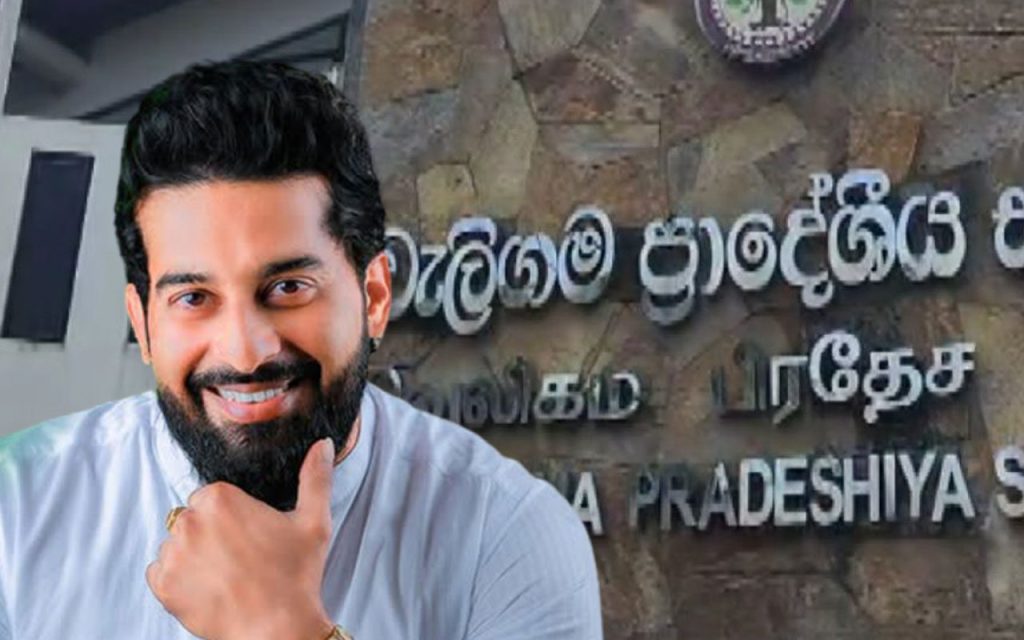
Weligama chairperson murder: Retribution frame for government; reputational risk for SJB

October 20, 2025 – October 26, 2025 | Vol.15, #40 | ISSN 3084-9330

Photo credits: Lanka Sara

[paywall layout_id=”1906″ service_tags=”TMA,FP” preview=”true”]

Over the past week, the Sinhala media focused on the assassination of the Weligama Pradeshiya Sabha Chairperson and SJB Member Lasantha Wickramasekara (alias Midigama Lasa).

This coverage spanned print, television, and social media commentary, with online narratives tracked and analysed using the monitoring tool, Junkipedia.[1]

This week’s analysis is set out under three headings.

1. What was the key event that captured public attention?

October 22: Weligama Pradeshiya Sabha Chairperson and SJB Member Lasantha Wickramasekara was shot by two unidentified individuals while in his office and later succumbed to his injuries at the Matara General Hospital.[2]

SJB Organiser for Weligama Rehan Jayawickrama revealed that Wickramasekara had formally written to the IGP in August 2025, warning of threats to his life and requesting police protection, which was reportedly denied.[3]

Minister of Public Security Ananda Wijepala claimed that Wickramasekara, commonly known as Midigama Lasa, was involved in underworld activities, citing six ongoing court cases and a suspended prison sentence.[4]

The assassination captured public attention not only for its violence but also for what it reflects— an intensifying debate over state accountability and due process.  


2. How did the assassination impact the government?

The assassination’s impact on the government unfolds through two intersecting dynamics—rationalising retribution and reactivating historical trauma.

The impact on the government plays out through two intersecting dynamics. First, rationalising retribution: by casting the murder as an “underworld” score-settling, official messaging normalises extrajudicial punishment and dilutes the state’s commitment to due process. Second, reactivating historical trauma: opponents invoke memories of late-1980s repression to argue that the government’s response clashes with promises of a “new political culture.”

Taken together, these dynamics are positioned to question the government’s moral authority and credibility on law and order.

Impact I: Rationalising retribution – Analogy of the “law of the underworld”

The government’s response in the aftermath of the assassination—particularly through statements by Minister of Public Security Ananda Wijepala—strategically foregrounded Wickramasekara’s alleged criminal background. By emphasising Wickramasekara’s reported underworld connections, the rhetoric tended—perhaps inadvertently—to rationalise it as a justified outcome rather than a breach of justice.

The government’s branding of the victim as a පාතාල සාමාජිකයෙක්/paathala saamajikayek (trans. “underworld member”) carried the implicit suggestion that certain lives fall outside the protection of due process. This framing evoked the “law of the underworld”—the idea that those who live by violence must, in turn, die by it.

This rhetoric had two key effects:

i. Distorting due process:
It creates a hierarchy of worth where presumed guilt replaces the presumption of innocence, tapping into a public sentiment that condones extrajudicial punishment of alleged “gangsters” or “drug addicts.” 

As highlighted in past MPA issues, segments of the Sri Lankan public have long perceived such killings as socially desirable, thereby legitimising impunity and undermining institutional accountability.[5]

ii. Distorting state–criminal boundaries: By appearing to equate the vigilant actors as legitimate enforcers similar to the police, the state risks collapsing the moral boundary between law enforcement and criminality—normalising extrajudicial violence and eroding its own moral legitimacy.

Impact II: Reactivating historical trauma – Analogy of the 1988/89 violence

Opposition voices and some privately owned Sinhala newspapers, such as Aruna, argued that the government’s response reignited collective memories of past repression, particularly the violence of the second JVP-led insurrection of 1988/89.[6] This historical echo holds deep symbolic weight, recalling a time when dissent was silenced through extrajudicial killings and enforced disappearances.[7]

Critics framed the current “wave of killings” as the re-emergence of that repressive ethos—what some described as the persistence of a “violent culture” or “JVP mentality.” These parallels appear to directly challenge the government’s self-presentation as the architect of a “new political culture” and a “civilised society.”[8]

This rhetoric operates on two levels:

* Cultural delegitimisation:
It positions the government as reverting to an uncivil and violent political ethos—one that stands in stark contrast to its reformist promises.

* Credibility delegitimisation:
It links NPP’s present-day state conduct to a longer legacy of JVP’s political violence, challenging the government’s moral standing and public confidence in its claim to have broken from the past.

3. How did the assassination impact the Samagi Jana Balawegaya (SJB)?

The assassination created a delicate balancing act for the SJB—testing its moral consistency while exposing its political vulnerabilities.

The assassination’s impact on the SJB also plays out through two intersecting dynamics.

First, a reputational challenge arises as the government’s framing of the victim’s criminal past appears to have pushed the SJB to distance itself from the image of the “chauvinistic politician” while still speaking to the concerns of public sentiment.  In Sri Lanka, the chauvinist politician has been broadly—and repeatedly—rejected by the public, a pattern made unmistakable during the aragalaya and in its aftermath. MPA uses “chauvinist politician” as a way of describing a recurring style of political actor: one that exudes entitlement, aggression, corrupt and anti-social behaviour.[9]

The murder created a reputational problem for the SJB. As the government spotlighted the victim’s criminal past, parts of the party moved to distance themselves—an implicit acknowledgement that Wickramasekara fits the “chauvinist politician” profile, even as the SJB seeks to project integrity and discipline as a credible alternative to the governing coalition.

Second, the party faced the risk of defensive positioning by having to take a principled stance on due process. In its official response, the SJB maintained that no crime, however severe, can justify murder. While this stance upholds due process, it simultaneously exposes the party to political vulnerability. By defending legality in the case of a figure linked to alleged criminal activity, the SJB was also perceived in the media as naïve or sympathetic to wrongdoing.

Taken together, these dynamics test the SJB’s credibility as both a disciplined and morally consistent opposition force.   

In sum, both the government and SJB seem to be affected, but in different ways.  


[1] The MPA team monitored Facebook profiles, TikTok handles and YouTube channels using Junkipedia for the keywords underworld, Midigama, Lasantha, crime and chairperson in Sinhala, from October 20 to 24, 2025.

[2] For more information, see: https://www.adaderana.lk/news.php?nid=113814 and https://www.newswire.lk/2025/10/22/gunmen-open-fire-on-weligama-ps-chairman/

[3] For more information, see: https://x.com/RehanJayawick/status/1981013290344964210 and https://www.newswire.lk/2025/10/23/igp-refused-protection-sought-by-weligama-ps-chairman-before-killing-sjb/

[4] For more information, see: https://www.newswire.lk/2025/10/22/involved-in-underworld-public-security-minister-on-killed-weligama-ps-chairman/ and https://www.adaderana.lk/news.php?nid=113842

[5] See TMA Vol. 11, #1 and Vol. 7, #9.

[6] MP Dilith Jayaweera established Liberty Publishers (Pvt) Limited, which is the publisher of three national newspapers – ArunaThe Morning and Thamilan. For more information, see: https://cdn.cse.lk/cmt/upload_report_file/568_1693568870427.pdf.

[7] For more information, see: https://www.hrw.org/reports/2008/srilanka0308/2.htm and https://www.amnesty.org/en/documents/asa37/021/1990/en/.  

[8] For more information, see: https://drive.google.com/file/d/1Wm5PQkxGyWtnQEfg2tV-K9owJpXmWbQf/view?pli=1

[9] See TMA Vol.11, #33 & 34.


To view this week’s news summaries, please click here.

To view this week’s social media data, please click here.

[/paywall]